














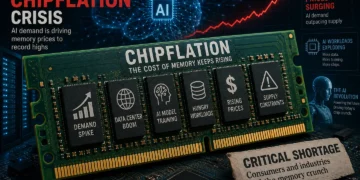


























































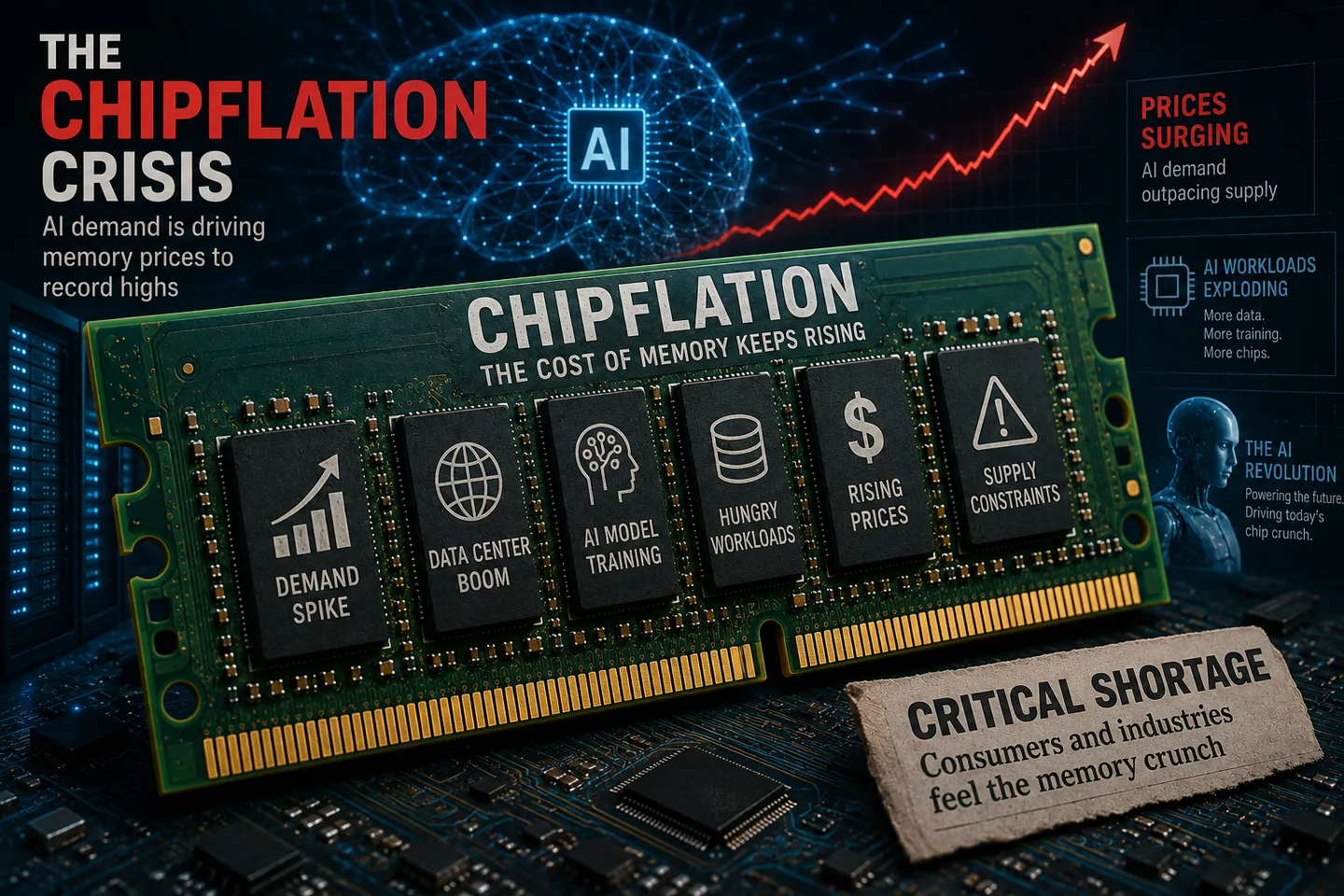
The era of predictable consumer electronics pricing, where devices offered more storage and memory for the same cost every year, has effectively ended. This shift is driven by a phenomenon known as “chipflation,” a term coined by Morgan Stanley to describe the reversal of a 50-year trend that saw memory costs consistently decline. Ram Bala, an associate professor of AI and analytics at Santa Clara University’s Leavey School of Business, notes that this steady deflation previously acted as a quiet subsidy for the entire electronics industry.
The current crisis stems from a massive supply-chain bottleneck. In the second quarter of 2026, DRAM contract prices surged by 58% to 63%, while NAND Flash prices climbed 70% to 75%—the most significant increases in a decade and the widest supply gap since 2011. This is not a result of general inflation or tariffs, but rather a strategic capacity allocation decision by the three dominant manufacturers—Samsung, SK Hynix, and Micron—which control between 90% and 95% of global DRAM production. These firms have redirected their capacity toward high-bandwidth memory (HBM) to satisfy the explosive demand from AI data centers.
Because HBM requires three to four times the wafer capacity of standard DRAM per gigabyte, every unit diverted to AI infrastructure removes roughly three units of conventional memory from the consumer market. Consequently, a 32GB DDR5 memory kit that cost between $100 and $200 in October 2025 now starts at $350, if it can be found at all. HP reported in February that memory now accounts for 35% of its PC material costs, up from 15% to 18% just one quarter prior.
Industry Responses to Rising Costs
- Price Adjustments: Lenovo, Dell, HP, Acer, and ASUS have warned clients of 15% to 20% price hikes and contract resets. Xiaomi and Redmi have signaled increases of 20% to 30%.
- Feature Stripping: Some manufacturers are opting for “electronic shrinkflation,” downgrading screen quality or cutting hardware features to maintain existing price tags.
- Product Line Reshuffling: Companies like Samsung, Microsoft, and Dell are raising prices on select models while limiting the availability of cheaper alternatives, suspending discounts, and delaying new product launches.
Impact on Gaming Consoles
- PlayStation Pricing: The standard PlayStation 5, which cost $499.99 in 2020, has seen two hikes in eight months, reaching $649.99. The Digital Edition rose from $399.99 to $499.99 in August 2025, and then to $599.99 by April 2026. The PS5 Pro has climbed from its $699.99 launch price to $899.99.
- Xbox Series X: Microsoft has increased the price of the Xbox Series X three times since its $499.99 launch, with the cost reaching $799.99 as of August 2026.
- Nintendo Switch 2: Launched in 2025 at $449.99, the console is set to increase to $499.99 starting September 1, 2026, due to long-term market conditions.
The console market serves as a stark illustration of these pressures, as mid-cycle price increases are historically rare. For context, in September 1995, Sony launched the original PlayStation at $299.99, successfully undercutting the $399.99 Sega Saturn. Today, the industry is moving in the opposite direction.
The outlook for consumers remains difficult. Expanding fabrication capacity is a multi-billion dollar, multi-year endeavor; meaningful volume increases are not expected until 2028, when Samsung’s P5 facility in Pyeongtaek targets mass production. J.P. Morgan estimates that every 10% rise in hardware costs adds roughly 0.1% to core inflation, with memory shocks contributing up to 0.4 percentage points. While some industry experts suggest prices could stabilize by the second half of next year, others, including the CEO of SK Hynix, have warned that the supply crunch could persist beyond 2030. As Bala observes, there is no long-term consensus, meaning consumers should expect higher prices and longer upgrade cycles well into 2027. The report also notes that economies shift, that jump was easy enough to explain: technology moves. The report also notes that after two hikes in barely eight months, from $499.99 to $549.99 in August 2025, then to $649.99 that April, the same console generation retails today for $649.99. The report also notes that laptops, smartphones, tablets, smart TVs and connected vehicles are all being squeezed by the same force: chipflation, a memory-price surge driven by the AI boom. The report also notes that one governed by contracts, allocations and, occasionally, spot markets, not a shop shelf, but behind the term sits a supply chain most consumers never see. The report also notes that large manufacturers forecast memory needs years in advance and lock in supply agreements. The report also notes that prices move, sometimes sharply, when demand spikes or supply tightens. The report also notes that that subsidy is now gone,” Bala said.
Source: TRT World