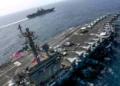















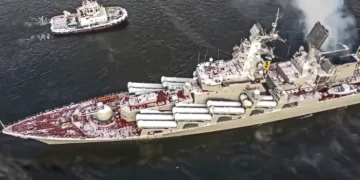


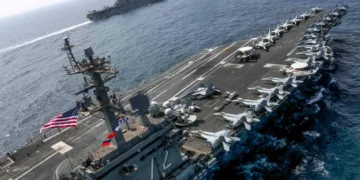




















































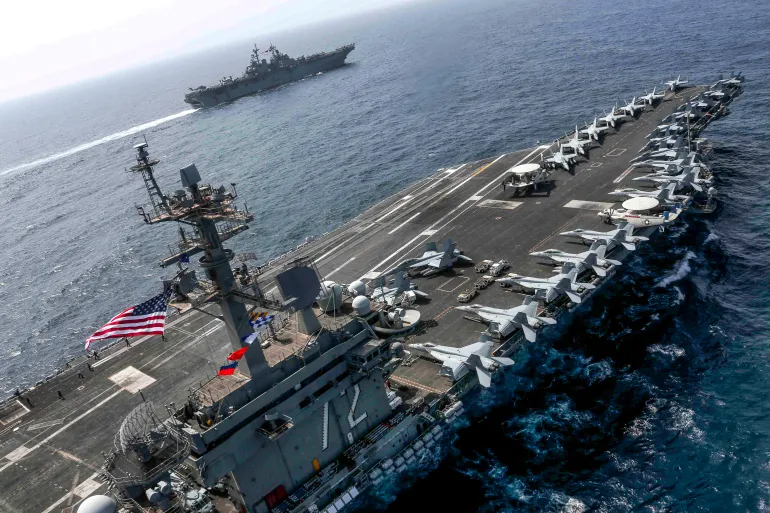
The USS Abraham Lincoln’s record-breaking deployment has ignited a heated debate in Washington regarding the sustainability of US naval operations. As the conflict with Iran enters its sixth month with no signs of a resolution, experts suggest that the strain on the aircraft carrier reflects broader readiness issues inherent in a prolonged, asymmetrical war.
Retired US Navy captain and RAND Corporation senior policy researcher Bradley Martin noted that the situation is a predictable outcome of sustained high-tempo operations. “The end state is that you will encounter readiness issues,” Martin said, emphasizing that while the navy is designed to project power and fill strategic gaps, it faces unavoidable physical and logistical limits.
Unlike previous concerns involving shortages of offensive or defensive munitions, the current reports from the USS Lincoln focus on crew morale, maintenance backlogs, and a lack of basic supplies. Family members have expressed alarm over the wellbeing of personnel, with some reports citing instances of sailors attempting to jump overboard. Democratic lawmakers have characterized these conditions as part of a recurring pattern under the current administration, pointing to similar issues previously observed on the USS Gerald Ford, which served a 326-day deployment before rotating out in May.
In a letter released Tuesday, Democratic legislators argued that the Department of Defense is failing to adapt to the realities of the CENTCOM area of operations. A significant factor in these logistical struggles is the loss of regional infrastructure; a New York Times report linked supply shortages to Iranian attacks that severely damaged the US naval base in Bahrain early in the war. Consequently, the navy has been forced to rely on Diego Garcia, an Indian Ocean island located approximately 3,540km (2,200 miles) from the current operational theater of the USS Lincoln and the USS George HW Bush.
Maritime security expert and former Romanian naval officer Alexandru Hudisteanu highlighted the immense burden of logistics in maintaining 11 carrier strike groups. “There’s a maxim that’s quite famous in the industry of military,” Hudisteanu said. “They say that amateurs talk strategies, while professionals talk logistics.” He noted that the US strategy traditionally relied on being within a few days of a resupply base, a model currently disrupted by the loss of the Bahrain facility.
Mona Yacoubian, director of the Middle East Program at the Center for Strategic and International Studies, described the navy’s stress as emblematic of a new era of drone-driven warfare. She noted that the conflict has forced a reckoning regarding the US military posture in the Middle East, which was largely built around bases established during the early 2000s. While the Pentagon is reportedly considering a troop withdrawal from the Persian Gulf, no official review has been ordered. Yacoubian warned that these naval stresses create a politically vulnerable front for an administration already facing public disapproval regarding the war’s trajectory.
The Pentagon and the White House have rejected claims that conditions on the USS Lincoln are dire, characterizing the environment as an austere but expected reality of wartime service. Nevertheless, acting US Navy Secretary Hung Cao confirmed the carrier would soon return home. It is being replaced by the USS George Washington, which was previously based in Japan. This transition leaves the western Pacific—a key strategic priority—without an aircraft carrier for the time being.
Currently, the US has three carriers deployed: the Lincoln, the Bush, and the Washington. All other carriers remain in the United States. According to the Center for the National Interest, the USS Theodore Roosevelt is expected to deploy in September, with two additional carriers projected to be available by late 2026 or early 2027.
Harlan Ullman, a former naval officer and chairman of the Killowen Group, argued that the current situation effectively removes critical assets from the board for extended periods. “One of the things that we don’t realise is that Iran has now put two US naval aircraft carriers out of commission for what could be a year, the Ford and Lincoln,” Ullman said, citing the lengthy post-deployment refit periods required for such vessels. He concluded that the US has effectively lost two carriers for a significant duration to sustain this grinding conflict. The report also notes that experts told, has underscored the limits of US naval might amid the conflict, which has entered a grinding stalemate and shown no signs of a more complete cessation after nearly six months, the recent attention. The report also notes that with similar conditions reported on the USS Gerald Ford, which was deployed for 326 days before its rotation in May, and the USS Lincoln, which has been deployed since November 2025, during which time it broke the naval record for the longest period without a port stop, democratic lawmakers have charged that this has been a “pattern” throughout the Trump administration’s leadership during the war. The report also notes that in a letter published on Tuesday, Democratic lawmakers charged the circumstances “leave both Congress and the public concerned that the Department is not adapting quickly enough to the conditions in the CENTCOM area of responsibility, nor taking the appropriate steps to mitigate the continued challenges in our fleet”. The report also notes that which typically include one cruiser, four to six destroyers, 75 aircraft, and 7,500 sailors and US Marines as part of a carrier strike group, such carriers are the lynchpin of naval fleets. The report also notes that “The logic of basing for the US was to never be more than a couple of days away from a resupply base somewhere. The report also notes that the closest one is a little island somewhere 2,000 miles [3,220km] south of Iran.”, but with the base in Bahrain being out of order. The report also notes that military experts agree that any efforts to staunch Iran’s nuclear programme would likely require boots on the ground, despite degrading Iran’s limited navy and setting back its ballistic missile programme.
Source: Al Jazeera