










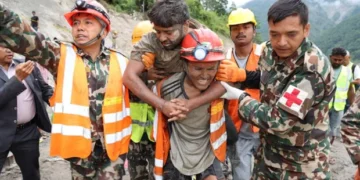






















































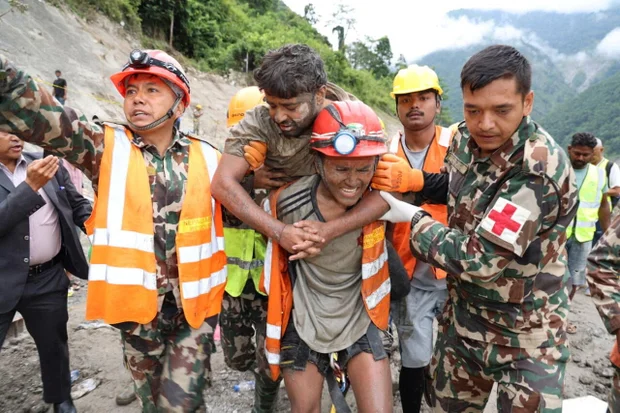
In a significant rescue operation in Kathmandu, Nepal, emergency teams successfully extracted two workers alive from a hydropower tunnel on Friday. The men had been trapped for nine days following severe flooding triggered by a suspected glacier collapse on August 26, which devastated local towns and swept away numerous villages.
The rescue occurred at the Trishuli 3A hydropower project. Army spokesperson Brig. Gen. Raja Ram Basnet confirmed the initial recovery, while lawmaker Shri Ram Neupane later provided updates on the second survivor via social media. Rescuers reportedly identified the location of the men after hearing voices from deep within the tunnel structure on Friday morning.
Both survivors, identified as mechanical foreman Sanjay Shah and mechanical supervisor Kabir Maharjan, were found in stable condition and subsequently transported to a hospital in Kathmandu for medical care. Family members expressed profound relief, with Kabir’s wife, Hirashova, describing the agonizing ten-day wait, while his brother, Amir, shared his gratitude for the successful operation.
The rescue has provided a surge of optimism for officials and families alike. Nepal Foreign Minister Shisir Khanal expressed his excitement over the development, noting that while the exact number of remaining survivors is unknown, the detection of further voices deep in the tunnels suggests more people may still be alive. Experts involved in the operation highlighted that the tunnel system consists of complex chambers and rooms, where the trapped workers—many of whom are highly skilled engineers—have likely been managing their oxygen supply and attempting to navigate toward safety.
Despite the success, the scale of the disaster remains immense. According to the country’s disaster management agency, the floods have claimed at least 1,287 lives, with over 5,000 individuals still reported missing. The impact extends across the border into China, where authorities in Tibet reported 21 deaths and 541 missing persons as of late Wednesday.
The situation at the Trishuli 3A site is particularly dire, with the Independent Power Producers Association of Nepal estimating that at least 557 workers are missing from the project, including approximately 115 believed trapped within the main tunnel. Across the country, roughly 900 workers remain unaccounted for from 12 different hydropower projects, with local authorities estimating that about 500 of them may be trapped in various tunnel systems.
As the operation continues, the focus remains on the urgent race against time to reach those still believed to be alive. The ongoing search efforts are being supported by a range of local and national agencies working to navigate the complex, flooded infrastructure. The report also notes that ‘ Ramy Inocencio reports that “there’s renewed hope that we might be seeing more survivors come out — possibly dozens more — because rescuers have already heard more voices deeper in those tunnels. The report also notes that local television news channels showed images of the first rescued worker covered in mud and being carried from the site on a rescuer’s shoulder. The report also notes that brother of the other rescued worker, mechanical supervisor Kabir Maharjan, told The Associated Press he “can’t explain what we are feeling at the moment, amir Maharjan. The report also notes that we are just grateful to God.” He said the family was on its way to the hospital to see him. The report also notes that kabir Maharjan’s wife, Hirashova, said partner network BBC News, “We couldn’t properly eat or drink for 10 days. The report also notes that a Nepali energy adviser told Inocencio it’s not just a tunnel that goes into the ground next to the Trishuli River but a system of rooms and chambers that snake up and down, and that’s where the workers are apparently stuck.
Source: CBS News