




































































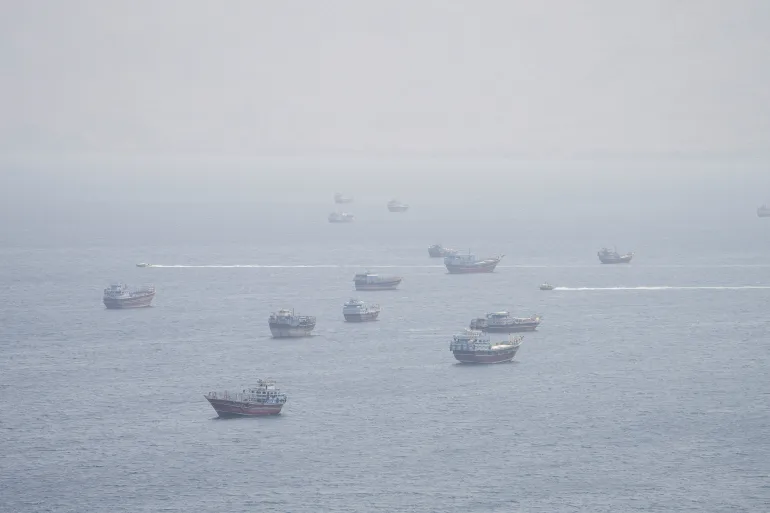
The United States and Iran are locked in a persistent dispute over control of the Strait of Hormuz, a critical maritime chokepoint that has remained largely closed since the onset of the US-Israel war on Iran six months ago. While the waterway historically facilitated the transit of one-fifth of the world’s oil and gas, current claims regarding its operational status vary wildly between Washington and Tehran.
Washington maintains that the strait is open and functioning under its influence. Last month, President Donald Trump asserted that the US held “total control” of the passage. More recently, US officials reported that 40 commercial vessels carrying approximately 18 million barrels of oil successfully navigated the strait under military escort on Tuesday, marking a potential wartime record. President Trump echoed these figures on Monday, claiming the US Navy is facilitating the passage of 30 ships nightly, while Treasury Secretary Scott Bessent stated that at least 10 million barrels are moving through daily.
These assertions follow a declaration by US CENTCOM commander Brad Cooper, who claimed last week that military forces had successfully cleared the transit lanes of sea mines. However, these figures stand in stark contrast to pre-war averages, which typically saw 100 ships and 20 million barrels of oil pass through the region daily. Data from PortWatch indicates that traffic has plummeted to an average of seven vessels since March.
Tehran disputes the US narrative, insisting that Iranian forces maintain complete authority over the waterway. Parliament Speaker Mohammad Bagher Ghalibaf acknowledged that some vessels have managed to pass but maintained that the strait remains closed to all but pre-approved traffic. He warned that any ships attempting to utilize southern routes based on “false guarantees” from the US would be targeted by Iranian forces.
The tension has manifested in physical incidents, with the Islamic Revolutionary Guard Corps (IRGC) reporting that two oil tankers were disabled by mines while traversing an “illegal route.” Simultaneously, Saudi Arabia reported an attack on one of its tankers that resulted in the deaths of two Filipino sailors.
Independent maritime analytics firms provide a significantly lower estimate of traffic than the US government. Kpler reported that only six vessels crossed on Wednesday, 11 on Tuesday, and five on Monday, with a 10-day average of 13 ships per day. Lloyd’s List Intelligence recorded a similar average of 12 transits between August 26 and September 1. Bridget Diakun, a director at Lloyd’s, noted that these figures might be incomplete due to ships turning off their tracking beacons, a practice known as “dark” transit.
The Joint Maritime Information Center (JMIC) confirmed in a September 1 advisory that commercial traffic remains “far below baseline” and maintains a “severe” risk level for the region due to the ongoing threat of drifting or uncharted mines. This assessment directly challenges the US claim that the lanes have been fully cleared.
Experts suggest the discrepancy in figures may stem from different counting methodologies. While firms like Lloyd’s focus on cargo-carrying vessels exceeding 10,000 deadweight tonnage, US operational counts may include smaller craft, tugs, offshore support vessels, and naval auxiliaries. Eirik Hooper of the consultancy Drewry noted that the US also possesses unique intelligence capabilities—including satellite, airborne sensors, and convoy manifests—that allow it to track vessels not visible via standard Automatic Identification System (AIS) data.
Hooper explained that by late August, most crossings were classified as “dark” or unknown, requiring retroactive adjustments to data as transponders are toggled. Ultimately, both Washington and Tehran appear incentivized to project strength in the strait, which has become a focal point of their ongoing conflict.
Former US Ambassador Henry Ensher recently suggested that the current cycle of confrontation was likely ignited by CENTCOM’s claims regarding de-mining operations. He argued that both nations would benefit from de-escalating their rhetoric regarding the status of the waterway. The report also notes that so what is really going on in the strait – and what explains the divergent accounts. The report also notes that in terms of oil, US Treasury Secretary Scott Bessent said that “at least 10 million barrels” were getting through the strait each day, with between 15 million and 17 million on Monday. The report also notes that other ship-trafficking services show a similar pattern. The report also notes that from August 17-23, Lloyd’s List Intelligence recorded “about 14 non-Iranian-linked ships each day”, Diakun told. The report also notes that diakun said that it is difficult to explain the gap between US-claimed transit figures and those recorded by ship trackers without insight into how the US tallies its own figures. The report also notes that eirik Hooper, a senior associate covering the ports and terminals sector for maritime research consultancy Drewry, also pointed to possible differences in how the US counts vessel transits. The report also notes that “A US operational count plausibly includes everything that moved under or near naval protection: naval auxiliaries, offshore support and tugs, coastal and small craft [and] dhows,” said Hooper, noting that ship-tracking firm Kpler filters out such vessels “on size or cargo grounds”.
Source: Al Jazeera