








































































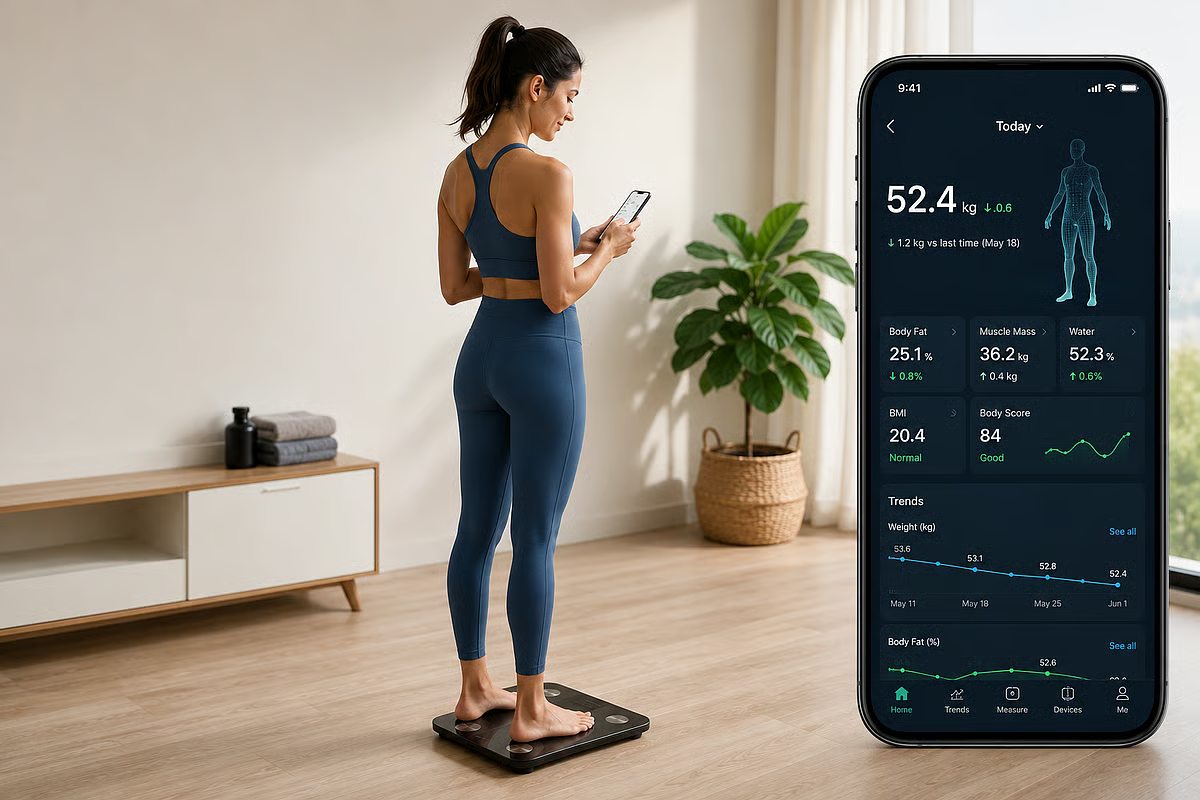
Transforming your daily weigh-in into a comprehensive health assessment is easier than ever with modern smart scales. These devices go beyond simple weight tracking, using bioelectrical impedance analysis (BIA) to estimate metrics like body fat, muscle mass, and water percentage. Whether you are restarting a fitness journey or looking to refine your health data, selecting the right scale depends on your connectivity needs, household size, and the specific metrics you wish to monitor.
The Withings Body Smart stands out as a top choice for those seeking convenience and reliable trend data. It utilizes multifrequency BIA to provide estimates for body fat, muscle mass, body water, bone mass, visceral fat, and basal metabolic rate. A key advantage is its Wi-Fi connectivity, which allows for automatic syncing without needing your phone nearby. It supports up to eight automatically recognized users and integrates with Apple Health and Google Health Connect, making it ideal for households that prefer a hands-off approach to data management. The scale measures weight in 50g increments and supports a range up to 200kg.
For data-heavy households, the Xiaomi Body Composition Scale S400 offers an extensive array of metrics. Using dual-frequency BIA at 50kHz and 250kHz, it can generate 25 distinct indicators, including BMI, fat mass, protein levels, and visceral fat rates. Xiaomi reports that its body fat data was benchmarked against DEXA measurements in research conducted with Beijing Sport University, achieving a correlation coefficient of at least 0.93. The S400 connects via Bluetooth Low Energy 5.0 to the Mi Home/Xiaomi Home app and supports up to 36 user profiles, accommodating a wide range of family members or roommates.
If you are looking for a straightforward, budget-friendly option, the RENPHO ES 24M is a reliable entry point into app-based tracking. It uses BIA to send 13 metrics—such as skeletal muscle, subcutaneous fat, and body age—to the RENPHO Health app. While it relies on Bluetooth rather than Wi-Fi, it offers an unlimited number of user profiles, making it highly versatile for shared living spaces. The device supports a weight range of up to 180kg with 0.05kg divisions, providing a solid, no-frills experience for those focused on long-term trend monitoring.
Fitness enthusiasts interested in more granular data may prefer the arboleaf CS10E. Unlike standard models that only use foot electrodes, this device features a wired hand grip to create eight contact points, allowing for segmental body composition analysis. It provides a 0.2kg to 180kg measurement range with 0.1kg resolution. The app documentation lists up to 26 segmental metrics, helping users track fat and muscle distribution across different parts of the body, which is particularly useful for those following specific training programs.
For those with limited bathroom space, the eufy Smart Scale A1 (model T9120) provides a compact, 26cm square footprint. Despite its small size, it supports up to 16 users and syncs 12 different measurements—including BMI, water, and bone mass—to the EufyLife app. It is compatible with Apple Health, Google Fit, and Fitbit, and can hold readings for later synchronization if your phone is not present during the weigh-in. It is a practical, uncomplicated choice for families or flatmates who prioritize space-saving design.
When choosing a smart scale, consider how you intend to use the data. Weight is the only metric measured directly; all other composition figures are estimates, so consistency in your weigh-in routine is essential for accurate trend observation. Connectivity is another major factor: Bluetooth models are excellent for personal use, while Wi-Fi scales offer a more seamless experience for shared households. Because these devices operate on batteries, they are not subject to regional plug compatibility issues, though they should always be placed on a firm, level, and dry surface to ensure accuracy.
While these tools provide valuable insights, they are best used as a guide for observing long-term progress rather than as medical diagnostic devices. By selecting a model that aligns with your household size and data preferences, you can turn a simple scale into a powerful component of your overall wellness strategy. The report also notes that those estimates are most useful for following trends rather than treating any single reading as definitive. The report also notes that which removes much of the friction when several people share it, it automatically recognises up to eight users. The report also notes that standing heart rate is available too. The report also notes that shared accounts and virtual users, up to 36 user profiles can be stored through its combination of a main account. The report also notes that separate accounts are the more sensible arrangement when users want to keep their measurements private.
Source: Gulf News