
















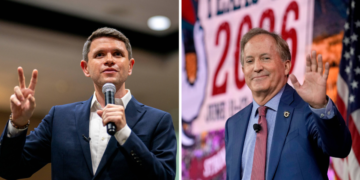







































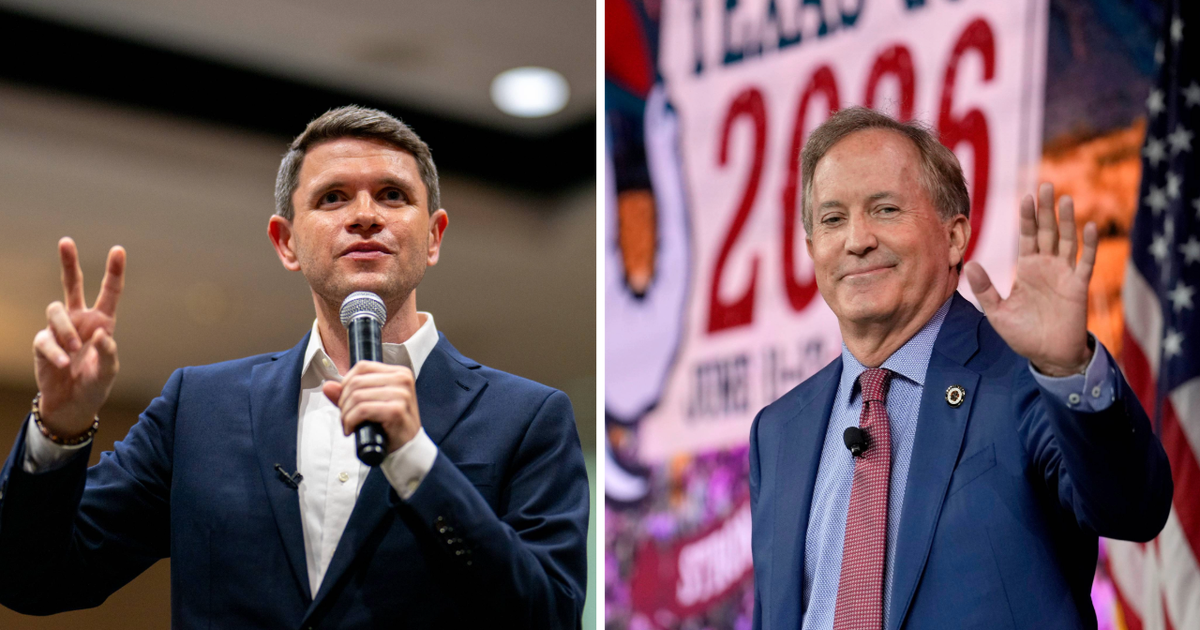
The campaign of Democratic Senate candidate James Talarico has formally accused Republican nominee Ken Paxton and his campaign treasurer of violating federal finance regulations. The complaint, submitted to the Federal Election Commission (FEC) on Wednesday, alleges that the pair illegally funneled more than $1 million into a super PAC aligned with Paxton’s candidacy, effectively bypassing federal contribution limits.
At the center of the controversy is Preserve Texas, Inc., a Virginia-based nonprofit organization. According to corporate filings in Virginia, the entity was incorporated by John Plishka, who serves as the treasurer for Paxton’s Senate campaign. While the organization has funneled significant sums into the Lone Star Liberty super PAC—which supports Paxton—it is not registered as a political committee and has avoided the public disclosure requirements typically mandated for campaign contributions.
Seth Krasne, Talarico’s campaign manager, argued in the filing that the arrangement allows Paxton to utilize dark money to influence his election while shielding donors from public oversight. The complaint invokes the 2002 Bipartisan Campaign Reform Act, which prohibits candidates from using outside entities to collect funds that they would be legally barred from accepting directly. Under federal law, Senate campaigns are restricted to individual donations of $3,500 per election cycle, and all donors contributing more than $200 must be publicly identified.
The complaint alleges that because the nonprofit appears to be controlled by Paxton’s agent, it should be subject to the same source restrictions and reporting requirements as the campaign itself. Between February and May, Preserve Texas transferred funds to the Lone Star Liberty super PAC, which recently launched a $15 million advertising blitz across 18 Texas media markets.
Legal experts note that the outcome of this complaint hinges on whether Preserve Texas is deemed to be under the control of Paxton or his agents. Richard Hasen, a law professor at UCLA specializing in campaign finance, stated that the allegations present a plausible claim of a regulatory violation, provided it can be proven that the nonprofit was established or maintained at Paxton’s direction.
Representatives for the entities involved have denied any wrongdoing. Greg Keller, a spokesperson for the Lone Star Liberty PAC, maintained that the group operates in full compliance with all applicable laws. He further criticized the Talarico campaign, suggesting that Democrats are hypocritical for attacking the use of super PACs while simultaneously utilizing a controversial practice known as “redboxing” to coordinate campaign materials.
Preya Samsundar, a spokeswoman for Preserve Texas, echoed these sentiments, asserting that the organization is an independent social welfare group focused on civic engagement and issue advocacy. She stated that the nonprofit has fulfilled all necessary IRS filings and that John Plishka’s role is strictly limited to administrative and back-office support, with no strategic influence over the group’s decision-making.
Despite the gravity of the allegations, the FEC is currently hampered by a lack of commissioners, making it unlikely that an investigation will be launched before the upcoming election. The vacancy stems from a series of departures, including the recent firing of a Democratic commissioner.
The dispute underscores the growing tension surrounding the influx of anonymous donations in the 2026 midterm elections. Saurav Ghosh of the Campaign Legal Center warned that the reliance on dark money, including funds from undisclosed donors used to fuel super PACs, risks fostering corruption and undermines voter transparency.
Talarico’s team remains adamant that the connection between the campaign treasurer and the nonprofit is a clear breach of federal law. J.T. Ennis, a spokesman for the Talarico campaign, stated that the overlap in personnel is illegal and that voters deserve to know the origins of the funding driving the advertising in this competitive race.
As the election approaches, the Texas Senate contest remains a toss-up, with spending levels reaching record highs. The controversy highlights the broader national debate over the use of complex fundraising structures and the influence of undisclosed donors in modern American politics. The report also notes that money raised under those rules is capped: Senate campaigns can accept $3,500 each from individuals for the primary and general elections, but every donor above $200 must be named in public filings, and campaigns cannot accept money from corporations or unions. The report also notes that nonprofits do not face the same constraints. The report also notes that still, the lines of attack from both sides illustrate how tensions have risen in American politics over the hundreds of millions in anonymous donations flowing into the 2026 midterm elections to decide control of the House and Senate. The report also notes that thanks to eight-figure advertising buys and cash infusions from super PACs that may raise and spend unlimited sums, spending in the Texas Senate race has ballooned. The report also notes that paxton’s donors should know that he is wrapping them up in his own criminality — and Texans should know who is behind the dark money spreading Paxton’s lies. The report also notes that or at least with his knowledge, that does not necessarily mean that Paxton did — the raising and spending of unregulated money would have to be at Paxton’s direction. The report also notes that a spokeswoman for Preserve Texas, said in a statement shared with that the group “is an independent social welfare organization operating fully within its primary purpose under section 501(c)(4), which is civic engagement and issue advocacy on matters affecting Texas communities, preya Samsundar.
Source: CBS News