
























































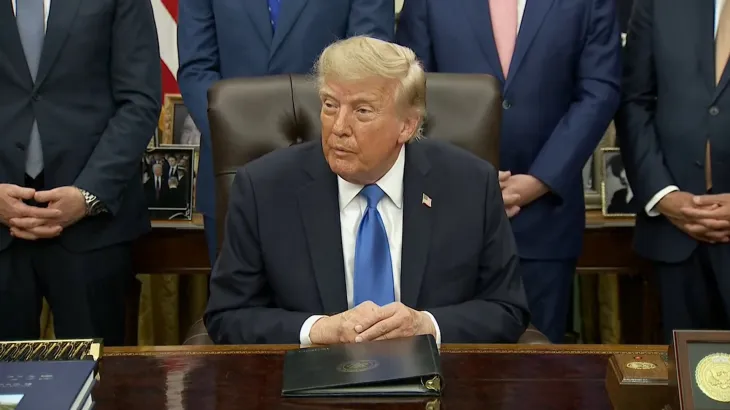
United States President Donald Trump has signaled that his administration may launch additional military operations against Iran, declaring that Washington retains the capability to strike the country “anytime we want.” This warning follows a recent escalation in hostilities that resulted in at least 18 deaths and left 108 individuals wounded.
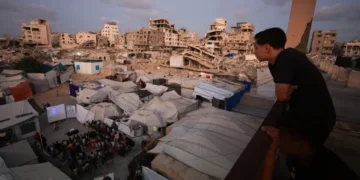
The latest surge in violence marks the most significant exchange between the two nations since July. US forces conducted a series of strikes targeting Iranian coastal cities and infrastructure near the Strait of Hormuz. Among the sites hit was a wedding celebration in the city of Kuhestak, located in Sirik county, where officials confirmed that at least four people lost their lives.
Iran’s health minister, Mohammad-Reza Zafarghandi, stated that the casualties included two children, one of whom was a four-year-old killed during the strike on the wedding party. In response to the attack, Esmaeil Baghaei, spokesperson for the Iranian Ministry of Foreign Affairs, condemned the operation as a “war crime,” rejecting US assertions that their military avoids civilian targets. Baghaei emphasized that the civilian toll is verified, noting that funeral proceedings for the four victims in Kuhestak are scheduled for Thursday.
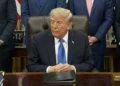
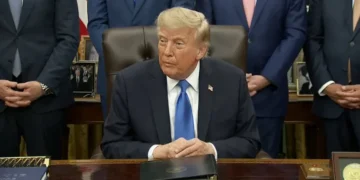
Addressing reporters at the White House, President Trump defended the military’s actions, stating, “We hit them very hard last night.” He claimed the strikes successfully destroyed new equipment Iran had been developing along the Strait of Hormuz. Trump added, “It was a very heavy attack last night. And we’re prepared to do another one. And anytime we want.”
The ongoing six-month conflict has significantly impacted global oil markets and created domestic political challenges for the Republican Party ahead of the US midterm elections. Recent polling by Reuters and Ipsos indicates that only 31 percent of Americans support the war effort, while 63 percent disapprove, largely due to rising fuel costs. Brent crude prices have surged to approximately $95 per barrel, an increase of over 30 percent since the war began. Consequently, President Trump’s approval rating has seen a decline from 40 percent to 33 percent.
Despite these pressures, Trump maintained that the military campaign would not be prolonged and insisted that his focus remains on preventing Iran from acquiring nuclear weaponry—a goal Iran denies pursuing. He clarified his role in the upcoming elections, stating, “Number one, I’m not running. My party is running, and I’m going to help my party.”
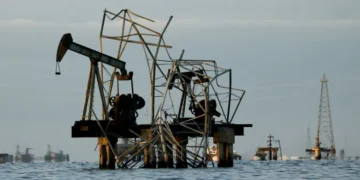
Strategic analysts suggest the US is facing a difficult position in the region. Retired Pakistani Lieutenant-General Tariq Khan noted that while the US cannot be defeated conventionally, Iran is effectively making the conflict economically and politically costly. By closing the Strait of Hormuz, Iran has disrupted a vital waterway that previously handled about 130 ships daily. Current estimates show only a fraction of that traffic remains, with Iran continuing to target vessels attempting to transit the area.
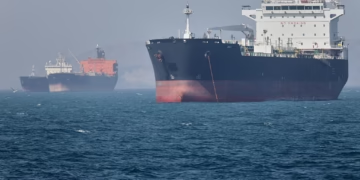
The Islamic Revolutionary Guard Corps (IRGC) reported that two oil tankers were disabled by mines this week, and the Saudi shipping firm Bahri confirmed that two Filipino sailors died in an attack on their vessel. Furthermore, Iran’s Persian Gulf Strait Authority has blacklisted an additional 11 ships for alleged noncompliance, bringing the total to 56, and warned that these vessels face seizure or fines if they fail to provide required documentation.
While the US continues an economic isolation campaign against Tehran, Trump insisted that Washington maintains “very strong control” over the strait, claiming US forces facilitate the passage of numerous oil-laden vessels daily. However, the reality of the waterway remains volatile, with the US military frequently engaging in drone interceptions as it attempts to maintain a presence in the contested maritime corridor. The report also notes that trump’s threat on Wednesday came after the US and Iran exchanged their biggest barrage since July. The report also notes that including Bahrain, Iraq and Jordan, iran retaliated with attacks on US bases across the Middle East. The report also notes that “The reality is so horrifying that even American propaganda has never dared make the claim [the US military] is making today. The report also notes that voters are particularly unhappy about high gas prices. The report also notes that the price of Brent crude oil, the international standard, has climbed to about $95, up more than 30 percent from the start of the war, since the fighting resumed this weekend. The report also notes that “But I think my party respects the fact that we’re not allowing Iran to have a nuclear weapon.”. The report also notes that “The US has not succeeded in restoring the maritime environment that existed before the war, and is now expending military resources to deal with a problem the war itself helped create,” he told, referring to Iran’s closure of the Strait of Hormuz.
Source: Al Jazeera