









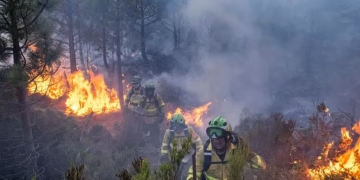



























































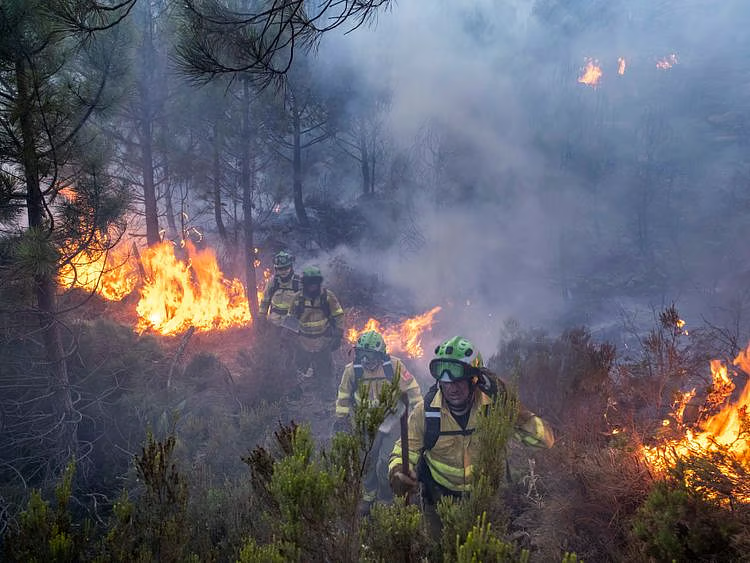
NEW YORK: Recent extreme weather events, including record-breaking heat waves, devastating floods, and widespread wildfires across the northern hemisphere, serve as a stark warning of the climate crisis ahead. A new report from the UN Environment Programme (UNEP) indicates that the planet is on a trajectory to exceed safe temperature limits, despite international commitments to avoid such a catastrophe.
UN Secretary-General António Guterres emphasized the gravity of the situation, noting that the world is failing to uphold the promises made during the 2015 Paris Agreement. That historic accord saw global leaders pledge to restrict temperature increases to 1.5°C above pre-industrial levels, a threshold scientists identify as vital to preventing the most severe environmental destruction.
“The fight for 1.5 degrees is the fight for humanity,” Guterres stated, warning that the world is set to breach this critical limit within the next few years. He cautioned that humanity is currently speeding past the boundaries necessary to avoid a climate disaster, adding that every fraction of a degree of warming will result in lost lives, destroyed livelihoods, increased inequality, and irreversible damage to ecosystems.
UNEP chief Inger Andersen echoed these concerns, stating that there are no positive outcomes if global temperatures remain consistently above the 1.5°C mark. She noted that extreme heat waves are already demonstrating that climate impacts are arriving faster and hitting harder than anticipated, causing significant disruption and loss of life globally.
Despite the grim outlook, Guterres maintained that it is still possible to pull the world back from the brink through immediate and decisive action. He stressed that the global community can still return warming to below 1.5°C by the end of the century if leaders act now to reduce greenhouse gas emissions and strengthen climate resilience.
“We must make the overshoot as small and short as possible, limiting how high temperatures rise and how long they remain above 1.5,” Guterres explained. He insisted that the science is clear and that the necessary solutions are already available, with the world better equipped than ever to deploy them.
Andersen urged a collective effort to accelerate these solutions, emphasizing that now is the time to raise ambition. By focusing on cutting emissions and improving adaptation strategies, the international community can still steer the planet toward a more sustainable path, ensuring that the period of exceeding the 1.5°C limit is kept to a minimum. The report also notes that g20 finance leaders close talks as US welcomes Russia. The report also notes that rare ‘train’ of Pacific cyclones fueled by El Nino.
Source: Gulf News