























































The trial of a former gang leader accused of orchestrating the murder of rapper Tupac Shakur finally began on Monday, 30 years after one of America’s most high-profile unresolved killings. The proceedings, expected to last a month, will likely not make clear who fired the shots that killed the California hip-hop legend on the night of September 7, 1996, while he was in Las Vegas to see a Mike Tyson boxing match. Prosecutors aim to show that the defendant, Duane “Keffe D” Davis, onetime leader of the South Side Compton Crips, ordered the killing and provided the gun used to kill Shakur in a drive-by shooting. The trial began Monday with jury selection, a process expected to last through the week.
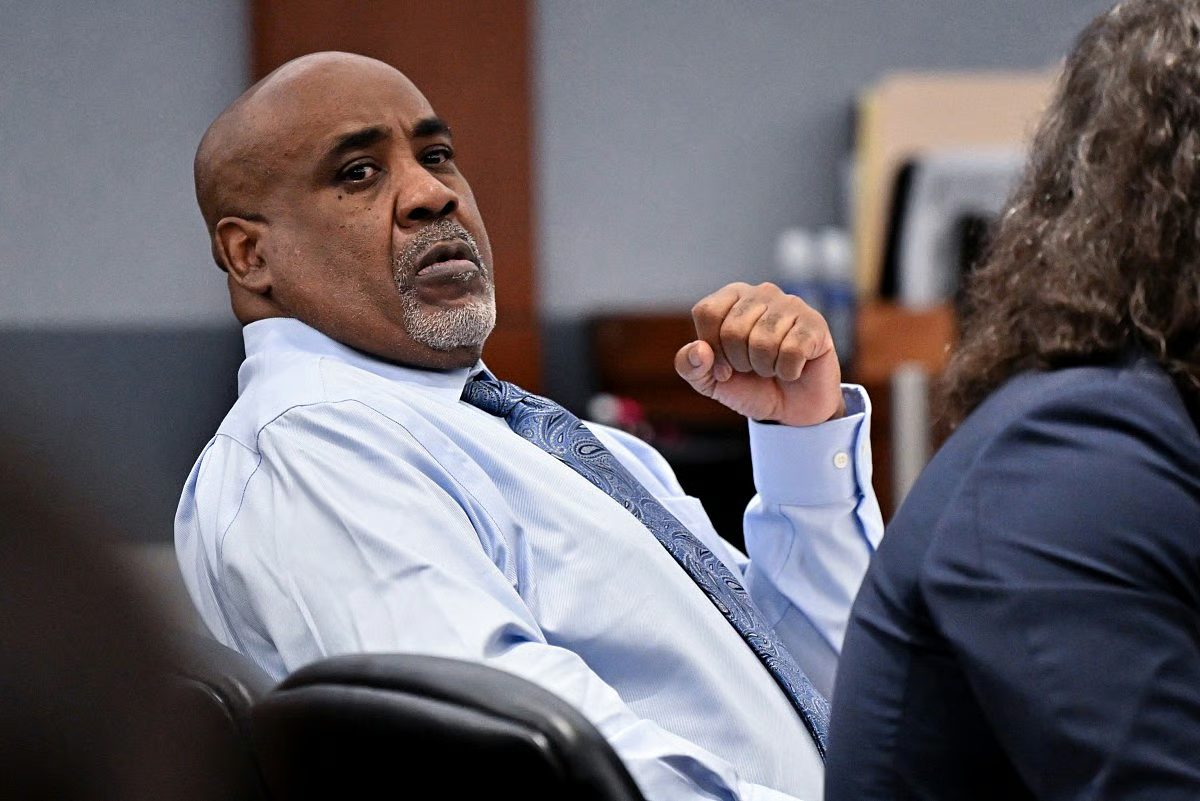
Davis, 63, appeared in court wearing a light-blue shirt and blue tie. He faces life in prison without parole if convicted. The killing of Shakur, also known as 2Pac, is one of America’s most celebrated cold cases, prompting endless debate among music fans over who did it and why. The rapper, who died at age 25, was a key figure in a hip-hop rivalry pitting the East Coast against the West Coast. Known for hits like “California Love” and “All Eyez on Me,” Shakur—the son of a Black Panther—was raised in Harlem and Baltimore, but quickly became the epitome of a California bad boy when he signed with Los Angeles-based Death Row Records.
The trial will revisit the battle between Death Row, founded by Marion “Suge” Knight, and Bad Boy Records, the East Coast label created by Sean “Diddy” Combs and starring Christopher “The Notorious B.I.G.” Wallace, who was murdered in March 1997. Prosecutors say Death Row Records was protected by Mob Piru, a Los Angeles gang that was part of the wider Bloods alliance, with which Knight was affiliated. Conversely, Bad Boy Records had hired the rival group South Side Compton Crips, led by Davis, as bodyguards.
Tensions reached a breaking point after the Tyson fight at the MGM Grand casino, when Knight and Shakur beat up Davis’s nephew, Crips member Orlando “Baby Lane” Anderson, in retribution over an alleged assault of a Death Row employee. The prosecution maintains that Davis was out for revenge. Later that night, a white Cadillac carrying Davis, Anderson, and others pulled up beside Shakur’s car in Las Vegas. Shots were fired from the Cadillac, and Shakur was fatally wounded.
The investigation sputtered for decades due to a lack of evidence, but the cold case was revived with the publication in 2019 of Davis’s memoirs. In that book, Davis recounted that he was in the front seat of the Cadillac and that he handed a pistol to those in the back seat, though he did not specify who opened fire on Shakur. Everyone else who was in the Cadillac that night has since died. These compromising revelations were consistent with remarks Davis had made previously to reporters.
But this time, they came back to haunt him and he was arrested in September 2023. Davis has since backtracked and pleaded not guilty. During a March 2025 interview from prison with ABC News, Davis asserted his innocence, stating, “I’m innocent. I ain’t killed nobody. Never did ever kill nobody. They don’t have no evidence against me. They can’t even put me in Las Vegas.” Davis now claims he was in Los Angeles the night of the Shakur killing and that he never read his own memoirs, alleging they were inflated by his co-author to generate book sales.
In the run-up to the trial, Davis’s lawyers tried in vain to keep the book from being introduced as evidence, along with remarks he made in an interview with police in 2008 as a witness to the killing. Whatever the verdict is, it is unlikely to satisfy those close to Shakur. In May, the rapper’s stepbrother Maurice Shakur filed a wrongful death lawsuit in civil court. “There remain individuals who were involved in Tupac’s murder who, for 30 years, have not been held accountable for their crimes,” his complaint says.
The civil suit cites a recent TV documentary mini-series entitled “Sean Combs: The Reckoning,” in which Davis says in an interview with police that Combs, now in prison himself, offered him $1 million to kill Shakur. This new legal pressure adds a complex layer to a case that has remained a cultural touchstone for three decades. As the trial progresses, the court will have to weigh the defendant’s past admissions against his current denials.
Ultimately, the jury will be tasked with determining whether the evidence—spanning decades of gang affiliations, industry rivalries, and conflicting statements—is sufficient to secure a conviction. For the family and fans of Tupac Shakur, the trial represents a long-awaited, if uncertain, opportunity for closure regarding the violent end of one of hip-hop’s most influential voices.
5 real crimes that could get the next movie makeover
Man, 74, becomes oldest inmate executed in Florida
Indian woman found dead in Canada, partner charged
Man kills mother, daughters in UAE, gets death sentence
Delhi woman found dead two months after wedding
Source: Gulf News