









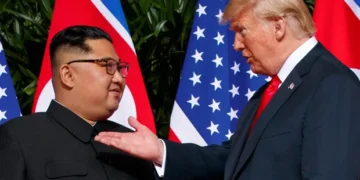























































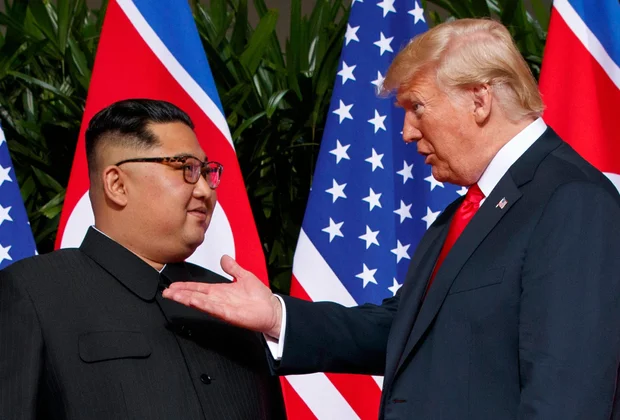
President Trump announced on Wednesday that he expects to hold another meeting with North Korean leader Kim Jong Un before the end of the year. While the White House has yet to confirm a formal schedule, the president indicated he is actively pursuing a summit, potentially coinciding with the APEC gathering in Shenzhen, China, this November.
When asked by reporters at the White House if a meeting was on the horizon, Mr. Trump confirmed his intentions, stating, “Yeah, I will be.” He expressed confidence in his rapport with the North Korean leader, noting, “I get along with him, and you know what, the fact that I get along with him, that’s a good thing, not a bad thing.”
The president’s push for renewed dialogue comes as he seeks to address the expansion of North Korea’s nuclear capabilities. Mr. Trump claimed that the regime now possesses 57 nuclear warheads, criticizing previous administrations for allowing the program to reach its current state. “He’s got them,” the president remarked. “Should have never allowed it to happen. If I were president, I wouldn’t have allowed it.”
Despite these overtures, Kim Jong Un has shown no public interest in abandoning his nuclear ambitions. Instead, the North Korean leader has recently insisted that the international community must formally recognize his country as a nuclear-armed state, effectively rejecting the premise of denuclearization as a basis for future talks.
The push for a new summit follows Mr. Trump’s directive to significantly scale back the annual Ulchi Freedom Shield military exercises with South Korea. The drills, typically spanning 10 days, were halved on the president’s orders and are set to conclude this Friday. Mr. Trump described the decision as a gesture of goodwill toward Kim, arguing that the traditional military exercises sent a “totally inappropriate and hostile signal.” He also cited South Korea’s lack of assistance in the conflict with Iran as a contributing factor to the policy shift.
This reduction in military cooperation has caused concern among U.S. allies in the region. Officials in South Korea and Japan are reportedly questioning the reliability of the long-standing U.S. security guarantee, particularly regarding potential aggression from North Korea or China. In response to the shifting landscape, South Korean President Lee Jae Myung has advocated for greater military independence from the United States, including the pursuit of nuclear-powered submarines.
Diplomatic activity in the region remains high, as evidenced by Chinese Foreign Minister Wang Yi’s visit to Seoul on Wednesday. During his meeting with South Korean counterpart Cho Hyun, the two discussed the necessity of Chinese cooperation in achieving the denuclearization of the Korean Peninsula.
The two leaders previously held three summits during Mr. Trump’s first term, which ultimately failed to produce a concrete agreement on disarmament. As the administration looks to restart these negotiations, the path forward remains complicated by North Korea’s continued expansion of its weapons program and the growing unease among regional partners regarding the future of the U.S.-South Korea alliance. The report also notes that possibly around the November APEC summit in Shenzhen, China, his comments followed a report by the Wall Street Journal that said he was hoping to have such a meeting organized soon. The report also notes that he has 57 very powerful nuclear weapons. The report also notes that far from signaling any willingness to abandon the program, Kim has said he wants the U.S. The report also notes that trump appears to be trying to rekindle direct talks with Kim on the heels of his decision to reduce the number of U.S. The report also notes that and South Korea have been close allies for more than 70 years. The report also notes that but they have been halved this year, on Mr, the exercises that started this week usually run for 10 days.
Source: CBS News