






























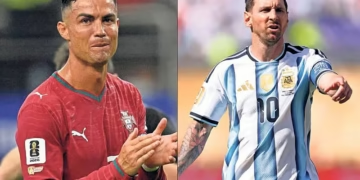

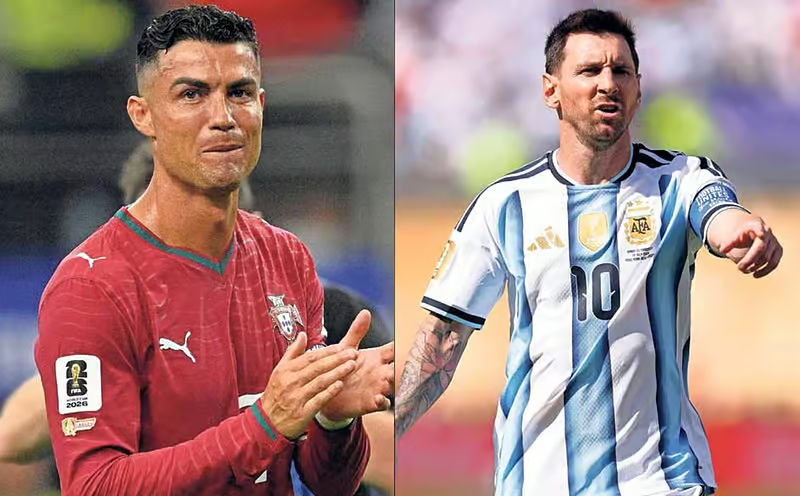
The landscape of professional football is bracing for a seismic shift as two of its greatest icons, Cristiano Ronaldo and Lionel Messi, have both recently hinted that their storied careers are nearing a conclusion. Within a span of just four days, the two superstars—whose intense rivalry defined a generation of the sport—separately addressed the reality of their eventual departures from the pitch.
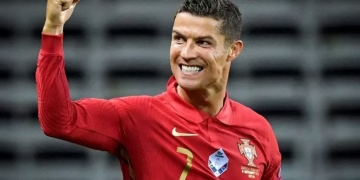
Cristiano Ronaldo, the 41-year-old Al Nassr striker, offered a direct assessment of his future during a recent feature with Vogue. Moving away from the elaborate maneuvers that characterized his early career, Ronaldo provided a candid response when questioned about his longevity in the sport. “This is probably my last year of football, and I want to leave a spectacular legacy,” he stated.
This revelation arrived shortly after Lionel Messi, 39, expressed deep uncertainty regarding his own professional path. The Inter Miami star shared a poignant tribute to his late father, Jorge, on social media, reflecting on the personal toll of his career. “I don’t know what I’m going to do without you, I don’t know how to go on,” Messi wrote. He admitted that his motivation has wavered, noting, “I just played soccer and now I have a lot of doubts that I’ll keep doing it for a long time more. Why didn’t you hold on a little longer and we could have finished together?”
While the timing of these two confessions appears eerily synchronized, it is likely coincidental. The Vogue interview was likely conducted weeks before its publication, yet the convergence of these sentiments has forced fans to confront the reality that the era of Messi and Ronaldo is drawing to a close. Their paths to global stardom were distinct, shaped by vastly different personal histories.
Ronaldo’s journey began in Madeira, Portugal, where he grew up in a family struggling with financial instability. His father, José Dinis Aveiro, suffered from depression following his service in the Portuguese army in Africa. Ronaldo’s drive was forged in the face of adversity; during his time at Sporting CP’s academy in Lisbon, he often endured hunger, sometimes resorting to seeking leftover food from a nearby McDonald’s. His career, marked by a relentless work ethic and high-precision goal-scoring across Europe’s major leagues, stands as a testament to his resilience.
Conversely, Messi’s ascent was deeply intertwined with his father’s unwavering support. After being diagnosed with a growth hormone deficiency in Argentina, Messi faced a lack of local support for his expensive treatment. His father became his primary advocate, eventually facilitating a move to FC Barcelona’s youth academy. The young Messi impressed coaches immediately, scoring five goals in a single trial match, yet the club hesitated to formalize his contract.
The situation reached a turning point when Jorge Messi threatened to take his son to rival clubs. In response, then-sporting director Carles Rexach famously drafted an agreement on a paper napkin, committing the club to sign the boy and cover the costs of his medical treatment. Without this intervention, Messi’s professional career would have been physically impossible.
These two legends spent years pushing each other to unprecedented heights, transforming the El Clasico rivalry between Real Madrid and Barcelona into the world’s premier sporting event. Their constant competition to break records and chase immortality set a standard that may never be replicated in the same way, even as the sport continues to produce new icons.
As both players now contemplate a life beyond the stadium, they serve as a reminder of the inevitable passage of time. While football will undoubtedly move forward with new stars, the simultaneous decline of these two titans marks the end of a unique chapter in sports history, leaving millions of fans to reflect on the legacy of a rivalry that pushed the boundaries of what was considered possible on the field. The report also notes that unlike the stepovers he famously unleashed in the early stages of his career against helpless defenders, Ronaldo, 41, decided to take a clear and direct shot on target when asked by Vogue how long he would continue to pl. The report also notes that from making a breakthrough in the Portuguese league to overcoming the pain of losing his father at 20 and conquering every major league in Europe with machine-like precision and a truckload of goals, Ronaldo is the produ. The report also notes that the monthly lifestyle magazine, sat down with Cristiano Ronaldo for the special interview published last Sunday, we can only speculate on when Vogue. The report also notes that unlike the stepovers he famously unleashed in the early stages of his career against helpless defenders, Ronaldo, 41, decided to take a clear and direct shot on target when asked by Vogue how long he would continue to play football. The report also notes that it certainly wasn’t designed that way — the timing could not have been planned.
Source: Khaleej Times