

























































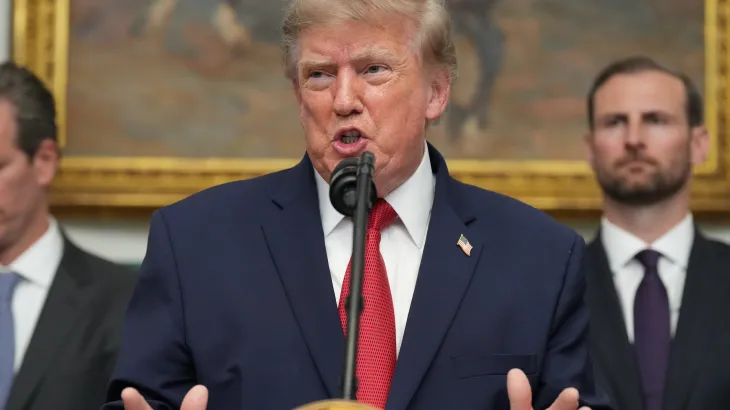
President Donald Trump has escalated his administration’s pressure campaign against Iran, vowing to launch what he described as the “most crushing economic operation ever taken against any country.” In a statement posted to Truth Social on Wednesday, the president accused Tehran of failing to capitalize on opportunities to reach a diplomatic deal, asserting that the nation will now face isolation and economic warfare on an unprecedented scale.
The announcement marks a significant intensification of the ongoing conflict, which has persisted for over five months. Trump’s directive explicitly targets any nation that provides a financial lifeline to Iran, including support through banks, businesses, airports, or government entities. He warned that such countries would face “tremendous” economic consequences, calling for an immediate halt to oil smuggling, cash transfers, ship registries, and the use of front companies. He characterized the move as an “economic D-Day” intended to force allies to join the United States in isolating Tehran.
This latest threat builds upon the “Operation Economic Fury” campaign initiated by the Trump administration in April. The U.S. has already implemented extensive sanctions targeting Iran’s energy, shipping, and financial sectors, alongside a naval blockade and measures against various brokers and tankers. Despite these existing restrictions, Iranian officials and state media have largely dismissed the new rhetoric as a continuation of long-standing U.S. policy.
Iran’s semi-official Tasnim news agency stated in a Telegram post that the announcement was not a new development, noting that the U.S. has spent years attempting to sever Iran’s financial ties. The agency added that Tehran has become highly skilled at circumventing such restrictions. Meanwhile, the state broadcaster IRIB described the threat as a reaction to the failure of previous military aggression, labeling the president’s claims as delusional.
From Washington, observers suggest the announcement reflects growing frustration within the White House regarding the lack of progress in the conflict. Mike Hanna, reporting from the capital, noted that while the rhetoric is aggressive, it remains unclear what specific, new measures the administration can actually implement beyond existing sanctions. He suggested that the message may be aimed at an American public increasingly weary of the ongoing confrontation.
Analysts point to China, Iraq, and Türkiye as the most likely targets for potential secondary sanctions. Nader Habibi, a professor of Middle East economics at Brandeis University, highlighted that Chinese independent refineries remain the primary purchasers of Iranian oil. He noted that the effectiveness of these threats depends on how Beijing responds, especially given that trade negotiations between the U.S. and China are currently underway.
Enforcing these restrictions along land borders with countries like Türkiye and Iraq remains a significant logistical challenge. Brett Erickson, managing principal at Obsidian Risk Advisor, argued that the fact these specific measures had not been deployed earlier suggests the administration is wary of the associated risks and potential international fallout. Erickson emphasized that targeting Chinese banks would be the most consequential lever available to the president, though he cautioned that such a move would be a major escalation that might still fail to alter the trajectory of the war. The report also notes that and we need all of our Allies to stand with the United States of America to isolate, and defeat, the Iran threat,” he wrote, this will be an ECONOMIC D-DAY. The report also notes that “I think the first question is: What economic pressures can he exert on Iran that are not already being exerted?” he said, adding that there was no clear answer because Trump had given no indication of what measures he planned to take. The report also notes that “Is this, to the Iranians, another shouting threat. The report also notes that but perhaps his target audience is an American public that continues to oppose this ongoing conflict. The report also notes that regardless of the fact that we do not have specific details on which to judge the possible efficacy of this particular move to strengthen economic action against Iran,” Hanna said, he is now taking what he hopes will be seen in the public forum as a very strong stance. The report also notes that it will be interesting to see how China reacts if, in the next few days, the United States announces specific targets or institutions that cooperate with those teapot refineries,” he said, given that trade negotiations are under way between the United States and China. The report also notes that “It is only an avenue for achieving full enforcement of sanctions along those borders, with the cooperation of the respective governments.”. The report also notes that adding: “Only Chinese banks will suffice — and that is truly crossing the Rubicon.”, he said economic pressure would have to produce results quickly.
Source: Al Jazeera