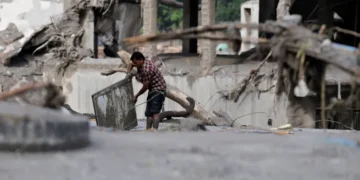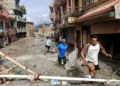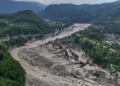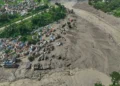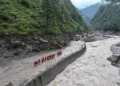









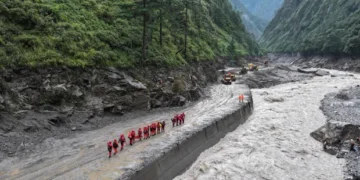


























































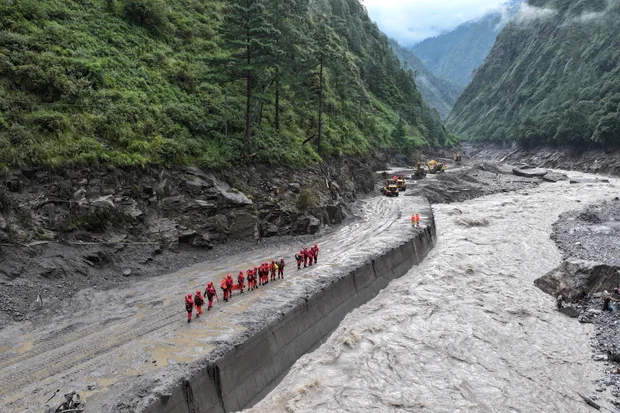
Authorities in Nepal have temporarily suspended rescue operations as of Friday, citing the urgent threat of a newly formed, overflowing lake that could trigger additional flooding in regions already devastated by a massive flash flood along the Himalayan border with China. The disaster has left a trail of destruction, with rescue teams previously navigating thick mud and debris in a desperate search for survivors.
Official figures from Nepal police indicate the national death toll has climbed to 469, up from 390 just one day prior, as recovery teams continue to locate bodies trapped within the wreckage. While China has reported three deaths in Tibet, the combined toll of missing persons across both nations is estimated to exceed 1,500. Nepal’s National Disaster Risk Reduction and Management Authority confirmed that 3,253 individuals have been evacuated from the disaster zone via helicopter.
The current danger stems from a lake that formed upstream following Wednesday’s collapse, which is already spilling over its natural debris barrier. China’s Ministry of Water Resources reported that the lake currently holds approximately 70 million cubic feet of water and is projected to receive an additional 106 million cubic feet over the next three days. Chinese state media outlet CCTV noted the lake sits at an elevation of 9,680 feet, roughly 3,280 feet above the Gyirong Port border crossing, which was previously submerged by floodwaters.
In response to the escalating risk, the Nepal Army has dispatched a team to inspect the Bhotekoshi River. Brig. Gen. Raja Ram Basnet, a spokesperson for the Nepali Army, stated that a specialized unit was deployed to the Upper Trishuli-1 Hydropower Project to reach individuals reportedly trapped inside a tunnel. Basnet noted the difficulty of the operation, explaining that identifying entry and exit points is complicated by heavy mud coverage, though the primary focus remains on reaching those stranded.
The impact of the flood has been widespread, destroying critical infrastructure including bridges, vehicles, and buildings. Survivors described the event as a sudden, overwhelming force. Karbir Gaire, a customs officer in the village of Timure, recalled feeling the ground shake before witnessing a “black storm” of water and debris. Gaire, who escaped by climbing uphill, noted that 15 of his colleagues remain missing from an office that once served a vibrant community of over 1,500 residents.
The tragedy has affected many travelers, including pilgrims and trekkers. The Nepal tourism board estimates that more than 500 foreigners are among the missing. Among those affected are groups traveling to Mount Kailash, a site sacred to Buddhists and Hindus. Spiritual leader Jaggi Vasudev, known as Sadhguru, stated on social media that 77 people from a single pilgrimage group were caught in the flooding at the border immigration office.
Personal accounts of the disaster highlight the sudden nature of the event. Rajan Tamang, a restaurant owner based in New York, shared that his mother and sister were killed, while other relatives remain unaccounted for. Similarly, Vishnuram Ramaswamy, working in India, reported that he has been unable to reach his mother and two sisters since their last conversation on Wednesday morning, when they were en route to the border area for a pilgrimage.
International leaders have responded to the crisis, with President Trump describing the destruction as “terrible to see” and noting that buildings were “wiped out like they were toothpicks.” The U.S. has reached out to Nepalese leadership to offer assistance. Scientists analyzing satellite imagery believe the disaster was triggered when the bedrock beneath a high-altitude Himalayan glacier collapsed, causing a portion of the ice to break away and surge into the valleys below, swelling rivers with a torrent of water and debris. The report also notes that they urged people in potentially affected areas to move to safer ground. The report also notes that our first priority is rescuing the stranded people. The report also notes that broken concrete lay upended in expanses of brown mud that also caked buildings and buried streets, in the aftermath. The report also notes that gaire reached his office around 8 a.m. The report also notes that right after the shake, I noticed a black storm coming towards us,” he recalled from Kathmandu, where he is back with family. The report also notes that we were climbing uphill on the opposite side of our office building, we all immediately started running out and within a few seconds. The report also notes that i think those 10 or so seconds saved some of us. The report also notes that but his 15 colleagues have gone missing, gaire doesn’t remember exactly how many people were in the office when the disaster struck.
Source: CBS News