


















































At least 111 people have been killed and hundreds remain missing after a magnitude 7.4 earthquake struck Colombia, in what officials described as the most powerful tremor to hit the country this century. The quake on Monday ravaged cities across western Colombia, including Cali, Pereira, Quibdo and Manizales, and was felt in neighbouring Ecuador and Panama.
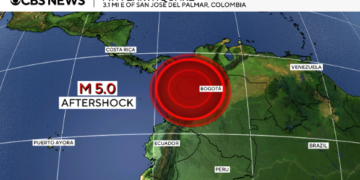
The epicentre was in San Jose Del Palmar in the Choco region, about 400km (250 miles) west of the capital, Bogota, the US Geological Survey said. The quake struck at a depth of 107km (66 miles), and at least 21 aftershocks followed within hours.
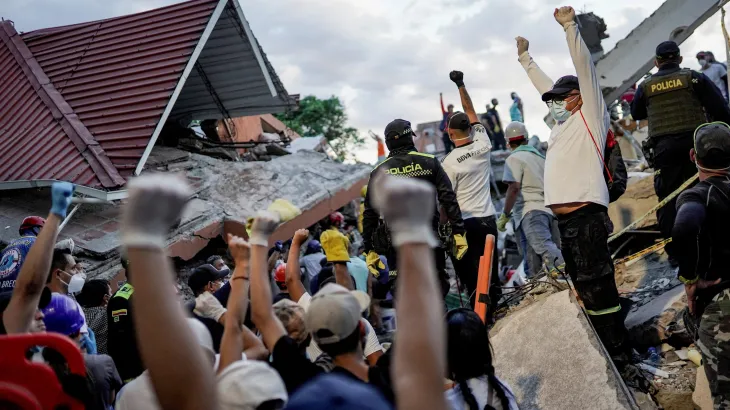
In Cali, the country’s third-largest city, search teams and civilians picked through the remains of destroyed buildings, passing large pieces of concrete and other rubble down a long line of volunteers. Local officials said at least 20 buildings crumbled, while 380 were damaged, trapping many people.
Jorge Moncayo, a 64-year-old taxi driver in Cali, told The Associated Press news agency that he saw plumes of dust shoot up across the city as buildings collapsed. “My entire house shook. I’ve never lived through such a powerful earthquake,” he said. “We’re thanking God we’re alive.”
Juan Carlos Osorio told Caracol Television that the collapse of one building “sounded like a bomb”, as he helped remove debris from a collapsed structure in Cali. “All of us neighbours are working together, forming human chains. We need heavy equipment. There are many people trapped.”
The earthquake struck just days after Abelardo de La Espriella was sworn in as president, thrusting the new administration into its first major crisis. “The national government has all of its capabilities deployed to protect lives, assist affected communities and deliver aid wherever it is needed,” he said in a national address at about 1pm local time (18:00 GMT), upon declaring a national state of emergency. “The first priority is rescuing the people trapped under the rubble.”
De La Espriella said preliminary reports indicated 111 dead and 87 injured. Local authorities said the death toll included at least 40 people killed in the Risaralda region, part of Colombia’s coffee-growing area. Pereira, the region’s capital, suffered extensive damage, with rescue workers continuing to search collapsed buildings for survivors. At least 27 people died in the Valle del Cauca region, where Cali is located, including three children.
Reports from Choco, near the epicentre, were slowed by communications outages. Governor Nubia Carolina Cordoba said 12 people had been killed and 84 injured in the largely rural area. Luis Gregorio Moreno, a community leader in the region’s capital, Quibdo, told the AFP news agency that many people were missing. “We are all devastated,” he said. “At this moment, there are reported deaths, dozens of wounded, but what there are most of are missing people.”
By Monday afternoon, people had begun reporting their loved ones missing on digital databases, one of which had more than 1,400 people, mostly in Cali and Pereira, with the number steadily climbing. In Pereira, photos and videos on local media showed pieces of the airport ceiling falling down on travelers taking shelter and screaming. The footage also showed a four-story building crumbling there. Pereira’s mayor, Mauricio Salazar, told a local radio station there were at least 15 collapsed buildings where people were feared trapped.
In nearby Manizales, footage showed one of the side towers of the city’s landmark neo-Gothic cathedral collapsing and scattering debris onto nearby streets. Colombia’s civil aviation authority suspended operations at several airports in the country’s west, including Pereira, Manizales, Quibdo, Armenia, Cartago and Buenaventura, while engineers carried out structural inspections.
On Monday night, the US State Department announced it would provide $15.5m for emergency shelter, food and other earthquake response aid. Washington is “closely monitoring the large earthquake that struck Colombia and stands ready to support the people of Colombia,” US Secretary of State Marco Rubio wrote on X.
El Salvador’s President Nayib Bukele and Mexican President Claudia Sheinbaum said they were ready to assist. “From El Salvador, we are in communication and ready to provide immediate support with our rescue teams, medical personnel, paramedics, supplies, or any other assistance that our Colombian brothers and sisters deem necessary,” Bukele said. Chilean President Jose Antonio Kast also pledged help, noting that Chile “knows the pain and the challenge left by earthquakes.”
Small earthquakes are common in Colombia, which sits along the seismically active Pacific Ring of Fire, but those above 6.0 magnitude are rare. In 1999, a 6.2 magnitude quake near the city of Armenia killed more than 1,100 people. Colombia’s Geological Service confirmed Monday’s event was the most significant seismic activity in the region for decades.
Northwestern University seismologist Suzan van der Lee said the quake’s powerful magnitude, inland location and strike-slip motion may have amplified damage in populated valleys despite its considerable depth.
At this magnitude, it did actually cause a lot of shaking,” she told the Reuters news agency.
“This one was far below the crust, and in theory it shouldn’t cause as much shaking.
Governments across Latin American also lined up to to help.
Source: Aljazeera