

































































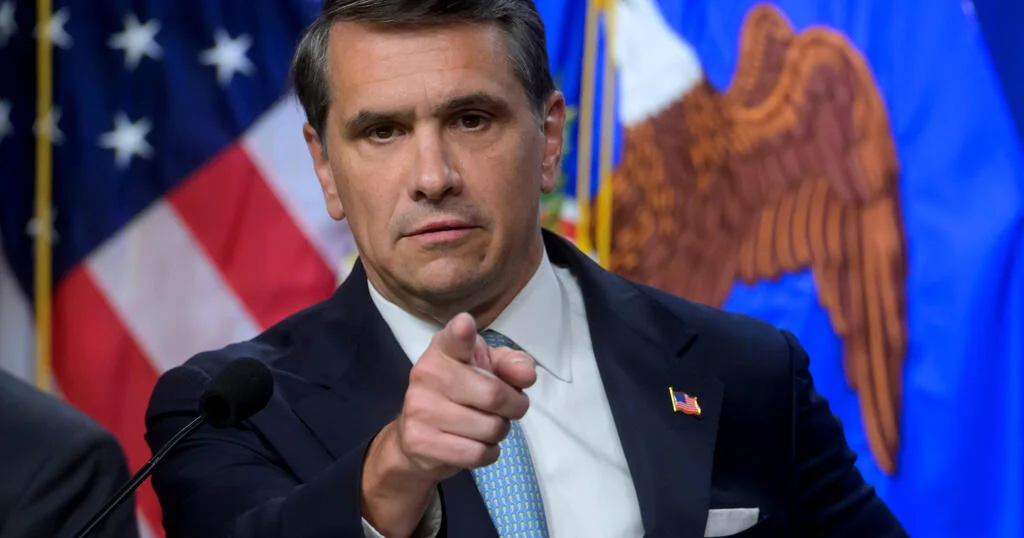
The United States Senate voted early Saturday to confirm Todd Blanche as attorney general, placing President Trump’s former defense attorney at the helm of the nation’s primary law enforcement agency. The confirmation passed by a narrow 50-49 margin, reflecting significant division within the chamber.
Blanche’s path to confirmation was secured following a critical endorsement from Sen. Bill Cassidy, a Louisiana Republican, on Friday. With GOP Sen. Mitch McConnell absent and both Sens. Susan Collins of Maine and Lisa Murkowski of Alaska voting against the nomination alongside all Democrats, Cassidy’s support proved decisive for the administration.
Following the vote, Blanche expressed his gratitude on social media, stating he was “deeply honored by the trust and confidence President Trump has placed in me to lead the Department of Justice.” Blanche had previously served as deputy attorney general and acting attorney general after the departure of Pam Bondi in April. President Trump formally nominated him for the permanent position in June.
The confirmation process faced substantial hurdles regarding a controversial $1.8 billion “anti-weaponization” fund established by the Justice Department. This fund was created as part of a settlement to resolve a $10 billion civil lawsuit filed by Mr. Trump against the Internal Revenue Service over the unauthorized leak of his tax returns. Lawmakers from both parties expressed concern over the fund and a separate provision granting broad tax audit immunity to the president, his family, and his business entities.
During his June confirmation hearing before the Senate Judiciary Committee, Blanche declared the fund “dead” and confirmed the department would cease its implementation. To finalize support from key Republicans, including Sens. John Cornyn of Texas and Thom Tillis of North Carolina, Blanche issued an order in late May rescinding the original directive. He further clarified that the immunity agreement was limited to specific tax returns and applied only to the president, his two oldest sons, and the Trump Organization.
Despite these concessions, opposition remained firm. Sen. Collins cited the erosion of the department’s independence, specifically pointing to the tax immunity deal and the anti-weaponization fund, as reasons for her “no” vote. Sen. Murkowski announced her opposition on Friday, though Blanche ultimately secured enough support from other Republicans, including Sen. John Curtis of Utah, to prevail.
Blanche’s professional background includes representing Mr. Trump in the New York criminal case involving “hush money” payments, which resulted in a conviction on 34 counts of falsifying business records. He also served on the legal team for two federal cases brought by former special counsel Jack Smith concerning the 2020 election power transfer and the handling of sensitive government documents. Both federal cases concluded following Mr. Trump’s election to a second term.
During his tenure as deputy attorney general, Blanche oversaw the release of over 2 million files related to the investigation of convicted sex offender Jeffrey Epstein. This process drew criticism after the department released unredacted personal information belonging to survivors. Blanche admitted during his hearing that “mistakes were made” regarding the document disclosures.
Blanche also met with Epstein’s survivors last month at the request of Sen. Tillis, who had conditioned his support on the meeting. However, the interaction drew backlash from some survivors, who characterized the event as a “check-the-box exercise” intended solely to facilitate his confirmation. Additionally, Blanche’s past meetings with Ghislaine Maxwell, who was convicted of sex-trafficking crimes, drew scrutiny, particularly after her subsequent transfer to a minimum-security prison camp in Texas.
Blanche narrowly won approval from the upper chamber in a 50-49 vote.
But Blanche faced headwinds during his confirmation, as Democrats and some Republicans took issue with the Justice Department’s creation of a $1.8 billion “anti-weaponization” fund to provide payouts to people who allege
Trump in his criminal case in New York state court that stemmed from a $130,000 “hush money” payment his lawyer made to an adult film star before the 2016 election.
He needed a simple majority of votes from the full Senate to be confirmed attorney general.
They urged senators to reject his nomination.
Source: CBS News