































































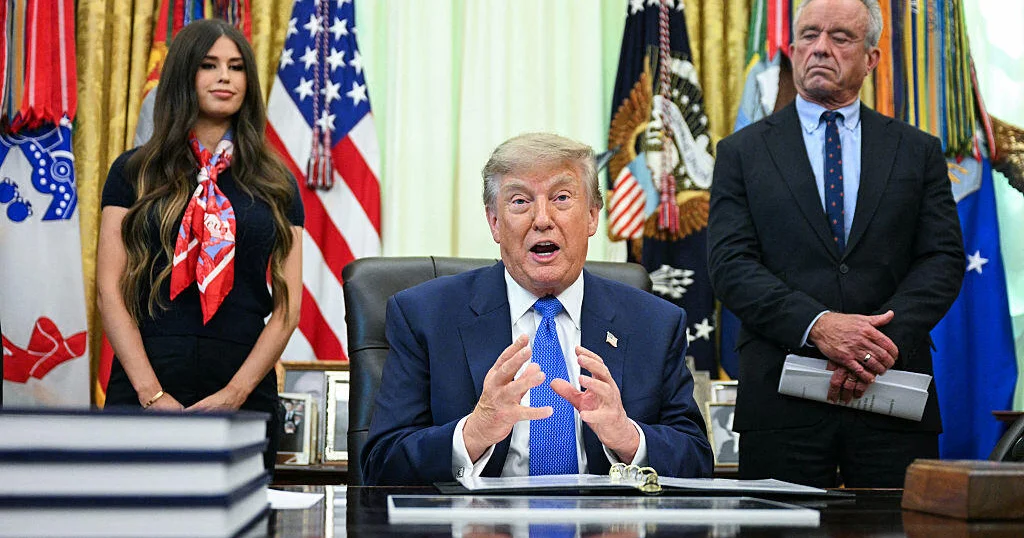
President Trump signed an executive order on Monday aimed at revising federal childhood vaccination recommendations. The directive, which mandates that the Department of Health and Human Services (HHS) reassess vaccine sequencing and timing within 90 days, specifically suggests that the measles, mumps, and rubella (MMR) vaccine should be administered as three separate shots, ideally during different medical visits.
While the president did not explicitly mention autism in the text of the order, he repeatedly linked the two during his remarks in the Oval Office. He argued that the current high rates of autism were not present decades ago when children received fewer vaccines, stating his intention to return to a schedule he believes is safer. He suggested that by spacing out vaccinations over a year or a year and a half, children would only receive 20% of the dosage typically administered in a single visit.
Medical experts have immediately challenged the feasibility and safety of these proposals. medical correspondent Dr. Céline Gounder pointed out that it is currently impossible to administer the MMR vaccine as three distinct shots because Merck, the manufacturer, ceased production of standalone measles, mumps, and rubella vaccines in 2009. There is currently no licensed version of these individual vaccines available in the United States, and no company has announced plans to develop them.
Dr. Gounder also highlighted the historical risks of such strategies, noting that when Japan attempted to split its vaccine shots in the 1990s, mumps vaccination rates dropped significantly, leading to hundreds of documented cases of children suffering from hearing loss. Furthermore, extensive research, including a 2019 Danish study of over 650,000 children and a 2015 study of nearly 96,000 American children, has consistently found no link between vaccines and autism.
The executive order arrives as measles cases in the U.S. have reached their highest levels in 35 years. The American Academy of Pediatrics (AAP) condemned the order as “disheartening” and “dangerous.” Dr. Andrew Racine, president of the AAP, stated that the order could sow confusion and discourage families from vaccinating their children, emphasizing that there is no new evidence to justify altering established immunization guidance.
Republican Senator Bill Cassidy, who is a physician, also criticized the move, stating on X that the president lacks the expertise to dictate medical policy. He warned that breaking up vaccines would require children to endure more injections to achieve the same level of protection, potentially increasing vaccine hesitancy and compromising child safety. He urged parents to consult their pediatricians rather than relying on the executive order.
Dr. Richard Besser, president and CEO of the Robert Wood Johnson Foundation, expressed concern over the politicization of medical care, noting that vaccination decisions should remain a private conversation between parents and their doctors. When asked about spacing out shots, Besser clarified that there is no clinical benefit to delaying vaccinations and that parents should explore any concerns directly with their child’s physician.
HHS Secretary Robert F. Kennedy Jr. defended the administration’s direction, announcing that the Advanced Research Projects Agency for Health is preparing a new initiative to investigate the foundational causes and biology of autism. He stated that the administration intends to examine every biologically plausible hypothesis to provide the answers the president has requested within the next two years.
Despite the administration’s focus, Jay Bhattacharya, director of the National Institutes of Health, maintained his trust in the science of childhood vaccines. During an appearance on ‘ “Face the Nation with Margaret Brennan,” Bhattacharya affirmed that he has vaccinated his own children and stressed the importance of standard childhood immunizations, including those for measles and DTP.
The executive order cites a desire to align U.S. policies with “best practices” from peer nations and to protect parental authority and religious liberty. However, the AAP has previously noted that international vaccine guidance varies significantly due to differences in population demographics, healthcare systems, and the prevalence of specific diseases in different regions.
While the federal government provides recommendations, the authority to set school immunization policies rests with individual states. The administration’s order acknowledges that previous efforts to implement these changes have been stalled by litigation, prompting the move to pursue additional executive measures.
President Trump concluded his remarks by promising that the research conducted by his administration would ensure that “nothing bad can happen.” Meanwhile, the scientific consensus remains that genetics and environmental factors—such as prenatal exposure to pollution or extreme prematurity—are recognized risk factors for autism, rather than vaccines.
No company has said it’s building one, and the order only takes effect once those products exist.”
And we’re going to bring it back to much closer to where it was.”
“So we’re reducing them, we’re changing it to visits over the period of a year, a year and a half, so they get 20% of what they would have gotten in one big shot.”
But medical correspondent Dr.
Gounder also warned that splitting the shot has been tried in the past, with some unfortunate results.
“In those times, people were much healthier and of course, the high rates of autism now observed did not exist.
“While we do not know exactly what the cause is with respect to autism, it is essential to our research efforts that we have the very best vaccine recommendations in the entire world,” he continued.
Research shows that genetics play a role in autism diagnoses.
The NIH says some possible risk factors for autism include prenatal exposure to pesticides or air pollution, extreme prematurity or low birth weight, certain maternal health conditions, or parents conceiving at an older age.
President, you have told us you want answers, so do I.
We have just over two years to finish the work and I know you’re impatient.
And we are moving with an urgency that that deadline demands.
We will bring you actions and findings as soon as they are read.”
A 2019 Danish study followed 657,461 children and found the autism rate in vaccinated kids was slightly lower.
And a 2015 study of 95,727 American children included nearly 2,000 who had an older sibling with autism.
If a vaccine had triggered autism in a genetically vulnerable child, links would have appeared, but their risk was no higher.
“In many cases, we were requiring 72 jabs for our beautiful, healthy, lovely, delicate little children,” the president said.
Dozens of studies involving millions of people show there is no link between vaccines and autism, and yet federal leaders continue to promote this outdated, disproven idea to scare families,” the group’s president, Dr.
“Delaying or skipping shots is risky, especially as measles continues to spread and children go back to school.”
It will increase hesitancy and make children less safe.
Richard Besser, a pediatrician and the president and CEO of the Robert Wood Johnson Foundation, told, “What we’re seeing now is the injection of politics into something that should be a very personal conversation between a parent and their child’s doctor.”
Bhattacharya, who’s also been serving as acting CDC director in recent months, acknowledged that the U.S.
may lose its measles elimination status, while pointing to other countries that have also recently lost their status.
Kaia Hubbard and Kathryn Watson contributed to this report.
Source: CBS News