









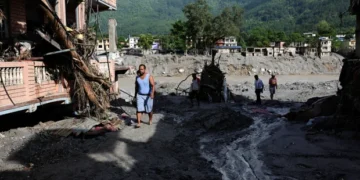
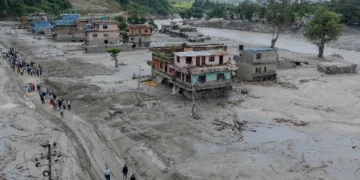
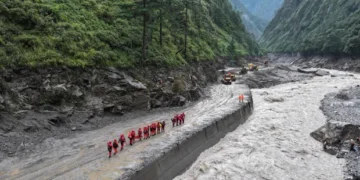



























































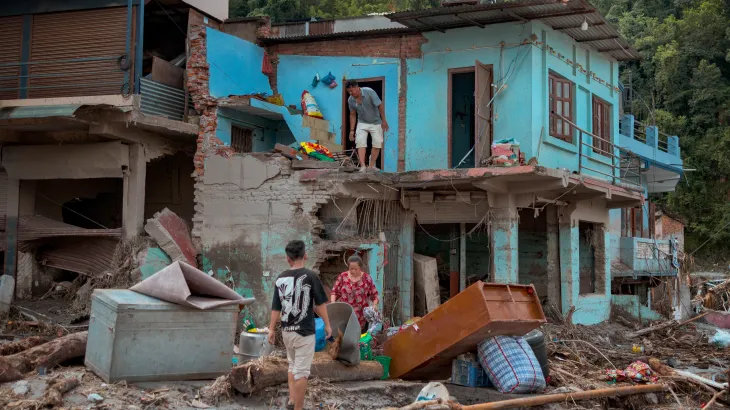
A catastrophic glacier collapse in the Himalayas has left a trail of destruction, resulting in 469 confirmed deaths and leaving more than 1,000 people missing across Nepal and China’s Tibet region. Two days after the initial disaster, the situation has worsened as a newly formed barrier lake began to overflow, forcing a halt to critical rescue operations in the affected areas.
The disaster has resulted in the formation of two distinct lakes. One has pooled in the upper reaches near the glacier, where meltwater is trapped. The second, larger, and more hazardous lake has formed in Nepal along the Lehende river system, near the confluence of the Chhochen Khola and Purepu Tsangpo rivers. This lake was created when a massive ice-rock avalanche deposited a significant volume of debris, effectively damming the valley and blocking natural drainage.
Narendra Pariyar, a senior official in Nepal’s Rasuwa district, confirmed on Friday that the barrier lake had begun to overflow. “We can see that the level of water in the river is rising,” Pariyar stated, noting that the exact dimensions and water levels of the lake remain difficult to determine due to the remote and treacherous terrain. The lake is situated upstream of the Bhotekoshi and Trishuli rivers, which flow south toward Kathmandu.
Chinese authorities have mobilized an eight-member engineering team to conduct aerial surveys and 3D modeling of the site. Engineer Chen Hanxiao reported that the collapse created a landscape of isolated, steep cliffs, making access to the area extremely challenging. The Ministry of Water Resources in China estimated on Thursday that the lake currently holds between 1.5 and 2 million cubic meters of water, with the potential for an additional 3 million cubic meters to flow in over the coming three days—a volume equivalent to roughly 1,200 Olympic-sized swimming pools.
Experts warn that the primary danger lies in the potential for a sudden dam failure. Pawan Bhattarai, an assistant professor of civil engineering at Tribhuvan University, explained that in such steep valleys, even a brief breach can generate a high-velocity, debris-laden flood with minimal warning for downstream communities. “The avalanche and formation of the natural dam itself were probably not preventable,” Bhattarai noted, though he suggested that better satellite monitoring and real-time detection could have helped mitigate the consequences.
Nitesh Khadka, a physical geographer specializing in glacial floods, emphasized that the formation of such lakes is a natural process, yet it poses severe risks to rescue workers, engineers in downstream hydropower tunnels, and displaced survivors. “If it poses a danger, safe and controlled breaching could be done, but it also seems infeasible due to complex terrain,” Khadka said. He added that if the lake breaches, the resulting flood would likely mobilize massive amounts of sediment, significantly increasing the destructive power of the water and further hindering search operations.
The current crisis is not without precedent. Similar events have occurred in the region, including a 2016 incident in Tibet’s Aru Range where a glacier collapse released 68 million cubic meters of ice, and a 2022 event in the Kunlun Mountains that created a 13-meter-high wave. In May 2022, a sudden breach of an ice-dammed lake formed by the Shishper Glacier also caused significant flooding in Pakistan’s Hunza Valley. As the situation in Rasuwa remains volatile, authorities are stressing the need for continuous monitoring to manage the ongoing flood risk. The report also notes that however, there are challenges when it comes to accessing the site. The report also notes that creating a natural dam and hence causing this lake to form, these immense piles of debris blocked river channels. The report also notes that additionally, when a barrier lake is held behind only by loosely packed rocks and mud, even moderate overflow can erode the barrier and trigger a sudden, destructive outburst flood downstream. The report also notes that “It is a threat, because if a formed lake suddenly breaches it may cause another flood; it may mobilise the sediments that will hamper search and rescue operation and will also put dangers to those surviving in the hydro tunnels,” Khadka said. The report also notes that it could slam into these tunnels and power stations, trapping or injuring anyone who is still there, if a sudden flood rushes down. The report also notes that what’s the status of rescue efforts. The report also notes that they were paused on Friday since the barrier lake broke its banks, in the hard-hit Rasuwa district.
Source: Al Jazeera