

































































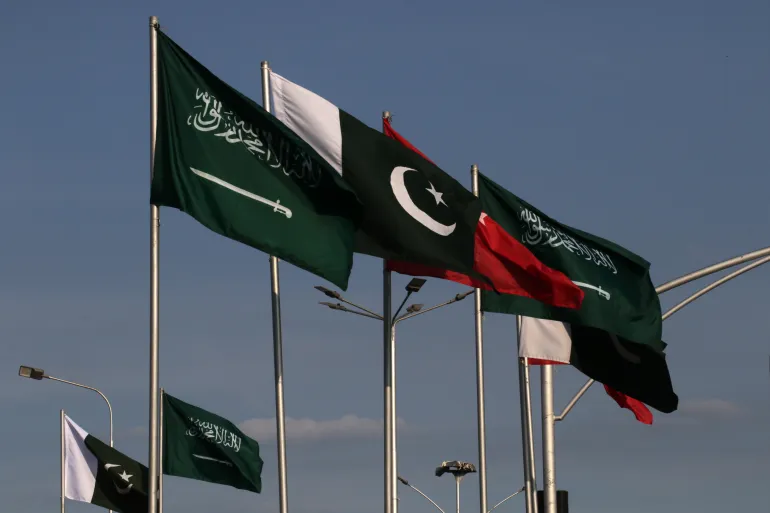
Turkiye is actively seeking to broaden its newly established defence alliance with Saudi Arabia and Pakistan, according to Turkish Foreign Minister Hakan Fidan. Citing the vision of President Recep Tayyip Erdogan, Fidan indicated that the current trilateral structure is intended to grow, with the ultimate goal of bringing additional nations under the security umbrella. Speaking to the state news agency Anadolu on Saturday, Fidan emphasized that the alliance should not remain restricted to its three founding members.
The Mecca Joint Deterrence Agreement, signed by the three nations on Friday, represents a significant shift in regional security architecture. The pact functions on a NATO-like principle, where an attack on one member is considered an attack on all. While the specific operational details remain under development, Fidan noted that allies will determine the format and scale of support through consultations, ensuring that no external nation is viewed as a threat unless a member state is directly attacked.
Turkish and Saudi officials have stressed that the pact is not meant to supplant any other strategic alliances or relationships. Turkiye, a long-standing member of NATO, has clarified that the agreement does not target any specific country, including Iran. Regional officials have suggested that the pact could eventually expand to include other countries, strengthening its role as a mechanism for collective security and deterrence in a volatile geopolitical landscape.
Egypt is the only country whose potential membership has been publicly raised by an official from one of the pact’s signatory countries. Fidan described Egypt as a “natural partner” and said he expects Cairo to formally join once “technical issues” are ironed out. “I believe that at the next stage, Egypt will also be among us in the alliance,” Fidan said, adding, “We already act towards one another as if we were alliance members.”
Egypt has also recently developed stronger military ties with Turkiye despite previous tensions over the Egyptian military’s 2013 overthrow of President Mohamed Morsi, the conflict in Libya, and the discovery of gasfields in the Eastern Mediterranean. This warming of relations has positioned Cairo as a key candidate for the expanded security framework.
Ali Bakir, a professor of international relations, security, and defence at Qatar University, noted that Egypt’s inclusion would “significantly increase the pact’s political weight, regional influence and operational effectiveness” if it materializes. Egypt already maintains a solid working relationship with Saudi Arabia, Pakistan, and Turkiye, with which it is part of a group called the R4, which consults on regional issues.
However, analysts warn that Cairo may be wary of the potential military obligations that could come with a binding defence treaty, especially when its interests do not always align with those of the other signatories. The implications for its existing international commitments remain a primary concern for Egyptian policymakers.
“Egypt may join only if the language protects its aid relationship with Washington, doesn’t undermine existing alliances and peace treaties, and maintains its own freedom to decide when and where it fights,” Karim Elgendy, associate fellow at Chatham House’s Middle East and North Africa Programme, told Al Jazeera.
Elgendy further explained the strategic calculus for Cairo: “If the pact stays a political framework with room to calibrate each response, Cairo can live with it and may eventually sign. If it hardens into an obligation that could pull Egyptian forces into someone else’s war, the answer is likely to be negative.”
Beyond Egypt, other nations are being monitored as potential additions to the coalition. Among the Gulf states, Elgendy suggested that “the names to watch first are Qatar and Kuwait.” Both countries are close to the three signatories and have strong motives to seek extra security insurance after feeling exposed during the recent regional conflicts, including the United States-Israel war on Iran and the strike on Doha in September.
Ali Bakir similarly identified Qatar as the “most natural” Gulf state to opt in, with Kuwait serving as another possible candidate. He also noted that Azerbaijan, Syria, and Jordan could potentially join the alliance “relatively quickly” depending on how the security architecture evolves in the coming months.
“This looks like a coalition of the willing that will grow on a case-by-case basis, shaped by each capital’s own risk calculus,” Bakir concluded. As the Mecca Joint Deterrence Agreement moves from a conceptual framework to a formal security mechanism, the international community will be watching to see which nations prioritize this new umbrella over existing regional alignments.
“On the legal side, Egypt needs to know exactly what it is committing to defend, and it will want assurances so that a signature never reads as a commitment against Israel or as taking Ankara’s side in Libya and the East
“Cairo’s preference is to be part of overlapping regional security arrangements that are narrow in scope and are issue-related … rather than being entangled in defence commitments with elevated risks/cost,” Aboudouh said
In a post on X, former Qatari Prime Minister Sheikh Hamad bin Jassim Al Thani expressed hope that all members of the Gulf Cooperation Council (GCC) would “take the initiative to join” the pact.
“On the legal side, Egypt needs to know exactly what it is committing to defend, and it will want assurances so that a signature never reads as a commitment against Israel or as taking Ankara’s side in Libya and the Eastern Mediterranean,” he said.
For Bakir, Cairo’s decision will come down to how it weighs the benefits of membership against the diplomatic complications.
Egypt’s decision on whether to join the pact will hinge on the level of “strategic value” it believes it brings as well as its ability to “manage relations with countries whose interests” contrast with or even “actively oppose” the alliance, he said.
“Cairo’s preference is to be part of overlapping regional security arrangements that are narrow in scope and are issue-related … rather than being entangled in defence commitments with elevated risks/cost,” Aboudouh said.
He added that Egypt may still opt to join the pact in the future but it would be a “complex decision”.
In addition to Saudi Arabia, the GCC includes Qatar, Bahrain, Kuwait, Oman and the United Arab Emirates.
Elgendy expressed scepticism about the pact transforming into a broader bloc.
Source: Aljazeera