

















































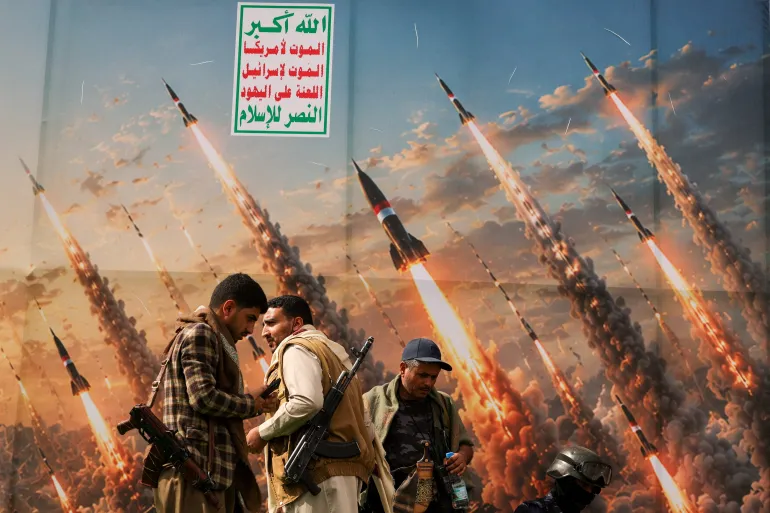
Sanaa, Yemen – Houthi missiles and drones struck military locations inside Yemen on Thursday, leaving at least 30 government soldiers dead and 15 others injured in the first such attack in years. The strikes, which targeted government military camps and gatherings in the provinces of Hadramout and Marib, represent a significant escalation in the long-standing conflict between the Houthi group and the internationally recognized government.
Yahya Saree, the Houthi military spokesperson, claimed in a broadcast statement that the attacks killed “hundreds” and “destroyed a large number of camps and depots.” He alleged that the strikes were launched after Houthi forces “detected a massive Saudi military mobilisation” with the aim of an escalation, framing the offensive as a preemptive measure to protect their security.
The two sides have been at war since the Houthis and their allies captured the capital, Sanaa, in September 2014, with a Saudi-led coalition intervening in March 2015 on the side of the government. While fierce fighting has subsided in recent years, there has been a notable consolidation of government and southern forces since the United Arab Emirates withdrew its primary presence in 2025.
Abdul Rahman Saleh, 34, who lives in Sanaa, said the war has now become tangible to the people living in Yemen. “It is no longer a potential threat; it has become a daily reality,” he explained. “We have repeatedly heard explosions over the past days in Sanaa. We watch the figures of deaths and injuries on the news, and parties boast of their deadly attacks on their media outlets.”
Saleh added, “It reminds us of the pre-2022 truce. Each party is hungry for revenge. As a civilian, I feel it would take a miracle to stop this war now.” His sentiments reflect a growing anxiety among the population as the fragile state of neither peace nor war appears to be unraveling.
The Houthis are now on high alert for any military developments, Saree said, as pro-government forces appear to be preparing to retaliate for Thursday’s attacks and the potential renewal of Yemen’s largely dormant war. The Houthi group stated on Thursday that it would not “tolerate” any Saudi military presence inside Yemen’s borders and maintains a “legitimate right to confront any hostile moves that threaten its sovereignty and security.”
Fuad Mussed, a Yemeni researcher focusing on political and military affairs, believes the recent attacks are proof that the Houthi group has shifted its strategic posture. “The Houthis’ message is clear: opting for escalation both inside Yemen and beyond,” Mussed told Al Jazeera. “As they expand their attacks internally, they continue targeting ships, signaling that the state of neither peace nor war has ended.”
Although the war in Yemen has largely halted since April 2022, when the rival sides reached a United Nations-sponsored truce, both sides have expressed a desire for a decisive military battle in recent months. Ahmed Nagi, a senior analyst at the International Crisis Group, noted that the expansion of these attacks means the threat of all-out war is increasing.
“Although there is still a chance for both sides to return to a policy of containment, the problem is that each new escalatory move makes that much more difficult,” Nagi said. “Based on what we are seeing today, the indicators pointing toward renewed conflict are stronger than those pointing toward de-escalation.”
Yemeni political analyst Yassin al-Tamimi suggested that the Houthis may hold an advantage in missile capabilities, but the magnitude of violence would be tremendous if a major war with the government erupts. “Should such a war break out, it would not resemble previous conflicts; rather, it would be far bloodier,” he warned.
Sheikh Othman Majali, a member of the Saudi-backed Presidential Leadership Council, argued that there can be no prospect of peace or stability while the militia remains in power. “This can only be achieved by confronting and toppling the militia, and by halting the harm and evil it inflicts upon our people and our region,” Majali told the government-run media.
As the Houthis ready themselves for war, Saudi Arabia and the Yemeni government have prioritized de-escalation over a military response, despite some calibrated attacks against the group. “Saudi Arabia and the Yemeni government still appear committed to a policy of containment, and it is possible they are testing this political approach to its limits,” Nagi concluded. “Whether that means limited military action or a broader shift in strategy remains to be seen, but the room for continued restraint is becoming narrow.”
Houthi officials say the presence of any Saudi-linked Yemeni militias or military units outside the Sanaa authorities’ control is intolerable.
Today, control of the north-central province could be a life-and-death battle for the Houthis, Adel Dashela, a researcher at Sanaa Center for Strategic Studies, told Al Jazeera.
The Houthis’ gradual engagement in the regional war between the US and Israel against Iran, the group’s key ally, included an announcement of a naval blockade on Saudi ports and attacks in the Bab al-Mandeb Strait last month.
“Yemenis have been waiting for the Houthis and the Yemeni government to reach a peace deal or implement a peace roadmap for years.
“They have used the years-long peace talks to accumulate and create weapons nonstop.
This has made them prepared for confronting local adversaries and capable of launching attacks as far as Israel and Saudi Arabia.
It is not easy to persuade them to abandon the path to war.”
If this stance continues, it points to the powerlessness of the Yemeni government and Saudi Arabia, and this will rob them of popular trust,” Al-Huraibi argued.
Marib is once again emerging as the focal point of the conflict with fatal clashes breaking out on the front lines there in recent days.
“A full-scale eruption across all battlefronts would make it difficult for the group to contend with government forces.
That remains unclear, especially as they continue to strengthen their position by building alliances and reinforcing military units along the front lines.”
Source: Aljazeera