
























































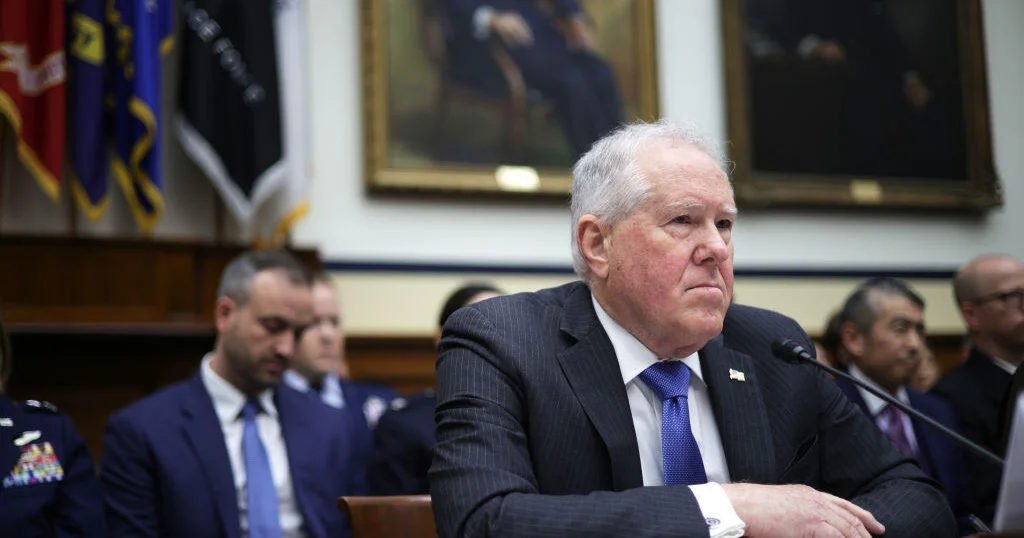
The Pentagon has officially revoked the security clearance of former U.S. Air Force Secretary Frank Kendall, stripping him of his eligibility to access classified information and barring him from holding any sensitive position. The decision, announced Friday, stems from allegations that Kendall shared sensitive details regarding the capabilities of the presidential aircraft, Air Force One, with a media outlet.
Pentagon spokesperson Sean Parnell confirmed the move in a social media statement, asserting that the action was a direct consequence of an unauthorized disclosure of classified material. Parnell emphasized that the protection of classified information is a non-negotiable duty, stating that individuals who breach that trust forfeit both their access and any professional role that requires such clearance.
The revocation follows recent media reports, including coverage by The New York Times, which raised security questions regarding a new, Qatari-gifted aircraft now serving as Air Force One. These reports suggested the jet lacked the advanced antimissile systems found on its predecessor. The Air Force has maintained that the rapid conversion of the aircraft was conducted without compromising security, safety, or communication protocols, though it acknowledged that certain complex engineering modifications—such as widening doors or installing integrated stairs—were intentionally omitted from the Qatari-provided plane.
Responding to the Pentagon’s action, Kendall expressed total confusion, telling The Associated Press that he was completely mystified by the decision. He maintained that he has always been extremely careful to avoid disclosing classified information and stated that no one has provided him with specific details regarding what he is accused of revealing. Kendall noted that he had been comfortable speaking on the record about the Qatari-gifted 747 because he was confident he had not shared protected data.
The aircraft in question underwent a $400 million retrofit. While it has been used for domestic travel and a recent NATO summit trip to Turkey, President Trump opted to use an older model for his departure from that summit. Reports indicate this switch occurred after U.S. intelligence detected a credible plot to target the president’s plane with a missile. The White House later stated that the new plane would undergo further upgrades and enhancements over the course of a month.
Although the Justice Department previously subpoenaed reporters from The New York Times to identify sources related to the plane’s security, those subpoenas were withdrawn last month following judicial criticism regarding the legal process. The Pentagon has not specified which media outlet Kendall allegedly leaked information to, nor did Parnell confirm if the department is referring the case for criminal prosecution under the Espionage Act.
This development marks another instance of the Trump administration taking action against security clearances, following the revocation of access for 37 national security officials last year and the removal of protections for retired Gen. Mark Milley shortly after the administration took office.
The broader context of national security leaks remains a point of intense focus for federal authorities. In 2024, a federal judge sentenced a Massachusetts Air National Guard member to 15 years in prison for leaking classified military documents concerning the war in Ukraine. Such cases are often compared to high-profile breaches like that of former contractor Edward Snowden, who fled to Russia after disclosing extensive surveillance data.
As of now, the Pentagon has declined to provide further details regarding the investigation into Kendall, leaving the specific nature of the alleged disclosure and the potential for future legal proceedings unclear.
“No one has said anything to me about what I’m asserted to have revealed and I can’t imagine what it could be.”
officials previously told that Mr.
The officials told that the U.S.
launched airstrikes on Iran and Tehran attacked three Gulf Arab states.
Secret Service swiftly swapped to a backup strategy.
The Secret Service suggested that the president take the old plane, which is equipped with secure communication systems and sophisticated military defenses, according to people briefed on the situation who spoke to last month.
The new plane donated by Qatar was hurried into service and is lacking some desired capabilities, U.S.
Trump last month denied to reporters that the swap was due to security concerns, although he also said he is under threat “all the time” and is Iran’s “No.
A well-known example was when the Obama administration filed charges against Edward Snowden, a former intelligence agency contractor who publicly disclosed a massive trove of secret documents about U.S.
surveillance operations before fleeing to Russia.
Source: CBS News