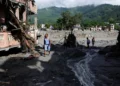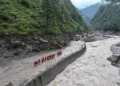









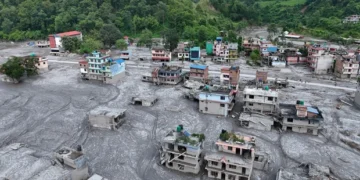




























































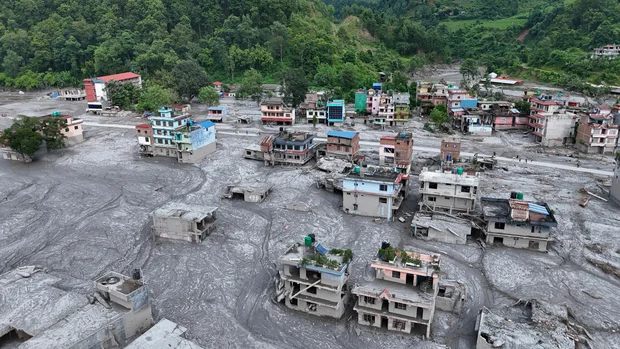
The death toll from Wednesday’s catastrophic flash floods in Nepal and along the border with China has climbed past 600, with approximately 3,000 individuals still unaccounted for as rescue teams enter their fourth day of operations.
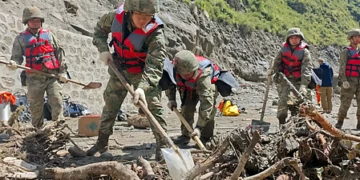
Aerial efforts to locate survivors have been severely hampered by poor weather conditions. Brig. Gen. Raja Ram Basnet, a spokesperson for the Nepali Army, confirmed on Saturday that helicopter missions remain suspended until conditions stabilize. These efforts are critical for reaching remote areas where workers and military personnel have been searching through deep mud since the disaster began.
Authorities are particularly concerned about a hydropower construction site in the Rasuwa district, where more than 100 people are believed to be trapped inside a tunnel inundated with thick mud. Rescue teams have utilized helicopters equipped with baskets to reach some survivors, though progress is slow due to the depth of the mud, which reaches up to five feet, and a lack of suitable landing zones. Video footage from the site shows rescuers struggling to pull survivors from the debris.
Both Nepali and Chinese officials have issued warnings regarding the potential for further flooding, as a new lake formed upstream by the disaster has begun to overflow. Residents in vulnerable areas have been urged to relocate to higher ground, and some rescue teams have been forced to temporarily withdraw due to the rising threat.
To date, authorities in Nepal have successfully rescued more than 3,700 people. Meanwhile, Chinese state media reports that 558 individuals remain missing on the Chinese side of the border. Many of the missing are foreign nationals who were in the region for work, trekking, or pilgrimage to a sacred peak in Tibet.
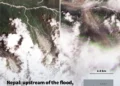
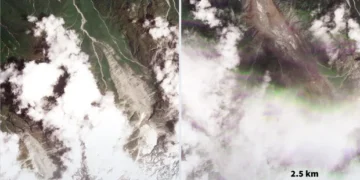
The Red Cross estimates that approximately 90,000 people have been impacted by the flooding. The disaster is believed to have been triggered by the collapse of a rocky ledge and a significant portion of a glacier it supported. Satellite imagery analyzed by scientists indicates that the bedrock beneath a high-altitude Himalayan glacier gave way, an event so powerful it registered as a magnitude 5.2 seismic tremor.
The resulting rockfall and massive release of meltwater surged into the valleys below, sweeping away bridges, buildings, and infrastructure. Jakob Steiner, a geoscientist at the University of Graz, noted that a lower section of the glacier had detached, warning that such events are becoming the new normal as the Hindu Kush Himalayan region warms rapidly, destabilizing permafrost and mountain slopes.
The U.S. State Department confirmed that five Americans have been rescued, while approximately 90 remain missing. Among the missing are 22 U.S. citizens who were part of a pilgrimage organized by the Isha Foundation, a group led by Indian spiritual leader Sadhguru Vasudev. Community liaison Leslie Crespi stated that the foundation is working closely with the State Department and the U.S. Embassy to track the missing pilgrims, noting that the organization has never lost a life in its 21 years of hosting such trips.
Deepak Dandu, a U.S. citizen, is among those awaiting news of loved ones, specifically his wife, Sridevi Vejella. He reported that she was crossing from China into Nepal at the Gyirong Port immigration complex when the floods struck.
In response to the crisis, the U.S. Embassy in Nepal announced it is coordinating with the government to deliver essential supplies, including food, blankets, mosquito nets, and insulating foam for temporary flooring. Catholic Relief Services and Caritas Nepal are assisting in the distribution of these materials to schools in the Rasuwa district.
President Trump addressed the disaster on Thursday, describing the destruction of sturdy buildings as akin to toothpicks being wiped away. He confirmed that U.S. officials have reached out to Nepalese leadership to offer comprehensive assistance. The report also notes that rescuers pulled and push a man covered in dark brown mud out of the tunnel, in a video from the scene. The report also notes that a helicopter carrying a basket was used to reach some people but the operation was slowed down by the 4 to 5 feet of mud and limited landing areas. The report also notes that causing torrents of water that swept buildings, bridges and earth downstream in Tibet and Nepal, the rocks and melted water suddenly swelled the rivers in the valleys below. The report also notes that but Jakob Steiner, a geoscientist at the University of Graz in Austria who is currently based in Bangladesh, said “a lower part of a glacier has really come off, scientists were still piecing together information from satellite and ground-level data to confirm exactly what caused the flood. The report also notes that located between about 14,760 and 19,685 feet above sea level, is highly exposed to warming, around 78% of the glacier area. The report also notes that it’s going to get worse from here onwards,” Steiner said. The report also notes that working through implementing partner Caritas Nepal, will deliver more than 2.5 metric tons of food supplies, 500 blankets, 500 mosquito nets, and 500 insulating foam sheets for temporary shelter flooring to two school locations in Rasuwa,” the embassy said, noting plans for subsequent supply shipments were already in place, catholic Relief Services.
Source: CBS News