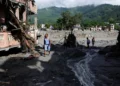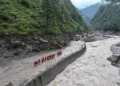









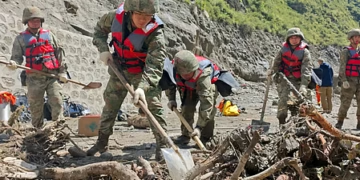
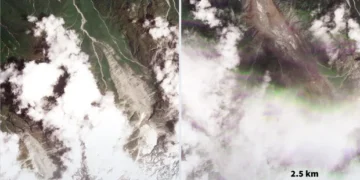




























































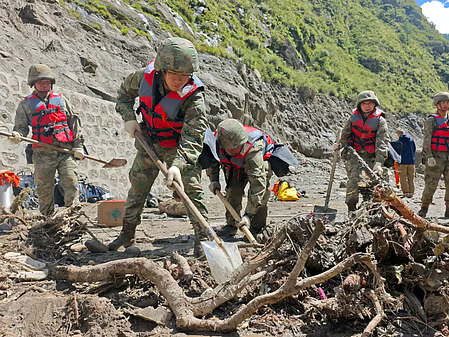
Emergency responders in Nepal and China are working under increasingly difficult conditions to locate more than 2,400 people still missing following a devastating, tsunami-like surge of water and debris that tore through the Himalayan region earlier this week. The disaster, which struck on Wednesday, has left a trail of destruction, with 586 bodies recovered so far. Some victims have been discovered as far downstream as India, where authorities have confirmed the recovery of seven bodies from rivers originating in Nepal.
The scale of the humanitarian crisis is immense, with the Red Cross estimating that up to 93,000 people have been affected by the catastrophe. As the search continues, officials warn that the death toll is likely to rise. The region, which hosts significant energy infrastructure, has seen a sharp increase in the number of missing persons; Nepal’s disaster authority recently added 933 hydropower workers to a list that already included trekkers and pilgrims traveling to Tibet’s sacred Mount Kailash.
Survival stories from the disaster zone highlight the terrifying speed of the event. Buddha Tamang, a worker at a dam project, recounted that he only survived because he was inside a tunnel when the flood hit, noting that senior officers on the other side were swept away. Similarly, 46-year-old Sivaranjani Muthunathan, who was traveling by bus toward the Chinese border, described a sudden wall of fog and smoke before a torrent engulfed the area. She and others managed to escape through a driver’s side window before scrambling up a nearby hill to safety.
The search operation is being severely hampered by the threat of further flooding. Nepali police have issued urgent warnings for rescue teams to relocate to safer ground following reports that a water dam has burst again on the Tibetan side. In Tibet, Chinese authorities briefly suspended operations in the hard-hit Gyirong area due to these risks, though state media later indicated the threat had eased and reported the rescue of two villagers early Saturday.
In Nepal, the military is focusing efforts on the Trishuli 3A hydropower project, where they are attempting to reach workers trapped inside a tunnel. Army spokesman Raja Ram Basnet noted that while 350 people have been rescued from the site, locating the tunnel’s entry points remains a significant challenge for helicopter crews. Across the border in Tibet, authorities have successfully evacuated 555 stranded tourists and 499 Chinese residents.
For those waiting for news, the situation is increasingly desperate. Survivor Buddhi Ram Dangol described the total destruction of local settlements, stating, “All the settlements near the river were swept away. There is nothing left.” Samjhana Thing, who has spent three days searching for her brother, echoed this sentiment, saying, “We don’t know anything. Hopefully he is in a safe place.”
Current figures indicate that Nepal has reported 579 deaths, with 1,924 individuals—including 517 foreign nationals—still unaccounted for. In Tibet, state news agency Xinhua reported seven deaths and 554 missing persons. As food and water supplies dwindle in the affected zones, the priority remains the extraction of survivors and the ongoing search for those lost in the mud and debris. The report also notes that and the prospect of rebuilding their lives from nothing, those that made it out say they have lost everything and now face an agonising wait to discover the fate of missing loved ones. The report also notes that and one of these formations has become a direct threat to emergency workers scouring the region for survivors, the deluge of ice and mud caused huge lakes to form. The report also notes that they were all swept away,” Tamang, who was airlifted on Thursday after being marooned for more than 24 hours, told AFP, the senior officers working on the other side. The report also notes that the previous missing figure was 977. The report also notes that sivaranjani Muthunathan was travelling by bus with 56 others towards the Chinese border when they became stuck in what they thought was a traffic jam. The report also notes that smoke, something that seemed to suddenly engulf us,” Muthunathan, 46, told AFP on Friday, showing a phone video she recorded of a torrent surging towards her, then there was fog. The report also notes that nepal-China floods: 469 dead, 1,400 still missing.
Source: Gulf News