









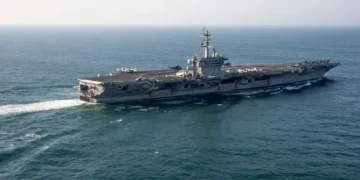


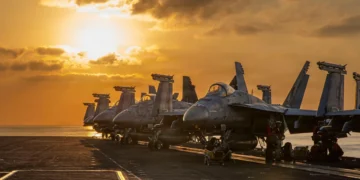














































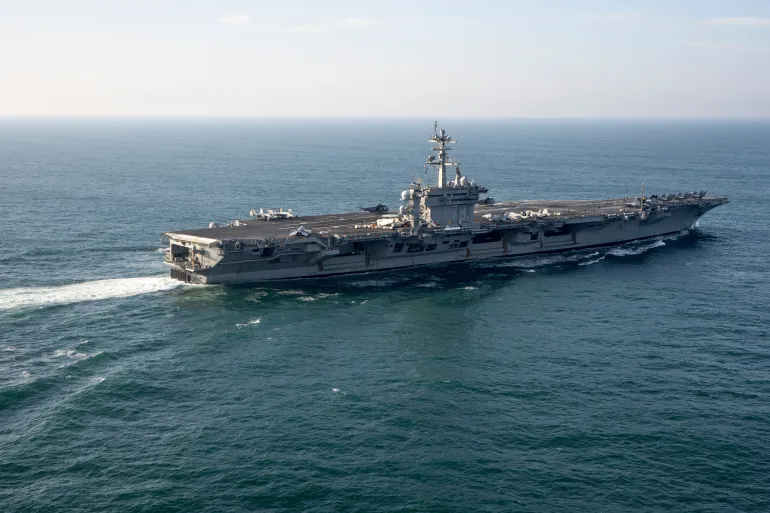
Asian allies of the United States are expressing growing unease as Washington redirects critical military assets to the Middle East, where the conflict with Iran has entered its sixth month. The latest shift involves the USS George Washington, the final US aircraft carrier stationed in the Asia-Pacific, which has been ordered to depart Japan to relieve the USS Abraham Lincoln. The latter vessel has been on deployment for nine months, amid reports of poor onboard conditions including food shortages, broken facilities, and morale issues that reportedly led to a suicide attempt.
This redeployment follows earlier strategic adjustments that saw parts of the Terminal High Altitude Area Defence (THAAD) system moved from South Korea to the Middle East, alongside a general drawdown of regional missile and munitions stockpiles. William Yang, a senior analyst at the International Crisis Group, warned that these cumulative moves weaken the US power projection in Asia. He noted that the departure of the USS George Washington specifically impacts the effectiveness of regional deterrence against China, describing it as part of a concerning broader trend.
While the US carrier presence is currently reduced, Chinese naval activity has intensified. Beijing’s fleet is increasingly operating beyond the First Island Chain, a defensive perimeter stretching from Japan through Taiwan and the Philippines to Borneo. Furthermore, Chinese coastguard activity has surged since June in waters east of Taiwan, encroaching on the exclusive economic zones of Japan and the Philippines. Yang emphasized that these maritime maneuvers are clearly aimed at Taipei, Manila, and Tokyo, serving as a test of US responsiveness and capability.
Security experts suggest that these shifts may embolden Beijing. Ja Ian Chong, a political scientist at the National University of Singapore, noted that allies are concerned this perceived power vacuum could encourage China to push harder, thereby increasing pressure on regional partners. While the US maintains a significant presence of roughly 375,000 military and civilian personnel in the region—largely in Japan and South Korea—the redeployment signals a shift in strategy. Under the current administration, the focus is increasingly on burden-sharing, with the 2026 National Defense Strategy urging allies to bolster their own defense capabilities.
This strategic pivot has prompted a rapid increase in regional defense spending. Taiwan has announced plans to boost its 2027 defense budget by 18 percent, while Philippines Defence Secretary Gilberto Teodoro Jr. recently advocated for raising defense spending to 4 percent of GDP. Japan and other partners are also deepening security cooperation with one another to build organic capabilities. Experts like Kei Koga of Nanyang Technological University view the Middle East deployment as a short-term concern rather than evidence of a permanent US withdrawal from Asia.
K. Tristan Tang of the National Bureau of Asian Research added that the region still retains key assets, such as Amphibious Ready Groups capable of hosting F-35B stealth fighters. Tang expressed confidence that the US remains focused on its primary strategic rival, noting that despite the demands of the Iran war, the administration continues to prioritize economic and security interests regarding China. As he stated, the US remains deeply focused on the world’s second-largest superpower, which remains the most important factor in the president’s long-term strategic outlook. The report also notes that reports suggested that at least one sailor tried to jump off board. The report also notes that but it has recently done little to keep China’s Liaoning and Shandong aircraft carriers from moving into the Western Pacific, the Cold War defensive line was originally designed to contain Beijing. The report also notes that that could in turn put more pressure on them,” he told. The report also notes that although US allies could still take comfort in the fact that the lion’s share of US forces remain in the region, chong said the aircraft carrier’s redeployment has reduced some US operational flexibility. The report also notes that the strategy also calls for allies in Europe and Asia to raise military spending to 3.5 percent of gross domestic product (GDP) and security-related spending to 1.5 percent of GDP by the 2030s. The report also notes that he expected to see this trend deepen as Asia navigates its way forward, chong said that going forward. The report also notes that this most recent development may further spur this trend.
Source: Al Jazeera