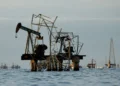












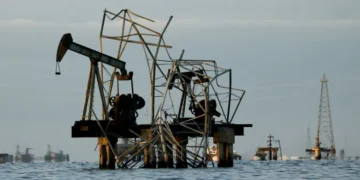






















































Omani authorities have launched an intensive inspection of fish products across local markets following an oil spill that reached the country’s coastline. The Ministry of Agriculture, Fisheries and Water Resources confirmed that the Sultanate’s Food Safety and Quality Centre is actively collecting samples to ensure all seafood meets established health and safety standards.
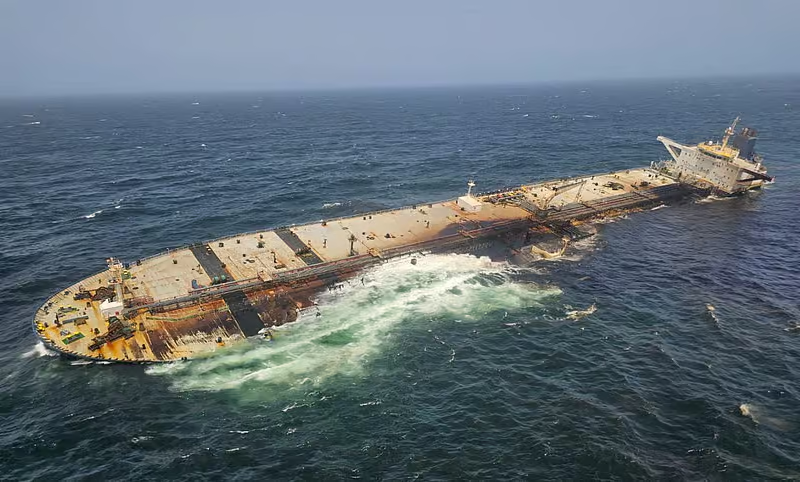
The environmental crisis stems from the sinking of the crude oil tankerCaroline Bezengiwhich occurred on August 6 near Al-Qibliyyah Island, part of the Al Hallaniyat archipelago in the Dhofar region. The vessel, which sails under the Cameroonian flag, measures 274.48 metres in length and 48 metres in width. The incident has prompted an urgent response from national technical teams and specialized experts currently working on-site to mitigate environmental damage.
Recent assessments by the environmental authority identified oil contamination along beaches in the Ras Madrakah area. Experts warn that the slick could extend up to 40 kilometres along the coastal stretch, with the potential to spread toward the southern beaches of Masirah Island within a 10 to 20-kilometre radius. Initial observations indicated the spill began northeast of the Hallaniyat Islands, moving toward the mainland with an observed extension reaching approximately 449 kilometres.
The Ministry has issued a formal advisory to fishermen and maritime users, urging them to strictly follow official instructions. Authorities have requested that the public report any sightings of oil slicks, unusual odors, or anomalies in marine life. Fishermen are specifically cautioned to avoid operating in areas where such indicators of contamination are present.
Operations to manage the disaster include aerial surveillance, marine diving, and continuous field monitoring. The primary technical focus is to contain the spill, maintain the integrity of the ship’s hull, and address internal leaks. A secondary objective involves safely transferring the tanker’s oil cargo before salvaging the vessel in accordance with maritime safety protocols.
The Al Hallaniyat Islands, located about 40 kilometres off the southeastern coast of Oman, are a remote group of five islands known for their ecological significance. Al Hallaniyah, the largest and only inhabited island in the group, is a popular destination recognized for its rich biodiversity, including coral reefs, turtles, dolphins, and whales.
The archipelago is currently under consideration for designation as a UNESCO world heritage site to better protect its fragile ecosystem. The islands serve as critical nesting grounds for various species, including the Masked Booby, Socotra Cormorant, Sooty Gull, and Bridled Tern. Notably, the Socotra Cormorant breeds exclusively on these islands within the context of Oman.
The government emphasized that these monitoring efforts are essential for protecting consumer health and maintaining the safety of the food supply. Officials have underscored the importance of relying solely on information provided by official sources as the situation evolves.
Authorities remain committed to ongoing precautionary measures to protect the marine environment from further deterioration. The cleanup and containment efforts continue as teams work to balance the protection of the islands’ natural heritage with the necessary maritime safety requirements.
The observations had led experts to believe that the slick could expand in the coastal stretch, reaching up to 40 km in length in the same area, also possibly spreading towards the southern beaches of Masirah Island with
The vessel is a crude oil tanker, sailing under the flag of Cameroon, according to Marine Traffic, and is reportedly 274.48 metres in length and 48 metres wide.
Stay up to date with the latest news.
The islands are proposed to be designated as a nature reserve with the UNESCO with the aim of conserving turtle nesting beaches, coral reefs and birds, and sustainable use of fish resources.
Moreover, dolphins and whales can be seen daily.
Al Hallaniyyat is also considered a safe place for birds to lay eggs where their food is guaranteed.
The islands are dominated by seabirds and particularly provide the only nesting sites in Oman and the Arabian Sea for Masked Booby.
Laraib Anwer is a Digital Journalist who loves the thrill of breaking headlines almost as much as she does unapologetically using GenZ slang.
She dreams of a world free of animal cruelty and hopes to tell community stories that make a difference.
Source: Khaleej Times