


























































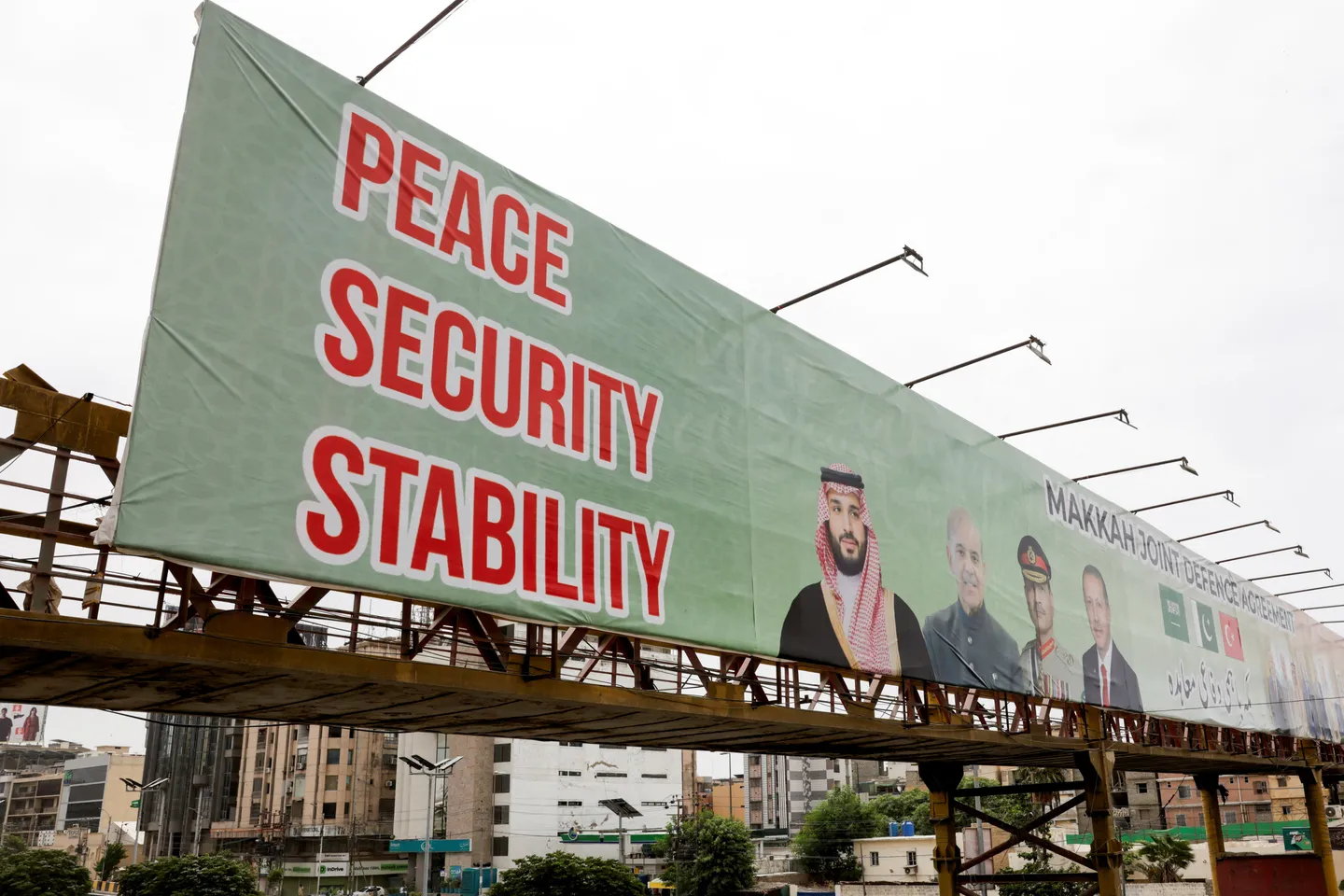
Bringing together Saudi Arabia, Türkiye, and Pakistan—countries with substantial military, economic, and strategic weight—the Mecca Agreement marks a significant development in regional geopolitics. Analysts suggest the pact signals a collective move toward greater security self-reliance, reflecting a growing consensus that Middle Eastern powers must assume more responsibility for their own stability rather than relying solely on external actors.
A defining feature of the agreement is its deliberate lack of a specified adversary. Oral Toga, an expert at the Ankara-based Center for Iranian Studies, notes that this omission is a strategic design choice. “It names no adversary, and Ankara has been deliberate about saying so,” Toga explains. “That omission is the design choice that makes everything else possible, because it lets each signatory keep its existing relationships intact.”
The agreement also reflects a broader reassessment of regional security following the recent Iran-US confrontation and the blockade. For many Middle Eastern governments, these events have underscored the limits of relying on external powers for long-term protection. The regional response has so far reflected the agreement’s flexible design, with Kuwait, Bahrain, and Qatar welcoming the initiative, while others like Egypt and the United Arab Emirates have yet to publicly endorse it.
Ozgur Korpe, an academic at Türkiye’s National Defence University and a military analyst, argues that the agreement’s flexibility is precisely what makes it attractive to countries that may wish to join later. “In this context, it is perceived that the Mecca Agreement gives the impression of a flexible platform open to actors sharing a common vision of stability, rather than an exclusionary structure,” Korpe tells.
Korpe further explains the regional dynamics: “Broad security complexes like the Middle East contain ‘sub-complexes’ within themselves, such as the Gulf or the Levant. It is anticipated that potential participation will occur in a cautious and gradual manner, in accordance with each state’s own sub-regional threat perceptions and security interdependencies.”
Analysts also note that some regional powers must carefully balance a range of existing security and diplomatic partnerships. “Joining means accepting a commitment that could be invoked by someone else’s crisis, and states with dense relationships on multiple sides will weigh that carefully,” Toga says, referring to countries such as Egypt and several Gulf states that maintain complex ties with both Washington and regional rivals.
The agreement’s flexible design has prompted questions about whether the three founding members intend to expand the pact. Analysts believe the answer is yes, with expansion likely to take shape as the institutional framework develops. Qatar is widely seen as one of the strongest candidates to join the framework, given its close defence, political, and economic ties with Türkiye.
The Gulf state has maintained working relations with Iran while simultaneously serving as a key US security partner and an important mediator between Washington and Tehran. This unique position makes Qatar a potential bridge within the evolving security architecture, though experts warn that the path to enlargement will be measured.
Saira Bano, an assistant professor of politics at Thompson Rivers University in Canada, says the agreement is better understood as “an emerging mechanism of regional strategic coordination” than as a NATO-style military alliance. “However, Gulf and Middle Eastern states have different threat perceptions and different relationships with Iran, Israel, and the United States,” she says, adding that this will make “the creation of a unified regional military bloc difficult” in the short term.
Toga shares that assessment, arguing that the agreement’s architects envision “selective growth rather than a wave.” He notes that “President Erdogan’s stated vision is a broader structure rather than a permanent trio.” While the agreement contains a collective security principle similar to NATO’s Article 5, where aggression against one is treated as aggression against all, experts caution against viewing it as a direct Middle Eastern equivalent to the Western alliance.
Regarding the prospect of further growth, experts remain pragmatic. “Expansion is possible, but I would not expect a rapid enlargement into a large formal alliance,” Korpe observes. The focus remains on building trust and establishing the institutional mechanisms that allow for deeper coordination without forcing members to abandon their existing strategic autonomy.
Ultimately, the agreement serves as a message to regional stakeholders. “The perception is clear that this kind of alliance is a message to both Iran and Israel,” Toga tells. While Iran’s constitution prohibits formal military alliances, some analysts suggest that even Tehran could eventually be a candidate for participation, provided the agreement continues to prioritize regional internalisation of security over traditional adversarial balancing.
“Restoring deterrence is the most important objective of the pact, after the war started on 28 February.
“Although it’s initially a result of recent US war on Iran and Iran’s attack on US-related infrastructures in the region, the ultimate goal of this treaty is not to deter or balance Iran rather it is for the means of int
Much will depend on how the agreement develops in practice,” she tells.
Instead, she expects countries to deepen cooperation in specific areas rather than seek full membership.
“Therefore, we may see other countries cooperating with the three states in particular areas such as intelligence sharing, military exercises, maritime security, counterterrorism or defence technology without necessarily becoming full members of the agreement.”
But the deal also aims to enhance strategic diversification, combining the different capabilities each of the three have, with the aim of reducing dependence from the US,” Zaccara tells.
But it doesn’t mean states are forced to respond automatically to the aggressor.
That interpretation is shared by Mohammed Eslami, a political scientist at the European University Institute.
“Although it’s initially a result of recent US war on Iran and Iran’s attack on US-related infrastructures in the region, the ultimate goal of this treaty is not to deter or balance Iran rather it is for the means of internalising the regional security architecture after decades of dependence on major powers,” Eslami tells.
He even suggests that, depending on how the agreement evolves, Iran itself could one day become part of the framework.
“The agreement could represent an early step towards a more autonomous security architecture among influential Muslim majority states.
“If additional states eventually participate and the agreement develops permanent institutions, regular military consultations, joint exercises and clearer mutual defence obligations, then comparisons with a collective security alliance would become more appropriate.”
Source: TRT World