




































































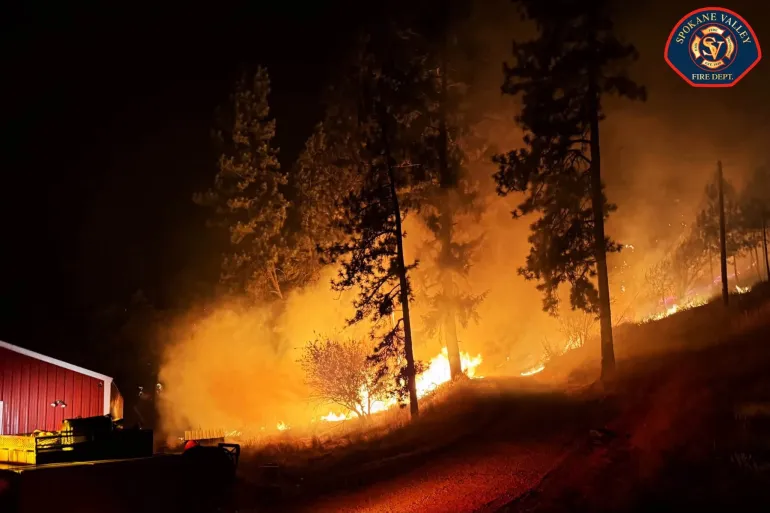
A series of fast-moving wildfires has devastated the outskirts of Spokane, Washington, triggering emergency evacuation orders for approximately 65,000 residents. The blazes, which spread rapidly from surrounding vegetation into residential neighborhoods, have destroyed more than 700 buildings, creating an unprecedented threat to both property and public safety.
The scale of the emergency escalated dramatically over the weekend, with evacuation orders surging from 4,000 people on Sunday to 65,000 by Monday. As search teams begin to access the most severely impacted areas, authorities have confirmed that while no deaths have been reported, the full extent of the destruction remains under assessment. Initial reports of nearly 300 missing persons have decreased significantly as families successfully reunited.
Spokane, the state’s second-largest city, is currently at the center of one of Washington’s most destructive wildfire events in recent history. Three separate fires ignited on the northern outskirts, fanned by strong winds and fueled by exceptionally dry brush. According to the Spokane Valley Fire Department, these fires have consumed more than 8,000 acres, leaving entire neighborhoods reduced to rubble and, in some cases, only brick chimneys standing.
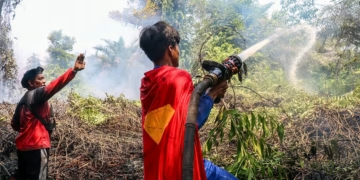
The disaster has strained local resources, leading to one of the largest firefighting mobilizations in the state’s history. More than 1,000 personnel from across the region have been deployed to combat the flames. Despite these efforts, the fires remain uncontained. Officials have established emergency shelters and are urging residents to avoid returning to evacuated zones or operating drones, which could interfere with critical aerial firefighting operations.
Washington is currently enduring one of its most severe wildfire seasons in over three decades, with roughly 450,000 acres burned throughout the summer. Recent major incidents account for more than 250,000 of those acres. In a related development, the Spokane County Sheriff’s Office reported the arrest of a 37-year-old individual on Monday evening on suspicion of arson.
Experts attribute the rapid spread of these fires to a combination of severe drought, an unusually low winter snowpack, and extreme heat. These environmental factors have left vegetation highly flammable. Climate scientists note that while human-caused climate change does not directly spark fires, it creates the hotter, drier conditions that allow blazes to ignite more easily and spread with greater intensity.
The situation is further complicated by the fact that multiple large fires are burning simultaneously across the western United States, stretching national firefighting resources thin. With over 100 new wildfires reported across 15 states in a single weekend, equipment and personnel are being shared across various emergency sites.
While firefighters have utilized a brief window of cooler temperatures and lighter winds to make progress, the outlook remains concerning. Forecasters warn that hotter, drier, and windier conditions are expected to return by midweek. Projections for Thursday indicate temperatures could reach 37 degrees Celsius (99 degrees Fahrenheit), accompanied by low humidity and wind gusts up to 26 km/h, raising fears of further fire growth.
Beyond Washington, the National Interagency Fire Center reports that fire activity remains concentrated in the northwest. In western Idaho and eastern Oregon, a lightning-caused fire has consumed more than 530 square miles of grassland, threatening over 600 homes and 800 other structures in a region dominated by cattle ranches.
In central Utah, another blaze has quadrupled in size since the weekend, reaching nearly 109 square miles by Monday afternoon. Law enforcement officials have confirmed that the fire has resulted in the deaths of more than 100 cattle.
Washington’s congressional delegation is currently awaiting a response from President Donald Trump regarding their request for an expedited emergency declaration. Such a move would provide immediate federal relief to the thousands of families displaced by the ongoing crisis.
As the state prepares for the return of more volatile weather, officials emphasize that the threat is far from over. The convergence of multiple large-scale fires, limited resources, and worsening environmental conditions continues to present a significant challenge for emergency responders working to protect communities and critical infrastructure.
Fanned by strong winds and fueled by exceptionally dry vegetation, the fires have burned more than 8,000 acres (3237 hectares) and spread from surrounding forests and grasslands into residential neighbourhoods, forcing a
While no deaths have been confirmed, authorities initially received nearly 300 reports of missing people after the evacuations, though that number has since fallen significantly as families have been reunited.
Washington is experiencing one of its worst wildfire seasons in more than three decades, with about 450,000 acres (182,000 hectares) burned so far this summer.
The blazes have become the top firefighting priority in the US because of their scale and the danger they pose to communities.
Fanned by strong winds and fueled by exceptionally dry vegetation, the fires have burned more than 8,000 acres (3237 hectares) and spread from surrounding forests and grasslands into residential neighbourhoods, forcing approximately 65,000 people to evacuate, according to the Spokane Valley Fire Department.
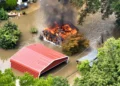
Hundreds of buildings, most of them homes, have already been destroyed, with aerial surveys suggesting many more may have been damaged.
The fires advanced rapidly into populated communities: Driven by strong winds, the flames jumped roads and rivers, allowing them to move from forests and grasslands into residential neighbourhoods.
Drought dries out vegetation, turning forests and grasslands into fuel that can ignite and burn more intensely.
Climate change amplifies these conditions, as rising global temperatures are increasing the likelihood of prolonged droughts, more frequent heatwaves and longer fire seasons, making large, destructive wildfires more likely once they ignite.
Extremely high temperatures, particularly on Thursday, with highs forecasted up to 37 degrees Celsius (99 degrees Fahrenheit).
Gusty winds with speeds up to 26 km/h.
Because the fires remain completely uncontained, authorities are keeping evacuations in place.
They warn that the worst outcome would be letting residents return to their homes, only to have to evacuate them again 24 to 48 hours later when the hot, windy weather returns.
Right now, the major fires are mostly grassland burns in Idaho, Oregon and Utah, as well as fires in Florida’s Everglades National Park, in addition to new fires reported in Left Creek in Wyoming, Antelope Creek Fire in Nevada and the Sand Creek and Middle Coulee fires in Montana.
A lightning-caused fire that has burned more than 530 square miles (about 1,370 sq km) of grassland in western Idaho and eastern Oregon continued to grow on Monday.
In central Utah, a blaze quadrupled in size more than the weekend to nearly 109 square miles (282 sq km) by Monday afternoon.
Source: Aljazeera