










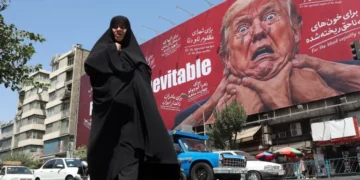


























































Tehran is currently recalibrating its military and economic strategies as the United States prepares to implement a series of measures aimed at the total collapse of the Iranian government. US President Donald Trump recently announced what he described as the “most crushing economic operation” against the nation, warning that Iran faces unprecedented isolation and economic warfare.
In response, Iranian officials have emphasized the resilience of their domestic defense industry. During the National Day of Defence Industry, Chief of Staff of the Armed Forces Ali Abdollahi praised a “deterrent defensive industrial revolution.” While the military opted not to display new hardware this year, Ministry of Defence spokesperson Reza Talaei-Nik explained that the government is limiting public unveilings to safeguard sensitive information and maintain a strategic advantage.
Talaei-Nik asserted that in the year following the 12-day conflict with Israel and the US in June 2025, Iran doubled its production of defensive equipment. Since the current hostilities began on February 28, he claimed that output for strategic products has tripled. He further noted that over 9,300 domestic companies are involved in the defense sector, making it difficult for foreign strikes to dismantle the nation’s manufacturing capacity.
The assessment of Iran’s capabilities remains a point of contention. The White House has claimed that 85 percent of Iran’s defense-industrial base has been decimated, including the majority of its long-range drones, ballistic missiles, and mobile launchers. Furthermore, US officials reported that 150 warships were destroyed, all submarines were sunk, and 97 percent of the naval-mine inventory was eliminated. However, a confidential US intelligence assessment from May suggested that Iran still retained roughly 75 percent of its mobile launchers and 70 percent of its pre-war missile stockpile.
Military experts observe that Iran has successfully utilized geographically dispersed underground bases to continue production, shielding manufacturing lines from US airstrikes. Acting Defence Minister Majid Ebn-e Reza noted that the armed forces have achieved greater strike accuracy and improved air defense interceptions compared to previous engagements. IRGC spokesperson Hossein Mohebbi added that the development of new ballistic and cruise missile warheads continues unabated.
The conflict has seen significant losses on both sides. Despite the failure of Iran’s aging air force to prevent airspace breaches, smaller heat-seeking and electro-optical systems have managed to down an F-15 fighter jet. Additionally, reports indicate that at least 45 US MQ-9 Reaper drones—roughly a quarter of the fleet valued at over $1.3 billion—were lost to Iranian fire or operational failures.
While a truce has been in effect since April 8, the situation remains volatile. Even after intense US bombardment in July, Iranian forces continued to target US bases and shipping in the Strait of Hormuz. Although oil flows through the strait remain below pre-war levels due to these attacks, the US and its allies have managed to increase discrete energy transfers. Meanwhile, the Houthis in Yemen continue to disrupt traffic in the Red Sea and Bab al-Mandeb strait.
IRGC commander-in-chief Ahmad Vahdi warned on Friday that the nation must rely on intelligent solutions to neutralize enemy plots. With no meaningful diplomatic dialogue between Washington and Tehran, the prospect of a peaceful resolution to the ongoing war remains distant. The report also notes that “The only intelligent and effective solution to navigate difficult historical junctures and neutralise the enemy’s plots today and in the future,” Ahmad Vahdi, commander-in-chief of the Islamic Revolutionary Guard Corps (IRGC), warned on Friday. The report also notes that authorities opted not to exhibit new arms, but as happened last year. The report also notes that talaei-Nik also said more than 9,300 companies in Iran are involved in producing weapons, which means US and Israeli strikes would not be able to destroy this sector. The report also notes that which took hold on April 8, followed nearly 40 days of intense bombing and involved thousands of flight sorties, the truce between the US and Iran. The report also notes that and the military was ready to counter any such efforts by Washington, iranian commanders have said the July strikes by the US signalled potential planning for ground operations in southern Iran. The report also notes that cheaper and easier-to-make explosive drones have helped Iran consume a large number of US interceptors, reveal radar positions, force airports or energy sites to suspend operations, and create disruptions in the Strait of Hormuz, in addition to the more complex and costly ballistic missiles.
Source: Al Jazeera