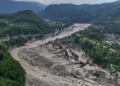








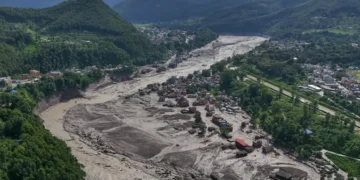
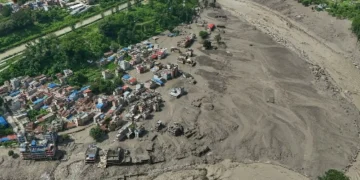






























































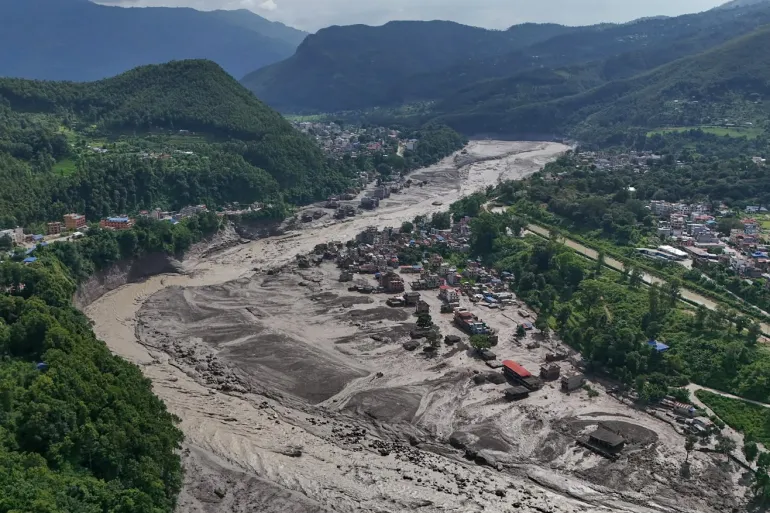
A catastrophic flash flood has swept through regions near the Nepal-Tibet border, resulting in at least 160 confirmed deaths and leaving hundreds of people missing. The disaster destroyed numerous villages, bridges, roads, and critical power infrastructure, according to local authorities. Nepali police reported late Wednesday that 157 bodies had been recovered, while search teams continue to evacuate residents from high-risk zones.
The scale of the crisis is significant, with the Ministry of Tourism confirming that 403 tourists, including 341 foreign nationals, remain unaccounted for. The missing foreigners include 142 Indian citizens, along with individuals from the United Kingdom, Australia, Malaysia, the Netherlands, Portugal, South Africa, South Korea, and the United States. Additionally, 28 police personnel are currently listed as missing.
Across the border in Tibet’s Gyirong county, Chinese authorities reported at least three deaths and 265 people missing. A mudslide in the area severed road access, communications, and power lines in the Shigatse region. President Xi Jinping has called for an all-out search effort and emphasized the need for improved early warning systems to mitigate future disasters.
In Nepal, Prime Minister Balendra Shah has urged national unity, pledging that the government will take full responsibility for rescue, medical treatment, and essential supplies. Shah convened an emergency meeting of the National Disaster Risk Reduction and Management Authority to coordinate efforts with the Red Cross, medical teams, and scouts. The Nepal Army has deployed helicopters and disaster response units to the affected areas, though officials noted that high water levels have hampered landing operations in the mountainous Rasuwa district.
The economic impact is substantial, with the Nepal Electricity Authority reporting damage to approximately 430 megawatts of production capacity, including solar and hydropower facilities. Among those missing are eight South Korean workers employed by Korea Energy and Doosan Enerbility Co. at a local hydropower plant. The South Korean government has established a task force and is preparing to send a rapid-response team to assist in the search.
Climate experts at the International Centre for Integrated Mountain Development believe the flooding was likely triggered by an ice-rock avalanche from a glacier on the Nepal side. This event blocked the Lhende Khola River, a tributary of the Bhote Koshi, causing a sudden, massive surge of water downstream. Saswata Sanyal, a disaster risk reduction specialist, noted that the Lhende Khola has flooded twice in the last 14 months due to similar glacial instability.
The Bhote Koshi River, which originates in Tibet and flows into Nepal’s Trishuli River before reaching India, has a history of such disasters. Last year, a flood triggered by the drainage of a supraglacial lake killed nine people and destroyed the “Friendship Bridge” between Nepal and China. As the region faces the annual monsoon season, climate activists like Prayash Adhikari warn that while the current climate catastrophe cannot be fully reversed, urgent investment in early warning systems is essential to protect vulnerable communities.
Government spokesperson Sasmit Pokharel confirmed that Nepal has requested assistance from both India and China to bolster rescue operations. Meanwhile, authorities in the Indian state of Bihar have begun evacuations in six districts as a precautionary measure against potential downstream flooding. As search and recovery efforts continue, officials are working to verify casualty figures and assess the full extent of the destruction caused by the sudden torrents. The report also notes that police spokesman Abi Narayan Kafle said that 28 police personnel were also missing. The report also notes that state broadcaster CCTV said that specific casualty figures were still being verified. The report also notes that we all need to stand together,” Shah said in a statement shared on social media, in times of such a disaster. The report also notes that with a population of about 50,000, officials said, the waters were too high for helicopters to land in Nepal’s affected areas of Syapru Besi and Timure in the mountainous district of Rasuwa. The report also notes that pointing to reports that nearby villages and infrastructure project sites were washed away, district administrator Narendra Pariyar urged those living on the banks of the Bhote Koshi River in the area to seek higher ground. The report also notes that cutting off roads, communications and power in the Shigatse region, Xinhua added, without giving details, the mudslide hit China’s Gyirong port. The report also notes that “Hundreds of people are missing,” Adhikari said from Kathmandu, stating it wiped out buildings, schools, bridges and highways.
Source: Al Jazeera