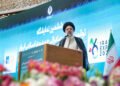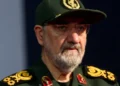







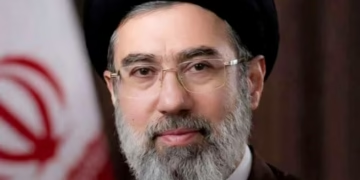
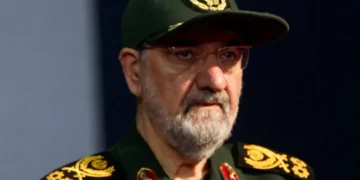






































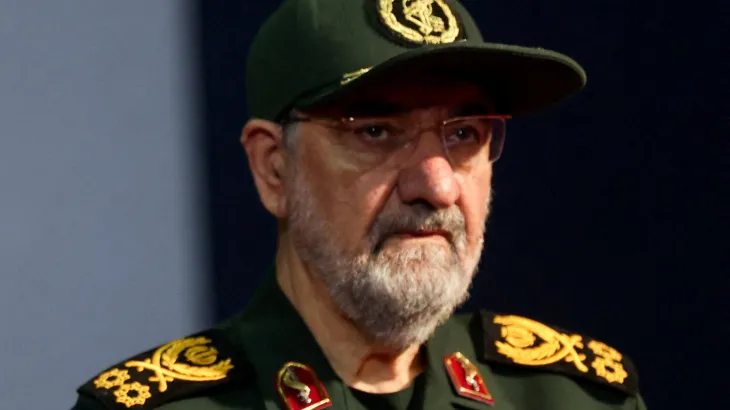
Tehran has announced a significant restructuring of its security apparatus, with the office of Supreme Leader Mojtaba Khamenei appointing a veteran Islamic Revolutionary Guard Corps (IRGC) commander to lead the country’s primary security body. Mohsen Rezaee, who served as the IRGC’s commander-in-chief for 16 years—a tenure that spanned the intense Iran-Iraq war during the 1980s—has been named the secretary of the Supreme National Security Council (SNSC) and the Supreme Leader’s representative to the council.
The move is part of a broader shake-up within the military leadership. On Monday, six additional high-level military positions were filled. Ali Abdollahi, previously the head of Iran’s joint war command, has been appointed as the new chief of staff of the armed forces. Concurrently, Ali Ozmaei has been named the new head of the IRGC Navy. Furthermore, Brigadier General Ahmad Vahidi has been confirmed as the commander-in-chief of the IRGC with the rank of major general, officially succeeding Mohammad Pakpour, who was killed during the initial phase of the US-Israel war on Iran in late February.
Sina Azodi, an assistant professor of Middle East Politics at George Washington University, noted that these appointments indicate a firm stance against any softening in negotiations with the United States. According to Azodi, there is little doubt that Khamenei, Vahidi, and the broader IRGC leadership share a consensus that continued resistance against the US remains a strategic necessity. He added that Rezaee’s appointment is likely intended to bolster internal cohesion and leverage his significant authority among both the rank-and-file and senior commanders.
Rezaee brings extensive institutional experience to the role. Following the Iraq war, he transitioned into politics and macroeconomics, serving as the secretary of the Expediency Council, a key state arbitration body. The 71-year-old also played a role in developing a long-term national development plan and held high-level economic coordination authorities during the presidency of Ebrahim Raisi from 2021 to 2024. Despite his long career, he has never held an elected office.
Rezaee returned to a prominent military role during the ongoing conflict, serving as a military adviser to the Supreme Leader shortly after Mojtaba Khamenei succeeded his father, Ayatollah Ali Khamenei, in early July. His political trajectory has been marked by a staunch opposition to diplomatic overtures. Regarding the memorandum of understanding (MoU) signed with the US in June—which temporarily suspended oil sanctions and lifted a naval blockade to reopen the Strait of Hormuz—Rezaee expressed strong disapproval.
In early July, shortly before that agreement was suspended amid renewed hostilities, Rezaee urged those opposing negotiations to wait, claiming the Americans would inevitably undermine the process themselves. More recently, he warned that the US must alter its behavior or face serious risks and casualties to its forces, explicitly stating that Iran would never permit the opening of a second corridor in the Strait of Hormuz.
The internal political dynamics surrounding his appointment were reportedly complex. Local media indicated that President Masoud Pezeshkian had initially resisted replacing the former security chief, Zolghadr, with Rezaee. While Zolghadr was considered a hardline but pragmatic figure, he lacked the deep political connections and seniority of Rezaee. Reports suggest that after the Supreme Leader insisted on the change, Zolghadr was moved to a different post.
The SNSC serves as a critical nexus for the Iranian state, bringing together the presidency, the foreign ministry, the armed forces, and various intelligence organizations. It also facilitates communication with the office of the Supreme Leader, which holds final authority over all strategic decisions. State-linked outlets reported that 12 out of 13 voting members of the council had supported the earlier MoU with the US, with ultraconservative Saeed Jalili being the sole dissenter.
The appointment has drawn sharp criticism from abroad. Israel’s Ministry of Foreign Affairs condemned the move, stating that the Iranian regime rewards the architects of terror by promoting them to the highest levels of power. Rezaee’s history of rhetoric against the US remains a point of contention; in July 2015, he famously suggested that if the US attempted a military attack, Iran would capture at least 1,000 American prisoners in the first week, who could then be used to resolve Iran’s economic issues through multi-billion dollar ransoms.
State television has sought to frame Rezaee’s appointment through the lens of his wartime experience, airing segments that highlight his military logic. Meanwhile, the regime is working to project stability. An official with the IRGC’s Basij paramilitary organization announced that state media would soon release new images of the Supreme Leader to counter rumors from the US and Israel regarding his health.
To further project unity, President Pezeshkian mentioned on Monday that he had held a seven-hour meeting with the Supreme Leader, during which the importance of national cohesion was emphasized. The state-linked Mehr news service also recirculated older, undated footage of the Supreme Leader meeting with clerics to maintain a public image of continuity.
As Iran navigates the ongoing regional conflict, the consolidation of these figures into key security roles suggests a hardening of the state’s strategic posture. With the military and security apparatus now under the guidance of veteran commanders, the leadership appears focused on maintaining a unified front against external pressures while managing internal economic and political challenges.
It rejected the notion that Zolghadr was removed for failure or dissatisfaction or that the government opposed the appointment, adding that Rezaee could better integrate military, diplomatic, economic and energy policy t
“The central issue is not one secretary’s departure and another’s arrival, but how consequential the steps taken by the SNSC secretariat in this new phase will be,” Nournews said.
But Ghalibaf was among senior officials who released congratulatory messages on Monday for Rezaee – as did Vahidi and newly reappointed judiciary chief Gholam-Hossein Mohseni-Ejei.
Since then, he has projected a message of defiance and resilience to the US, Israel and regional actors during interviews with media and posts online.
He argued that his position was closer to that of Mojtaba Khamenei, who ended up approving the MoU despite stated reservations.
But a number of hardline MPs, media and supporters of the Islamic Republic blasted the agreement as they believe the strait should not have been allowed to reopen until the US gives more concessions.
But he was immediately appointed as political adviser to Khamenei, who has himself not been seen or heard from publicly since the start of the war.
An official with the IRGC’s Basij paramilitary organisation said this week that state media will soon release new pictures from the supreme leader taken after the war to disprove claims by the US and Israel that he may have been badly wounded in the same February 28 strikes that killed his father and other top commanders.
It rejected the notion that Zolghadr was removed for failure or dissatisfaction or that the government opposed the appointment, adding that Rezaee could better integrate military, diplomatic, economic and energy policy to overcome “siloed management”.
Analysts have noted that Zolghadr was close to Mohammad Bagher Ghalibaf, Iran’s parliament speaker and chief negotiator in talks with the US, so his replacement could also be an attempt to tame Ghalibaf’s growing influence.
Vahidi, among the most powerful people in Iran at the moment, said Rezaee’s presence in the council can “advance a strategic coordination between the field of battle and diplomacy, as well as economic and political security with an approach of resistance and hope-inducing governance”.
“The whole world has clearly seen over the past year-and-a-half that our country is a country of institutions, not individuals.
This was exactly the secret of the longevity and victory of the Islamic Republic in these challenging conditions,” spokesman Esmaeil Baghaei told reporters during a news conference on Monday.
Israel reacted harshly to the appointment, pointing out that Rezaee – along with Vahidi – is subject to an Interpol Red Notice for his alleged role in the 1994 bombing of a Jewish centre in Argentina’s capital, Buenos Aires, which killed 85 people.
After the appointment, some Iranian users online remembered a number of Rezaee’s controversial comments that made headlines over the years.
In one such comment in July 2015, months before Iran signed a landmark accord with world powers that lifted sanctions in exchange for nuclear curbs, Rezaee suggested readiness for a US ground assault on Iranian soil.
“If the Americans want to look at Iran with ill intent or think about a military attack, they can be sure that in the very first week we will capture at least 1,000 Americans as prisoners,” he told state television.
“Then, to free each of them, they will have to pay a few billion dollars, which could resolve many of our economic problems.”
A number of hardliners in Tehran also appeared pleased with the change at the security council as a hardline figure, unafraid of military confrontation, was taking charge, with some using it to attack Pezeshkian’s pro-deal government.
Source: Aljazeera