










































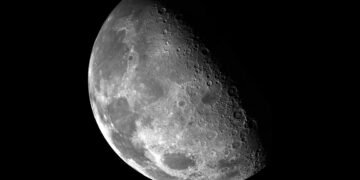
























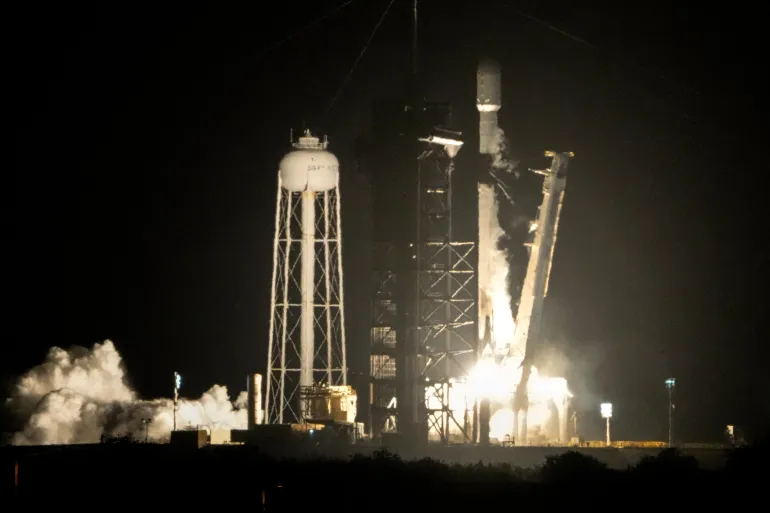
A four-tonne piece of debris from a SpaceX rocket, roughly the size of a school bus, has collided with the Moon. Tracking data confirms the object, identified as the second stage of a Falcon 9 rocket launched in early 2025, impacted the lunar surface near the Einstein Crater early Wednesday. Traveling at approximately 8,700 kilometres per hour (5,400 miles per hour), the debris struck with the force of about three tonnes of TNT.
While rocket components typically re-enter Earth’s atmosphere to burn up or land in the ocean after completing their missions, this piece followed a different trajectory. Over an 18-month period, the combined gravitational influence of the Sun, Earth, and Moon shifted its path, leading to an unavoidable lunar collision. Julianna Scheiman, SpaceX’s director of NASA science and Dragon programmes, explained on Monday that the incident resulted from a combination of solar activity and gravitational forces, noting that the trajectory was unintentional and unavoidable due to the vehicle’s remaining fuel.
Space tracking expert Bill Gray noted that while the event poses no immediate danger, it underscores concerns regarding the management of discarded space hardware. “It doesn’t present any immediate danger, though it does highlight a certain carelessness about how leftover space hardware is disposed of,” Gray told The Associated Press, adding that the orbital environment is becoming increasingly crowded.
To capture data from the event, NASA’s Lunar Reconnaissance Orbiter and South Korea’s Danuri spacecraft have repositioned their sensors to observe the impact site. Although daylight will obscure the initial flash, these orbiters are tasked with analyzing the resulting dust plume and capturing high-resolution imagery of the new crater. This incident is only the second recorded instance of accidental space debris hitting the Moon; the first occurred on March 4, 2022, when a Chinese Long March 3C rocket stage from a 2014 mission created a unique double crater on the lunar far side.
But over 18 months, gravitational forces exerted by the Sun, Earth, and Moon gradually altered its flight path, setting it on an inevitable collision course.
Such rocket hardware typically re-enters Earth’s atmosphere to burn up or splash down into remote ocean zones after delivering payloads into orbit.
Source: Aljazeera