





























































The Supreme Court ruled 6-3 on Monday to allow the Trump administration to proceed with key components of an executive order designed to tighten mail-in voting regulations. The decision grants emergency relief requested by the Justice Department, which had sought to lift a lower court injunction that previously blocked federal agencies from carrying out the directive.
In an unsigned opinion, the high court determined that the coalition of 23 Democratic-led states that challenged the order had filed their lawsuit prematurely. The justices emphasized that their ruling does not validate the legality of the government’s specific measures, noting that the order itself did not cause immediate harm to the states, thereby rendering the district court’s initial intervention jurisdictionally flawed.
This ruling enables the Department of Homeland Security (DHS) to advance a proposal aimed at creating lists of eligible voters in each state. Additionally, it clears the path for the Postal Service to finalize rules for federal mail ballot envelopes. The Postal Service recently published a final rule establishing design requirements for these envelopes and plans to generate state-specific “Mail-In and Absentee Participation Lists” for election officials on Election Day.
The Postal Service has clarified that it will not participate in determining voter eligibility, maintaining voter rolls, or counting ballots. The agency stated it would act immediately to implement these new rules for the upcoming November midterm elections now that the government has secured relief from the lower-court injunctions.
The legal battle originated in March after President Trump signed the executive order. A group of 23 Democratic-led states and the District of Columbia sued to block the proposals, arguing that the president lacks the constitutional authority to dictate how states administer federal elections. A separate group of 12 Republican-led states intervened in the case to support the administration.
In June, U.S. District Judge Indira Talwani ruled in favor of the Democratic-led states, concluding that the Constitution grants states the sole authority to determine voter-eligibility requirements. The Justice Department appealed that decision, but the U.S. Court of Appeals for the 1st Circuit declined to stay the injunction, prompting the administration to take the matter to the Supreme Court.
Solicitor General D. John Sauer argued in filings that the executive order serves as an internal directive for future policymaking and that the states’ legal challenge was premature. He contended that the district court’s injunction was “extraordinary” and “indefensible,” particularly as mail voting is set to begin in several states within weeks.
Conversely, the Democratic-led states warned that the order would cause widespread confusion and potentially disenfranchise millions of voters. They argued that the administration’s program for voter verification and ballot interception is legally indefensible and forces states to divert significant resources to comply with the new federal mandates.
The Supreme Court’s decision does not prevent states from filing new lawsuits to challenge the specific policies once they are finalized and implemented. However, the ruling marks a significant victory for the administration’s efforts to exert federal control over election procedures.
Three liberal justices dissented from the majority. In her dissenting opinion, Justice Sonia Sotomayor, joined by Justice Elena Kagan, argued that the court’s decision “merely postpones adjudication” of the underlying constitutional issues. Sotomayor noted that the ruling fails to address whether the president’s attempts to interfere with state-run elections are lawful.
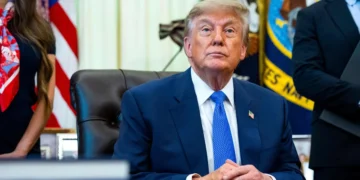
President Trump has frequently criticized mail-in voting and has alleged that significant numbers of noncitizens participate in federal elections, although he has not provided evidence to support these claims. The administration maintains that its directives are necessary to promote election integrity.
While a separate case involving voting-rights groups remains active in Washington, D.C., where lower courts previously declined to block the directive, the Justice Department is expected to argue that the Supreme Court’s latest ruling applies to that litigation as well. The report also notes that today’s decision does not address whether the President’s attempts to interfere with States’ administration of the November 2026 elections are lawful,” Sotomayor wrote in a dissenting opinion. The report also notes that since returning to the White House for his second term, Mr. The report also notes that the provisions at issue in the case direct DHS to compile “state citizenship lists” using federal databases and call for the Postal Service to deliver mail ballots cast only by individuals who are on its own voter-eligibility lists. The report also notes that in order to identify potentially anomalous incidents that may merit further investigation, the new rule said the lists are “primarily intended to assist election officials and law enforcement to understand who may have been mailed a ballot. The report also notes that the U.S, but in a 2-1 decision late last month. The report also notes that respondents’ real concern is not with the Order itself — which does not require anyone outside the government to do (or refrain from doing) anything — but with possible harms that may arise depending upon what specific actions the agencies ultimately decide to take in implementing the President’s directives. The report also notes that the state and local election administrators would be forced to divert time and resources away from election-preparation work “to compile and convert voluminous data for submission to USPS, train elections officials, educate voters, and change their ballot envelopes,” the attorneys general said, without the injunction from the lower court.
Source: CBS News