






































































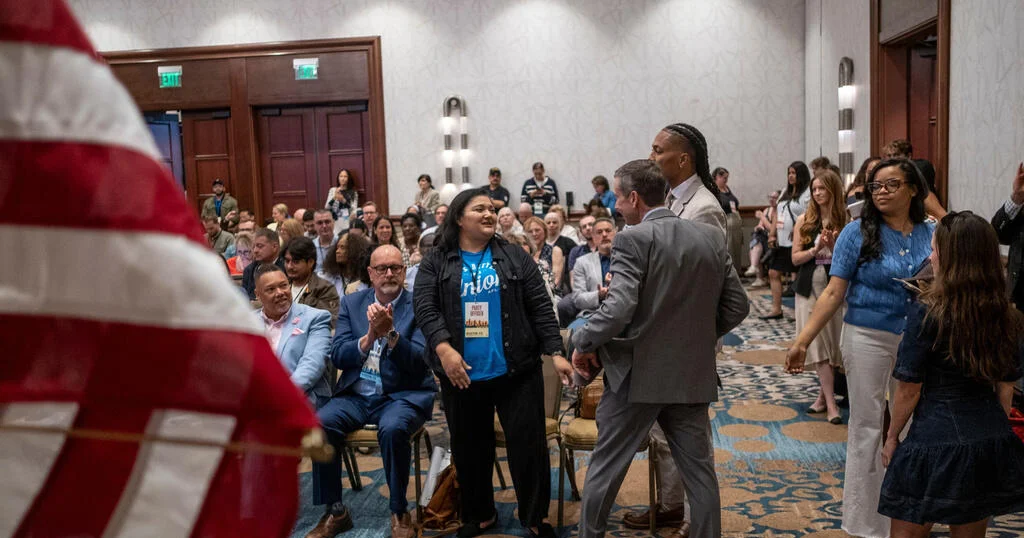
The Democratic National Committee (DNC) officially ratified a new presidential nominating calendar for the 2028 election cycle during its summer gathering in Austin. The approved schedule formally establishes South Carolina as the inaugural state to hold its primary on January 22, 2028, followed by Nevada on February 1. The remainder of the early-state lineup, which includes New Hampshire, New Mexico, Michigan, and Virginia, is set to conduct nominating contests throughout February, all concluding prior to Super Tuesday.
DNC Chair Ken Martin emphasized that the decision represents a strategic shift for the party. “This is much bigger than a lineup of dates on a calendar,” Martin stated. “This is about our approach to winning back the presidency. It’s about the kind of Democratic Party and the kind of country we aspire to be.” The move reflects a broader effort to move away from the traditional dominance of Iowa and New Hampshire, states with predominantly White populations, in favor of regions that better represent the party’s diverse coalition.
Democratic strategist and contributor Chuck Rocha noted that the new schedule serves as a signal of respect to Black and Latino voters, who are essential to the party’s electoral success. “If you’re not strong with Latino voters or if you’re not strong with Black voters, you know you can only get so far in this calendar,” Rocha explained.
The shift has drawn criticism from traditional early-voting states. New Hampshire’s congressional delegation argued that their state remains a vital, tested proving ground that forces candidates to engage directly with voters rather than relying on super PACs or large-scale donor funding. Similarly, Iowa Democratic Chair Rita Hart criticized the change as a product of “broken promises” that fails to ensure the selection of the strongest possible nominee, arguing it excludes significant portions of the electorate.
The DNC has taken a firm stance against potential defiance. During the 2024 cycle, New Hampshire ignored the party’s revised schedule to maintain its state-mandated first-in-the-nation status, leading the DNC to strip the contest of its sanctioned standing. Martin warned that any attempt by New Hampshire to jump ahead in 2028 would result in more severe consequences, asserting, “This is a calendar this party is actually going to protect.”
With no clear front-runner for the 2028 nomination, the new calendar is expected to significantly influence the ideological direction of the party. The early states offer varying advantages for different factions: while Nevada and New Mexico are viewed as favorable to progressives, South Carolina and Virginia have historically leaned toward more moderate candidates. Michigan presents a more complex landscape, having demonstrated openness to progressive figures alongside a history of electing moderates.
This restructuring also addresses the party’s need to counter Republican gains among minority voters. According to Pew Research Center data, Donald Trump secured 48% of the Hispanic vote in 2024—a 12-point increase from 2020—and nearly doubled his share of Black voters to 15%. Meanwhile, his support among non-Hispanic White voters remained steady at 55%. By elevating states with large Black and Hispanic populations, Democrats aim to better align their primary process with the demographics necessary to compete in general elections.
Momentum for South Carolina’s ascension in the calendar traces back to 2020, when a victory there shifted momentum in the presidential primary that year to Joe Biden after he performed poorly in Iowa, New Hampshire and
Under pressure from Biden and his allies, the DNC moved South Carolina’s primary to first for the 2024 calendar.
With no obvious 2028 front-runner, the newly approved schedule gives South Carolina, Nevada and the other four early states disproportionate influence over which faction can build early momentum in the 2028 presidential
The new calendar goes into effect amid a tug-of-war within the progressive and establishment wings of the party.
“As a state with highly engaged voters, we put candidates through their paces and thoroughly vet them.
And our small size means that actually meeting and talking to voters takes precedence over super PACs or mega-donor-fueled campaigns.”
“It’s a product of broken promises, and it excludes huge swaths of the country and the voters that Democrats need to win, the kind of majorities it takes to restore Democratic principles and reject this misguided and corrupt Trump administration,” she said.
Momentum for South Carolina’s ascension in the calendar traces back to 2020, when a victory there shifted momentum in the presidential primary that year to Joe Biden after he performed poorly in Iowa, New Hampshire and, to a lesser extent, Nevada.
With no obvious 2028 front-runner, the newly approved schedule gives South Carolina, Nevada and the other four early states disproportionate influence over which faction can build early momentum in the 2028 presidential primaries.
New Hampshire voters have over time shown an openness to outsiders, but they typically have a more independent streak rather than a steep ideological lean.
Source: CBS News