






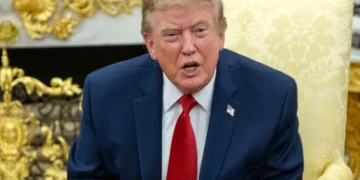
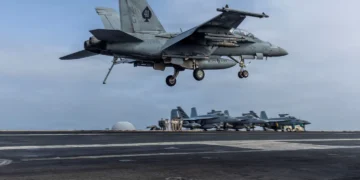
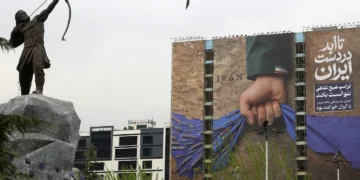






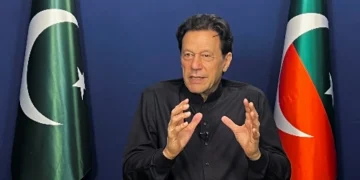











































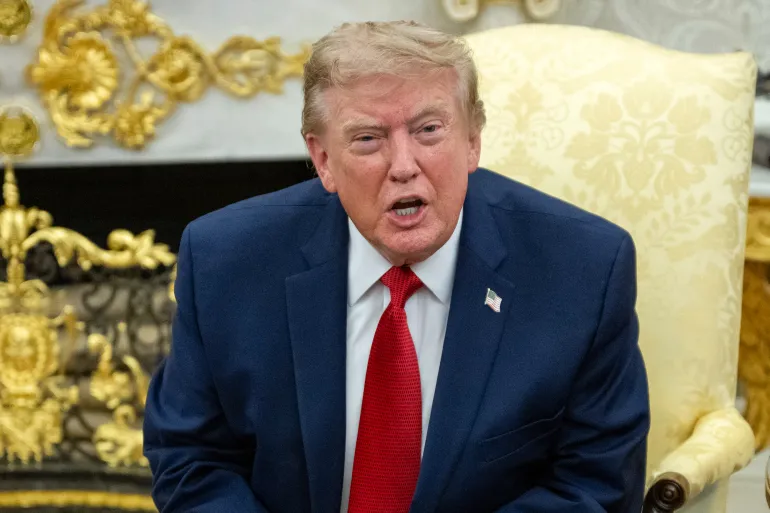
President Donald Trump stated on Tuesday that the United States is not currently engaged in, nor has it scheduled, any diplomatic discussions with Iran. In a social media update, the president maintained that the naval blockade of Iranian ports remains “in full force and effect,” while asserting that other maritime traffic is free to navigate the region. To underscore his position, Trump shared a map on his Truth Social account labeling the Strait of Hormuz as “New US Territory,” a move that echoes his previous threats to claim the waterway following demands for an Iranian surrender.
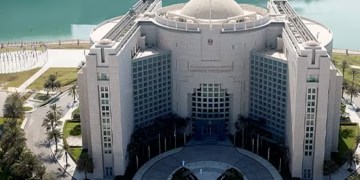
This latest declaration marks a significant shift from his comments just one day earlier, when he claimed the US was holding back-channel discussions with Iran’s Islamic Revolutionary Guard Corps (IRGC). Tehran quickly refuted that assertion. Kazem Gharibabadi, Iran’s deputy foreign minister for legal and international affairs, responded to the president’s social media post by suggesting that Trump’s “delusion” regarding the strait would eventually be corrected.
Despite the public posturing, a US official informed Al Jazeera that “positive talks” with Iran have been ongoing. The official explained that Trump has currently “decided to wait” and has instructed his team to pause negotiations until Tehran is prepared to finalize a deal, insisting there is “no conflict” within the administration regarding this strategy. Meanwhile, Qatar reported on Tuesday that regional mediators are waiting for an expected agreement between Iran and Oman before attempting to facilitate a resumption of direct talks between Washington and Tehran.
The impasse remains centered on the memorandum of understanding (MoU) signed in June. Top Iranian negotiator Mohammad Bagher Ghalibaf stated in comments published by state media on Tuesday that the Strait of Hormuz will remain closed until the United States fulfills the terms of that agreement. According to Ghalibaf, these conditions include the lifting of the naval blockade and oil sanctions, the release of frozen Iranian assets, and a complete cessation of military operations and threats against the country.
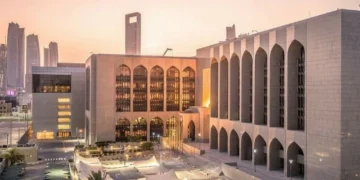
The diplomatic stalemate has been accompanied by a surge in regional military activity. On Tuesday evening, the United Arab Emirates issued a missile threat alert after its Defence Ministry reported that air defenses had “detected two ballistic missiles launched from Iran.” The ministry confirmed the projectiles landed in the sea and stated that it remains on high alert to address any further threats.
The broader conflict also saw escalation in Syria, where state media reported that eight airstrikes hit the Abu al-Duhur military base in the eastern countryside of Idlib on Tuesday. While no casualties were reported, the strikes caused significant damage. Several nations, including the US, have attributed the attack to Israel. Tom Barrack, the US special envoy for Syria and Iraq, condemned the incident as an “unnecessary escalation that does not advance regional stability.”
The current situation highlights a complete breakdown in progress toward restoring maritime traffic and achieving a lasting peace. With both sides entrenched in their respective demands and military posturing intensifying across the Middle East, the prospect of a diplomatic breakthrough appears increasingly distant. The report also notes that all water mines have been removed or detonated,” Trump posted. The report also notes that “Just as Trump correctly wrote the name of the eternal Persian Gulf, soon his delusion regarding the Strait of Hormuz will either be corrected or we will correct the delusions of this deluded man,” Gharibabadi wrote on social media. The report also notes that threatening to extend the conflict, the rhetoric emerging on both sides illustrates that outward progress towards peace talks and the return of maritime traffic through Hormuz has ground to a halt.
Source: Aljazeera