







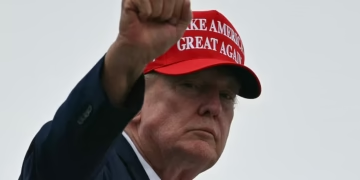














































President Donald Trump once famously argued that a president’s credibility hinges on the ability to enforce declared red lines. Nearly six months into the ongoing conflict with Iran, he now faces that very test as a series of military threats and deadlines have passed without the promised consequences. Despite his warnings of severe repercussions, Iran continues to defy U.S. pressure, and the Strait of Hormuz remains under heavy restrictions.
The administration’s rhetoric has recently expanded to include Oman, with the president threatening to bomb the Gulf nation if it interferes with U.S. maritime operations. This escalation comes at a delicate time, as Iran reportedly finalizes a shipping agreement with Muscat. Washington fears that such a deal could solidify Tehran’s control over a vital global energy corridor, potentially forcing the U.S. to reconsider its current maritime blockade.
A pivotal moment occurred on July 22, when Trump issued a stark ultimatum: for every Iranian attack on a ship in the Strait of Hormuz, the U.S. would “bomb and destroy ONE BRIDGE OR POWER PLANT.” Although the UAE subsequently linked attacks on Abu Dhabi National Oil Company vessels to Iran, there has been no evidence that Washington followed through with retaliatory strikes against Iranian infrastructure. These expired deadlines have led to growing skepticism regarding the administration’s resolve.
Danny Citrinowicz, a former head of the Iran branch of Israeli military intelligence, warns that targeting Oman could further erode Washington’s standing among its regional allies. “The Gulf States are actually quite disappointed from the US behaviour during the war itself, and the fact that they didn’t manage to protect them,” said Citrinowicz, now a senior fellow at the Institute for National Security Studies. He noted that the administration is currently trapped between poor options, eventually forcing a choice between escalation and capitulation.
Democratic Senator Mark Kelly, a U.S. Navy veteran, has also voiced concerns regarding the strategy. He described Oman as a critical security partner and an essential intermediary in negotiations with Tehran, questioning the wisdom of threatening a nation so vital to diplomatic efforts.
The current situation stands in sharp contrast to the principles Trump championed during his 2016 campaign. At the Republican convention, he criticized the Obama administration’s failure to enforce a red line regarding chemical weapons in Syria, calling it a “humiliation” that signaled weakness to the world. At the time, Trump declared, “The United States no longer makes empty threats. When I make promises, I keep them.”
Whether that principle remains intact is now being tested by Tehran. While the administration has occasionally cited diplomatic progress as a reason for restraint, these negotiations have repeatedly failed to yield a lasting settlement. As the standoff continues, the core issue for the White House is no longer just the success of any single threat, but whether regional adversaries and Gulf partners still believe the next one.
Beyond the geopolitical tensions, other developments continue to impact the administration’s agenda. Recent reports indicate that an Indian woman has been detained by ICE after 27 years in the U.S., while the president faces record-low approval ratings amid public anxiety over the duration of the war. Meanwhile, in the corporate sector, OpenAI is preparing to lease a new U.S. data center backed by Nvidia, and envoy Jared Kushner has characterized recent U.S.-Iran talks as “positive.” The report also notes that the warning comes at a particularly sensitive moment. The report also notes that but the bigger question is whether repeated threats that are not followed by action are strengthening Trump’s negotiating position — or gradually weakening it. The report also notes that but convincing an adversary that there are consequences for crossing a declared line, the pattern matters because deterrence depends not simply on possessing overwhelming military power. The report also notes that iran appears increasingly willing to test that proposition. The report also notes that making it particularly important as the US searches for a way out of the Hormuz crisis, muscat has long served as an intermediary between Washington and Tehran. The report also notes that “So I think those threats are not helping the US posture in the region.”. The report also notes that that leaves Trump facing an uncomfortable choice. The report also notes that but perhaps the most striking criticism of unenforced threats came years ago — from Trump himself.
Source: Gulf News