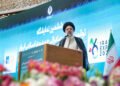





















































Tehran’s newly appointed security leadership has signaled no shift in its strategy following nearly six months of hostilities with the United States. Mohsen Rezaei, the newly installed secretary of Iran’s Supreme National Security Council, issued a firm declaration on Tuesday, stating that the Strait of Hormuz will remain closed until Washington halts its military operations and blockade, releases frozen Iranian assets, and commits to a comprehensive ceasefire covering Lebanon and Gaza.
Rezaei, a former wartime commander-in-chief of the Islamic Revolutionary Guard Corps (IRGC), emphasized that these conditions are non-negotiable. His stance aligns with the policy framework established by his predecessor, Mohammad Bagher Zolghadr, as Iranian officials continue to assert their capacity to sustain the ongoing confrontation.
During his inaugural meeting as security chief, Rezaei hosted a delegation led by Chinese envoy Cong Peiwu. State media reported that Rezaei advocated for strengthened ties with Beijing, commending China’s resistance to US-backed United Nations resolutions targeting Iran. He further clarified that any potential negotiations with Oman regarding the status of the Strait of Hormuz would remain separate from broader diplomatic discussions with Washington.
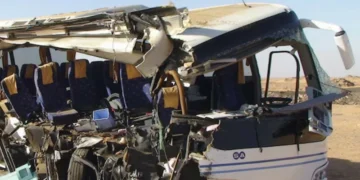
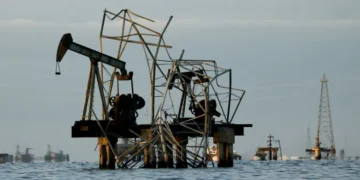
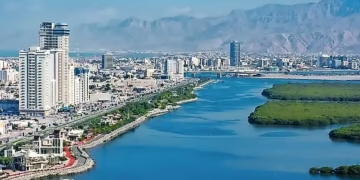
Despite reports last week that an agreement with Oman was nearing finalization, progress remains stalled as military activity persists across the Strait of Hormuz, the Red Sea, and the Bab al-Mandeb Strait. On Sunday, a merchant vessel was reportedly struck by a projectile near the Omani coast. Furthermore, the Iran-aligned Houthis in Yemen claimed responsibility for a maritime attack on Tuesday that killed six people aboard an Egyptian-owned ship in the Red Sea, according to the internationally recognized Yemeni government.
The US military continues its enforcement of a naval blockade. On Tuesday, a US Navy helicopter fired two Hellfire missiles at a Panama-flagged vessel, marking the 12th ship targeted by American forces since April and the third since the collapse of a June memorandum of understanding (MoU) between Tehran and Washington. With the 60-day window of that failed agreement expiring next week, mediators from Qatar and Pakistan are reportedly still working to facilitate a diplomatic opening.
Tehran’s rhetoric has intensified in response to threats from the administration of US President Donald Trump, including warnings of potential strikes on Iranian power plants and civilian infrastructure. IRGC spokesman Hossein Mohebbi warned on Wednesday that any further threats against Iran would trigger retaliation against global energy lines, power grids, and internet infrastructure.
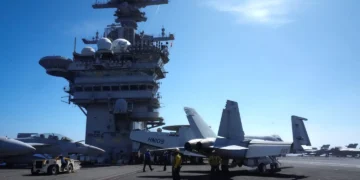
Mohebbi further claimed that the US naval presence in the region has diminished significantly, asserting that while the US maintained 30 to 40 vessels in the area before the war, no US warships are currently present in the Persian Gulf. He also characterized the declining stock of US precision munitions and air defense missiles as a significant strategic vulnerability for the Pentagon.
Meanwhile, IRGC commander adviser Mohammad Reza Naqdi claimed on state television that Iran is producing ballistic missiles and drones at a rate exceeding its usage, relying on domestic manufacturing capabilities. He asserted that Iran is prepared to continue the conflict for years if necessary.
Supreme Leader Mojtaba Khamenei has moved to consolidate his inner circle by appointing six new military leaders this week. This includes the appointment of Hossein Taeb as head of the IRGC’s Basij force and Ali Abdollahi to lead the General Staff of Armed Forces. Abdollahi is tasked with integrating the Khatam al-Anbiya wartime command with the general staff to enhance coordination across naval, ground, cyber, and asymmetric warfare operations.
President Masoud Pezeshkian acknowledged the mounting economic strain on the country, suggesting that opponents of the Islamic Republic may be attempting to incite internal collapse through renewed public protests. He described the current conflict as significantly more complex than previous engagements.
Addressing regional security concerns, Ali Akbar Javidan, head of the police border guard in Kurdistan province, dismissed US claims regarding a potential ground assault by Iraq-based Kurdish separatist fighters as “delusional,” maintaining that Iran’s borders remain secure.
For the Iranian public, the ongoing uncertainty has fueled deep pessimism. Jamshid, a 36-year-old resident of central Tehran, expressed little hope for improvement in the near term, noting that the country’s youth are disproportionately bearing the burden of the war and the tightening security environment.
With the 60-day period of the repeatedly violated MoU approaching next week, mediators such as Pakistan and Qatar have said they are continuing efforts to bring the two sides closer to a diplomatic solution.
“The US had about 30 to 40 war vessels in the region before the war, but today not even a single US warship is present in the Persian Gulf,” he said, adding that the declining level of key air defence missiles and precis
IRGC commander-in-chief Ahmad Vahidi said he would cooperate with the other military leaders in order to resist the “Zionist-American arrogance”.
But an arrangement with Oman, which Tehran said last week had been finalised and was awaiting confirmation at the top, still does not appear imminent, with military action continuing in the Strait of Hormuz, as well as the Red Sea and Bab al-Mandeb Strait.
“The US had about 30 to 40 war vessels in the region before the war, but today not even a single US warship is present in the Persian Gulf,” he said, adding that the declining level of key air defence missiles and precision munitions in the Pentagon’s arsenal was a “big threat” facing US decision-makers.
“Even if the war takes several years, our ballistic missiles would still descend on our enemies,” he said.
Battling an exacerbating economic crunch, President Masoud Pezeshkian suggested on Wednesday that the opponents of the Islamic Republic may be looking to defeat it by banking on another round of nationwide protests on the back of public discontent.
“The country’s borders are fully safe and impenetrable through the vigilance of border personnel and the backing of people living in border areas, including the brave people of Kurdistan, Sistan and Baluchistan, and Khuzestan,” he was quoted as saying by state media.
In the meantime, most of Iran’s population of about 90 million people continues to weather the worsening impact of war and uncertainty, as well as a tightening security grip at home.
“I have given up on predicting what’s going to happen,” Jamshid, a 36-year-old resident of central Tehran, told Al Jazeera.
Source: Aljazeera