








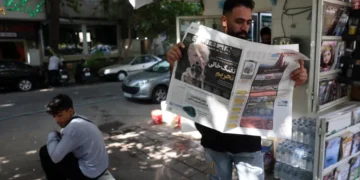









































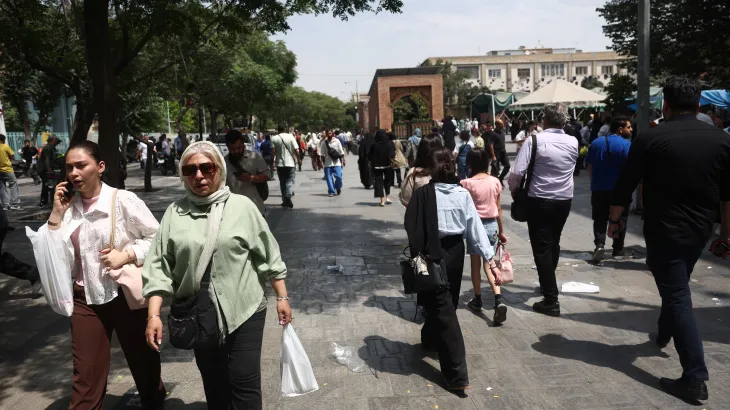
Tehran, Iran – For months, US President Donald Trump has issued nearly daily, contradictory proclamations regarding the war on Iran, oscillating between threats of extensive bombing and claims of renewed negotiations. For many residents in the capital, these statements have become a background noise of instability that they are increasingly choosing to ignore.
Faezeh, a 27-year-old employee at a financial firm in central Tehran, represents a growing segment of the population that has stopped tracking the president’s erratic messaging. “His words certainly impact our lives, but I try to escape this toxic environment of uncertainty by focusing on what I can control and protecting myself and my loved ones,” she told Al Jazeera.
As the conflict approaches its six-month mark, a significant number of Iranians are opting against chasing the non-stop headlines in an effort to protect their mental health. This week, as the threat of large-scale US military action once again loomed large, the level of expectation and concern among Iranians appeared to be much lower than on April 7, when the US president warned that “a whole civilisation will die tonight”, only to announce a ceasefire shortly afterwards.
Roham, a colleague of Faezeh, believes the shift in US presidential conduct is a major factor in this public fatigue. “The US used to have presidents who talked less and did more,” he asserted. “But now with the role of social media and other outlets in which Mr Trump is well-versed, he talks more and doesn’t have to do as much.”
For Roham, the core issue is not merely Trump’s decision-making, but a perceived lack of space for internal dialogue within Iran. He expressed skepticism that the current political climate would allow for more diverse voices to be heard, noting, “We’re up in the air and lack of certainty in our lives has reached a peak.”
Faezeh characterized Trump’s pronouncements as a “repetitive loop” designed to manipulate global markets. She argued that the rapid pace of his contradictory remarks renders them invalid, and she expects the economic situation to deteriorate further, specifically regarding the depreciation of the national currency.
The Iranian rial traded at approximately 1.91 million against the US dollar on Monday, hovering near an all-time low. This follows a brief period of strengthening in mid-June, which was driven by a now-suspended deal facilitated by regional mediators. Trump has actively touted the rial’s decline on social media, using diagrams to claim he is “destroying Iran’s currency” amid inflation rates that reached nearly 90 percent in July.
Ali, a product manager at a technology firm, monitors oil prices and stock markets to decipher the president’s true intentions. “My view is that Trump won’t undertake any serious action in terms of hitting energy infrastructure or launching a ground attack against Iran at least until the Congress elections,” he said, suggesting that the current volatility is a strategic game.
Despite the rhetoric, Iran remains firm in its stance. Foreign Ministry spokesperson Esmail Baghaei dismissed the US threats, questioning why observers place stock in comments that have repeatedly proven baseless. He emphasized that the Islamic Republic would not back down from its “principled positions,” which include maintaining control over the Strait of Hormuz and refusing to concede on its nuclear program or its support for the “axis of resistance.”
The threat landscape remains complex. State TV analysts have warned that the US might pursue a multi-pronged strategy to topple the government if the war escalates, potentially involving assassinations, infrastructure sabotage, and border clashes. Conversely, President Masoud Pezeshkian continues to advocate for a diplomatic path, citing the June memorandum of understanding with the US as the future “centre of gravity” for Iranian foreign relations.
Trump, however, remains combative. On his Truth Social platform, he recently stated, “Nothing gets through to Iran, unless we want it to, and nothing will get through, unless a Deal, or Total Surrender, is accomplished,” while pointing to the US blockade of southern ports. As the spectre of war persists, the disconnect between the president’s digital threats and the reality of ongoing, quiet negotiations continues to define the daily experience of the Iranian people.
He said he sees no chance of that becoming possible at the moment.
The currency had strengthened to about 1.54 million per greenback in mid-June, in reaction to a now-suspended deal between Iran and the US that was facilitated by regional mediators.
It also said there was “massive inflation” in Iran.
The Statistical Center of Iran put the inflation rate for the calendar month that ended on July 22 at nearly 90 percent compared to the same month a year earlier.
“He will keep playing this game and go back and forth”.
A hardline war-focused programme asked Foreign Ministry spokesman Esmaeil Baghaei on Sunday night whether the Trump administration’s claim was true that Tehran had directly or indirectly asked Washington not to attack energy infrastructure and instead focus on negotiations.
For any long-term deal, Tehran has also requested an effective lifting of harsh US sanctions that have hit Iran’s economy hard over the past decade.
State TV has urged people to remain prepared for a potentially resumed war, as hardliners refute any negotiated solution with Washington.
“We must strive to compel the enemy to remain committed to what it has signed.
The security of the country, the region and our allies will be enhanced by this memorandum,” he posted on social media.
Hours later, it was time for Trump to issue another declaration.
“Whether Iran wants to admit it or not, we are, in fact, talking of a solution to a problem that they have caused, for decades.”
Source: Aljazeera