










































































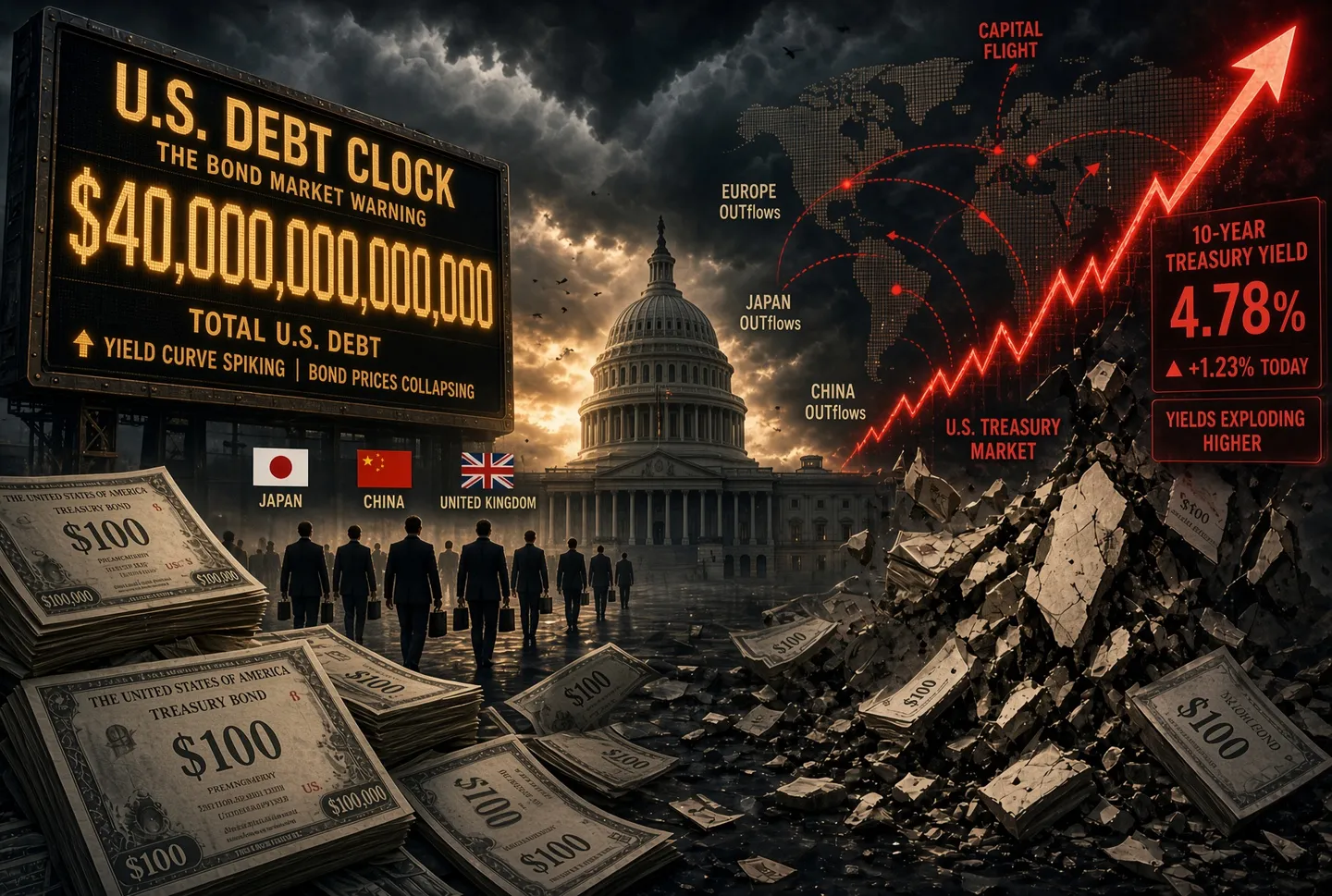
The US Treasury bond market, long considered a bastion of stability for global investors, is currently signaling significant distress. As Washington’s national debt climbs past a record $40 trillion, major foreign creditors—including Japan, China, and the UK—have begun reducing their holdings. This shift comes as borrowing costs have surged to their highest levels in nearly two decades, creating a ripple effect that extends far beyond American borders.
Treasury bonds function as the US government’s IOUs. Because the United States has never defaulted on its obligations, these instruments are viewed as the safest assets globally, serving as a benchmark for financial markets. Pension funds, banks, and central banks worldwide rely heavily on them. However, the relationship between bond prices and yields is inverse: when investors sell off bonds, prices fall and yields rise. If these higher yields persist, the US government is forced to offer more attractive returns to entice new buyers, thereby increasing the cost of servicing the national debt.
New data indicates that foreign holdings of Treasuries declined in June, with Japan, the UK, and China leading the retreat. In March alone, Japan and China offloaded $47.7 billion and $41 billion in holdings, respectively. As yields climbed, foreign holders faced a collective paper loss of $142.1 billion on existing Treasury assets in March, prompting some investors to seek safer alternatives amid concerns over US inflation and debt levels.
The motivations behind this sell-off vary by nation. In Japan, the pullback is largely driven by private entities like insurers and pension funds shifting capital toward domestic bonds. Meanwhile, the Bank of Japan has been forced to intervene due to a weakened yen, exacerbated by rising oil costs linked to the conflict in Iran. China’s divestment appears to be a strategic move regarding its government reserves, while some of the UK’s reported holdings represent assets managed by London-based global custody hubs on behalf of third-party investors.
In response to the market pressure, US Treasury Secretary Scott Bessent announced on August 19 that the department would double the size of its bond buyback operations, increasing them from $2 billion to at least $4 billion per operation between September 9 and November 4. Additionally, Washington has engaged in currency market interventions to support the yen, aiming to alleviate the pressure on Japan to liquidate its Treasury holdings.
Despite these measures, analysts remain skeptical about the long-term efficacy of the buyback program. Joseph Brusuelas, chief economist at RSM US LLP, described the initiative as a temporary salve for a self-inflicted financial wound, arguing that it fails to address the underlying issues of debt, inflation, and the massive borrowing requirements driven by the AI boom. Fixed-income manager Kelsey Berro noted that lower yields cannot be sustained without fundamental support, suggesting the buyback merely buys time rather than providing a permanent solution.
The fiscal outlook remains challenging. Total US debt reached $40.047 trillion on August 18, more than double the level recorded in 2017. When excluding intra-government holdings, the debt traded in the market—the figure most relevant to the current sell-off—stands at approximately $32 trillion. The Peterson Foundation attributes this growth to several factors: $8.7 trillion in lost revenue from tax cuts since the Bush era, $7.6 trillion in war and Medicare spending since 2001, and trillions more in emergency spending related to the 2008 financial crisis and the Covid-19 pandemic.
Interest payments on the debt now exceed $1 trillion annually, nearly triple the 2020 figure, and have surpassed Medicare as the government’s second-largest expense. Further pressure has been added by war spending in Iran and a wave of tariff refunds following the Supreme Court’s invalidation of emergency tariffs. The Congressional Budget Office estimates that total debt could reach $63 trillion by 2036.
While most economists agree that the US is not facing bankruptcy in the traditional sense—given that it borrows in its own currency—some experts are sounding alarms. Johns Hopkins professor Steve Hanke and former US Comptroller General David Walker have argued that the nation is effectively insolvent. The Committee for a Responsible Federal Budget suggests that the primary danger is not an immediate default, but rather a slow, systemic decay characterized by rising costs and diminishing policy options.
The market’s sensitivity to geopolitical events was highlighted on February 28, when the US and Israel struck Iran. Contrary to the historical pattern where investors flee to bonds during times of conflict, Treasury yields rose. This reaction, combined with a 50% spike in oil prices this year, has revived inflation fears and pushed yields higher. A report from the Conference Board warns that elevated national debt could drive up interest rates, making mortgages, student loans, and small business borrowing significantly more expensive for the average American. The report also notes that what the US is doing about it, and why it matters well beyond America’s borders, here’s what’s driving it. The report also notes that goods, or services to another), treasury bonds are simply the US government’s IOUs (I Owe You – a simple written acknowledgement that someone owes money. The report also notes that promising to repay them with interest, washington sells them to raise money it needs but doesn’t have on hand. The report also notes that a yield of 5%, say a bond has a face value of $100 and pays $5 a year in interest. The report also notes that the $5 payment stays the same, but it now represents a larger share of the new buyer’s cost, pushing the yield up to about 5.6%, if investors sell that bond and its price drops to $90. The report also notes that offloading $47.7B and $41B, respectively, japan and China had already sold heavily in March. The report also notes that since official data groups together very different actors, it helps to be precise about who is actually selling. The report also notes that by contrast, are managed centrally by the state, so declines there reflect government reserve strategy rather than private investors changing their minds, china’s holdings.
Source: TRT World