
































































A preliminary report released Thursday by the National Transportation Safety Board (NTSB) indicates that a bird strike might have caused a harrowing mid-air emergency last month. During the incident, a passenger was nearly pulled through a shattered window on a Ryanair flight operating over Europe.
On July 10, Ryanair Flight 1879, a Boeing 737, departed from Thessaloniki, Greece, en route to Memmingen, Germany. Shortly after takeoff, the aircraft’s second engine suffered a critical failure. According to the NTSB, the flight crew received an engine warning followed by a loud detonation.
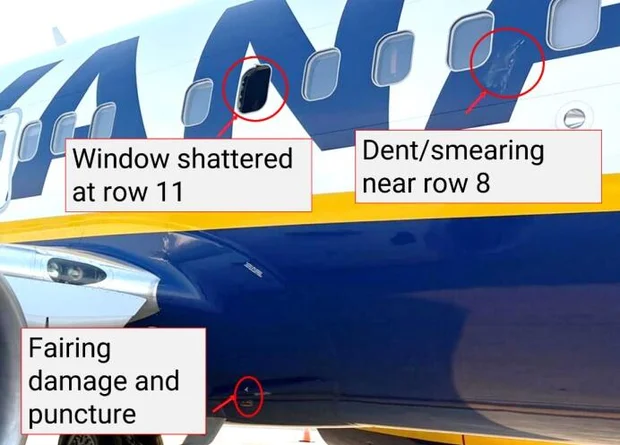
Investigators determined that a fan blade within the engine fractured, ejecting debris that pierced the fuselage at multiple locations. This structural damage resulted in the window at seat 11F being blown out, leading to immediate cabin depressurization. The passenger occupying that seat was partially sucked toward the opening, sustaining significant injuries.
NTSB personnel identified bird remains and feathers lodged deep within the failed engine. While the agency is currently verifying whether these biological traces originated from the July 10 event or a prior encounter, the samples have been forwarded to the Smithsonian Institution Feather Identification Lab in Washington, D.C., for forensic analysis.
The aircraft had recorded four bird strikes in the year preceding this event, with remains discovered in two of those instances. Data recorders indicated that vibrations in the No. 2 engine exceeded those of the No. 1 engine during the final stages of the takeoff roll. Furthermore, inspectors noted signs of metal fatigue at the base of the fractured fan blade, despite recent maintenance checks.
The NTSB highlighted that the aircraft lacked specific engine modifications currently mandated for U.S. carriers by 2028. Because Ryanair is an Irish-registered airline, it operates outside the jurisdiction of Federal Aviation Administration (FAA) mandates.
The 61-year-old Serbian passenger who was partially ejected later shared his account with The Guardian. He noted that he retains little memory of the event, though he continues to suffer from head and neck pain. He credited his survival to the fact that he remained fastened in his seatbelt.
Following the depressurization and the deployment of oxygen masks, a flight attendant observed the man trapped in the window frame. Fellow passengers successfully pulled him back into the cabin, relocating him to row 12, where a doctor on board provided emergency medical care. Another passenger utilized a metal box from the forward galley to partially obstruct the gaping hole in the fuselage.
The flight, carrying 149 passengers and six crew members, performed an emergency return to Thessaloniki International Airport. No other individuals on board reported injuries. Greek officials have designated the NTSB as the lead agency for the investigation, which is expected to conclude within 12 to 24 months.
In a formal response to the NTSB findings, a Boeing representative stated that the manufacturer is fully cooperating with the investigation. The company emphasized its adherence to International Civil Aviation Organization (ICAO) protocols and confirmed ongoing communication with Ryanair and Malta Air regarding the incident.
One of the engine’s fan blades broke off, according to the report, sending debris out of the engine, which sliced into the fuselage of the plane at several points, the NTSB determined, damaging the aircraft as well as bu
Pieces of the shattered window were found across several rows of the plane, the NTSB said.
2 engine were higher than those of the No.
One of the engine’s fan blades broke off, according to the report, sending debris out of the engine, which sliced into the fuselage of the plane at several points, the NTSB determined, damaging the aircraft as well as busting out a passenger window in row 11.
Three loose fan blade fragments were recovered from the engine.
NTSB investigators also found that engine updates that have been required for U.S.
airlines to complete by 2028 have not been made on this aircraft.
NTSB investigators said the latest bird remains they found were deep inside the engine, and they’re unsure if they were from the July 10 incident or from something previous.
“I don’t remember much and my head and neck still hurt but I am still alive,” he told the British outlet.
Source: CBS News