































































A series of overnight airstrikes conducted by the United States military in the city of Kuhestak, located in Iran’s Hormozgan province, has resulted in civilian casualties, including reports that a wedding ceremony was struck. The incident, which occurred near the Strait of Hormuz, has drawn immediate condemnation from Iranian officials.
The governor’s office in Hormozgan confirmed the identities of four victims on Wednesday: four-year-old Amir Ali Karimi, 16-year-old Mohammad Malahi, 43-year-old Kolsoum Malahi, and 43-year-old Zarkhatoun Taheri. Local authorities reported that more than 60 other individuals sustained injuries, some of which are considered serious.
Tim Hawkins, a spokesperson for US Central Command (CENTCOM), acknowledged reports of civilian casualties but characterized them as information that “originated from Iranian state media.” Hawkins stated, “The US military never targets civilians, unlike the IRGC,” referring to the Islamic Revolutionary Guard Corps.
Despite the lack of clarity regarding specific operational objectives, visual evidence, witness testimony, and official reports confirm that multiple projectiles impacted Kuhestak. Footage from the scene depicts the destruction of a telecommunications tower near the shoreline. Defense analysts, examining fragments recovered from the site, suggest the munitions may be a variant of the AGM-84K SLAM-ER, a precision-guided, air-launched cruise missile manufactured by Boeing.
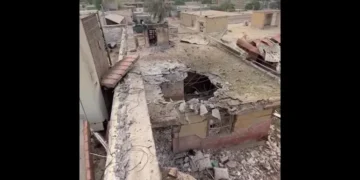
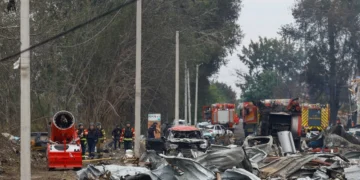
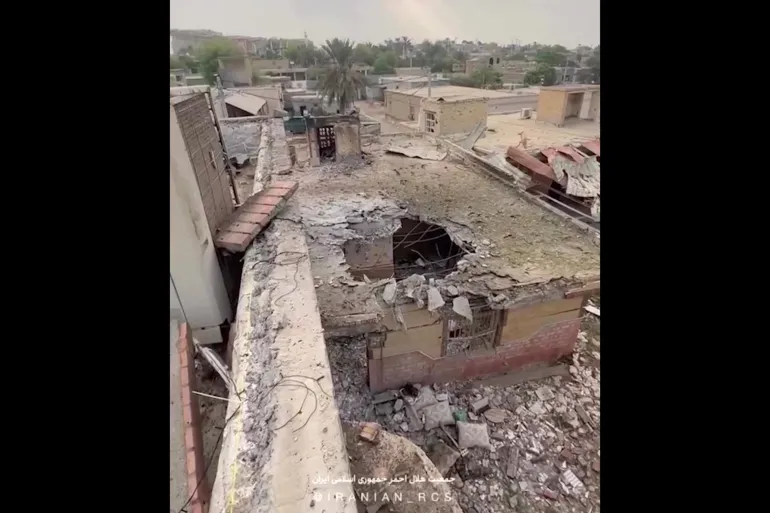
Video evidence captured on Wednesday morning shows a direct hit on the roof of the building where the wedding was being held. Further footage released by local sources shows extensive debris, power outages, and the personal effects of attendees, including children’s footwear, scattered throughout the damaged structure. Adjacent residential buildings were also reported to have sustained damage.
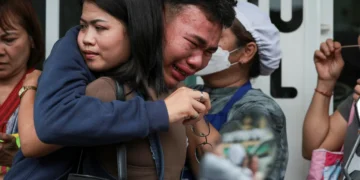
Ali Malahi, the owner of the targeted building, stated to state media that all individuals present were civilians. A wounded local man described the sound of approaching jets followed by massive explosions as he arrived at the house, noting that many women and children were among the injured. Another witness, a woman present at the scene, insisted the location was far from any military installation.
The Iranian Red Crescent Society has documented the aftermath, releasing images of the injured and the site of the strike. The organization has formally petitioned the Office of the Prosecutor of the International Criminal Court, seeking legal accountability for the attack.
Iranian Foreign Ministry spokesman Esmaeil Baghaei described the Kuhestak strike as part of a broader pattern of atrocities. He stated on social media that the incident cannot be viewed in isolation from previous strikes in Minab, Lamerd, and Qeshm. Baghaei warned against the normalization of such military actions, arguing that silence regarding these events risks granting them a veneer of legitimacy.
This incident follows other high-casualty events during the ongoing conflict. On February 28, an elementary school in Minab was destroyed, resulting in approximately 170 deaths, including children, teachers, and parents. While CENTCOM commander Brad Cooper alleged the school was situated on an active IRGC cruise missile base, the US military has not released findings from its investigation into the event.
In the city of Lamerd, a missile strike on a sports hall used by a women’s volleyball team killed 21 people, including four children, on the first day of the war. Although CENTCOM denied involvement, independent investigations by media outlets and analysts concluded that a US Precision Strike Missile was responsible for the attack, which utilized munitions designed to scatter tungsten pellets over a wide area.
Since the conflict began, the US and Israel have targeted a wide array of infrastructure, including oil and gas facilities, petrochemical plants, power grids, and medical centers. According to official Iranian figures, the total death toll has surpassed 3,500, with more than 50 people killed during a 60-day truce period that ended with renewed fighting in July. The report also notes that with one penetrating through the roof and creating a 1.5-metre (5-foot) hole in the ground, a state television reporter said three US missiles were used in the attack. The report also notes that state TV footage from a hospital in the area showed several wounded children and their families receiving medical care. The report also notes that and the bombs caused massive explosions while they were arriving, a young local man wounded in the attack said he and others were heading towards the house when they heard jets flying above. The report also notes that “This house was by no means close to any military site,” she said, adding that it appeared the munitions were directly targeting the building. The report also notes that “More dangerous than the bomb itself is the normalisation of bombing; and more dangerous than silence is the conversion of silence into legitimacy,” he said. The report also notes that scattering thousands of tungsten pellets that could claim casualties and deal damage to buildings and vehicles in a large area, the munition was designed to explode midair.
Source: Al Jazeera