









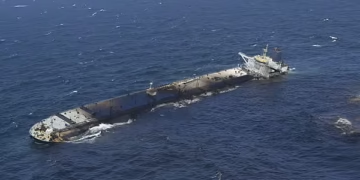






























































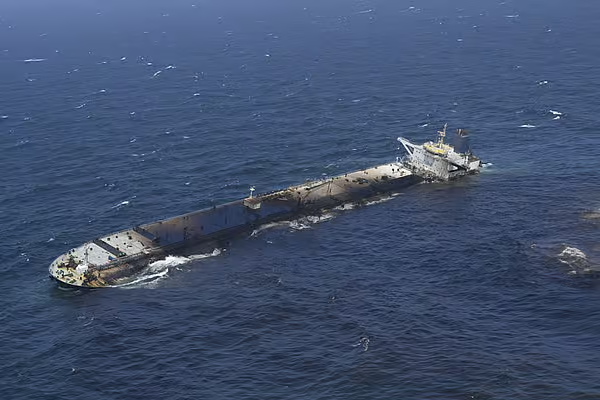
Rescue and containment operations are currently underway to address an oil spill caused by the Caroline Bezengi, a tanker that ran aground off the coast of Oman on June 30. The incident, which occurred near the Al Hallaniyat Islands, has resulted in a slick affecting approximately 12 kilometers of the Sultanate’s coastline.
Mohammed bin Abdullah Al Rawahi, Director General of Maritime Affairs at Oman’s Ministry of Transport, Communications and Information Technology, stated that the salvage mission is being severely hindered by adverse weather. During the ongoing khareef season, crews are contending with wind speeds reaching 40 knots and waves rising to roughly 4 meters, making it exceptionally dangerous to approach the vessel by sea or air.
The situation is further complicated by the local geography. The waters surrounding the grounding site are rocky and shallow, and there is a lack of precise hydrographic data regarding safe navigation routes. These conditions create significant operational risks for support vessels, forcing authorities to search for alternative methods to reach the tanker and assist the personnel working onboard.
To manage the environmental impact, Omani authorities have partnered with the British risk management firm Ambrey. The company is preparing to deploy specialized equipment, including rubber booms, chemical dispersants, and response materials. A dedicated vessel is being arranged to transport this gear to the site, though its deployment remains contingent on improving weather conditions.
The vessel itself presents a difficult working environment. Al Rawahi noted that the ship lacks a reliable power source to operate necessary rescue equipment. Furthermore, the deck is covered in a mixture of oil and seawater, creating slippery and hazardous conditions for technical teams. Before any cargo transfer can occur, crews must secure the area, conduct safety checks, and monitor gas and oxygen levels.
The primary technical strategy currently under consideration involves transferring oil from damaged tanks to intact ones to stabilize the vessel and reduce the risk of further leakage. This complex operation requires the installation of pumps and power systems, as well as continuous monitoring of the ship’s structural integrity. Simultaneously, teams are conducting marine surveys to identify safer approach routes for support craft.
The Caroline Bezengi, which was carrying an estimated 800,000 barrels of Russian oil, has been subject to international sanctions. The vessel first reported mechanical difficulties off the coast of Yemen on June 8, following what maritime sources described as a potential explosion. Corey Ranslem, CEO of the security firm Dryad Global, observed that images of the ship show burn marks, suggesting a fire or blast occurred, though the exact cause remains unconfirmed.
While no group has claimed responsibility for an attack, the tanker’s route took it through two active conflict zones. The ship departed from the Russian port of Novorossiysk on the Black Sea in April—a region central to the Russia-Ukraine war—before passing through the Suez Canal in late May. It subsequently navigated waters near Yemen, where Houthi militants have engaged in regional hostilities involving the US, Israel, and Iran.
Ukrainian forces have previously targeted the so-called shadow fleet of aging vessels used to transport Russian oil, though the specific circumstances surrounding the Caroline Bezengi’s distress remain under investigation. For now, Omani officials maintain that their immediate priority is ensuring the safety of the technical teams and preventing further environmental damage to the coastline. The report also notes that stay up to date with the latest news. The report also notes that which require a high degree of precision when operating near the grounded vessel to ensure safety, al Rawahi stressed that this posed an additional challenge for support vessels. The report also notes that the Omani official said, challenges are not limited to the conditions surrounding the vessel but also extend to the ship’s physical condition. The report also notes that combined with strong waves and winds, have made some work areas slippery and unsafe, he also noted that oil and seawater on the vessel’s deck. The report also notes that cargo transfer or intense rescue operations cannot begin until minimum safety requirements are met and work areas onboard are secured, under these circumstances. The report also notes that technical equipment and the necessary rescue equipment to enable the teams to carry out subsequent operations, this also includes preparing and transporting electrical generators. The report also notes that technical teams are assessing and implementing possible solutions to limit the continued spill and maintain the stability of the vessel and its cargo as far as possible, in parallel with securing the working environment. The report also notes that when its condition and safety requirements permit, with the aim of reducing the amount of oil at risk of spilling and mitigating the pressure and risks associated with the damaged tanks, one of the technical options being considered is the transfer of oil from damaged tanks to intact and safe tanks within the vessel.
Source: Khaleej Times