









































































The Senate Homeland Security Committee officially voted on Thursday to hold Dr. Anthony Fauci in contempt of Congress. The decision stems from his refusal to provide testimony during a committee hearing last week, where he invoked his Fifth Amendment right against self-incrimination in response to every question posed to him.
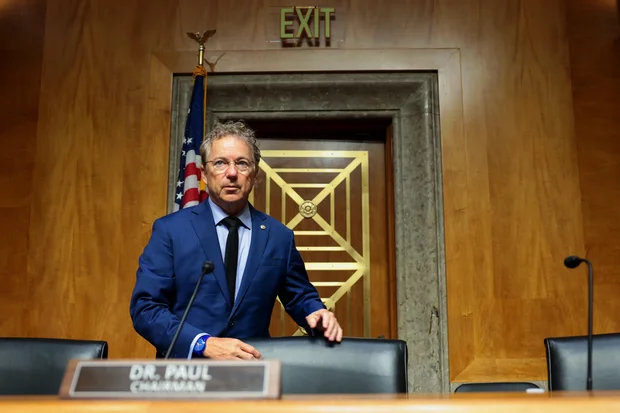
During the proceedings, Committee Chairman Sen. Rand Paul emphasized the gravity of the situation. “Holding a witness in contempt is a serious thing, and it should be rare,” Paul stated. “But the contempt power exists for precisely this circumstance.” The resolution passed with an 8-5 vote, with all committee Democrats opposing the measure, including two who cast votes by proxy.
Fauci’s appearance before the panel was part of an ongoing investigation into the origins of the COVID-19 pandemic. In his opening statement, Fauci criticized the proceedings, suggesting that Paul’s motivation was rooted in a personal vendetta rather than legitimate oversight. He claimed that Paul’s primary goal was to elicit statements that could be used to support the senator’s public assertions that Fauci should be “behind bars.”
A point of contention remains the legal validity of Fauci’s Fifth Amendment invocation. While the Constitution protects individuals from self-incrimination, Sen. Paul contends that this privilege is inapplicable because Fauci has already been granted a federal pardon. Fauci’s legal counsel maintains that he is on “solid legal ground,” though Paul argues the matter remains an unsettled legal question.
Paul clarified that the committee’s focus is not on Fauci’s past policies or personal opinions, but rather on the principle of witness compliance. “We only have one question: Whether to hold a witness responsible for his contempt toward Congress,” Paul said, noting that the witness declined to answer questions on 111 separate occasions.
Democratic members of the committee, led by Sen. Gary Peters of Michigan, vehemently opposed the move. Peters argued that the resolution serves as a punitive measure that fails to actually compel testimony. He warned that the action sets a dangerous precedent that could undermine the committee’s future ability to conduct oversight, characterizing the effort as a continuation of a long-standing political campaign against a single individual.
Moving forward, Sen. Paul intends to bypass the traditional Senate floor vote, which would likely fail to meet the 60-vote threshold required for advancement in the chamber. Instead, he plans to send the contempt resolution directly to the Department of Justice as a formal referral. “We will send it to the Department of Justice tomorrow so there’s no delay,” Paul told reporters, adding that while a full Senate vote could occur after the August recess, it may be unnecessary given the DOJ referral strategy.
The resolution requires that Vice President JD Vance, in his capacity as president of the Senate, certify the report regarding Fauci’s refusal to testify to the U.S. Attorney for the District of Columbia, Jeanine Pirro. Ultimately, the decision to pursue criminal charges rests with the Justice Department.
The committee’s investigation has been marked by significant tension, highlighted by the recent release of over 1,000 pages of Fauci’s personal journal entries from his tenure overseeing the pandemic response. As the matter moves to the DOJ, the political divide over the committee’s oversight tactics remains stark.
Ahead of the hearing, Paul, a Kentucky Republican who has for years accused Fauci of misleading the public about the source of the outbreak, released more than 1,000 pages of Fauci’s journal entries from his time leading
“The only conclusion I can reach is that the sole reason he is calling me before this committee is to get me to say something, anything, that could vindicate his repeated public pledges that I end up, in his words, quote
“The witness had many chances to answer the questions pertinent to our investigation, and he made his decision 111 times.”
Ahead of the hearing, Paul, a Kentucky Republican who has for years accused Fauci of misleading the public about the source of the outbreak, released more than 1,000 pages of Fauci’s journal entries from his time leading the government’s response to the COVID-19 pandemic.
“The only conclusion I can reach is that the sole reason he is calling me before this committee is to get me to say something, anything, that could vindicate his repeated public pledges that I end up, in his words, quote, ‘behind bars,'” Fauci said of Paul.
During the committee meeting Thursday morning, Democrats on the committee tried repeatedly to table or postpone the vote, but were blocked by the panel’s GOP majority.
The move to hold Fauci in contempt would all but certainly fall short of the 60-vote threshold needed to advance most legislation in the upper chamber.
With 53 Republicans, it would require support from Democrats, who have widely come to Fauci’s defense in recent days.
Joe Walsh contributed to this report.
Source: CBS News