































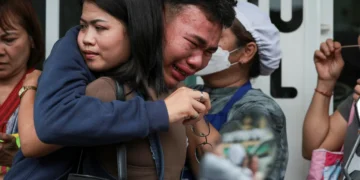
















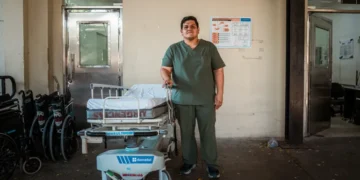





















Yasmany Moreno de Armas, a 31-year-old Cuban immigrant who had been living and working in Florida, now finds himself in the Central African Republic. He is among dozens of deportees sent to the impoverished and conflict-stricken nation by the U.S. government. Moreno de Armas reported that he was unaware of his destination until he arrived in the country’s capital, Bangui, in late July.
The group of deportees currently residing in a building in Bangui includes individuals from various nations, such as Russia, Vietnam, Serbia, Honduras, and Ecuador. Moreno de Armas described their situation as desperate, noting that they lack legal documentation and are struggling to survive in a place where they have no cultural or personal ties. During a video call, he stated, “We cannot leave, we don’t have documents and we’re suffering and missing our families, in a continent we don’t know.” When asked if he had any prior knowledge of the Central African Republic, he admitted he had never heard of the country.
The Central African Republic is currently classified under a Level 4 travel advisory by the State Department, which warns Americans against visiting due to widespread insecurity, political instability, and the presence of Russian mercenaries. Despite these conditions, the landlocked nation is one of more than 30 countries that have entered into agreements with the U.S. to accept deportees as part of a large-scale immigration enforcement initiative.
Zena Gebrgzabher, a 39-year-old from Eritrea, is also among those stranded in the country. His wife, Yrgalem Gehrehiwet, who lives in Maryland with their 5-year-old son, described the situation as inhumane. Gebrgzabher, who previously worked as a truck driver in the U.S., stated that he was not given notice or an opportunity to contest his removal to the Central African Republic.
Gebrgzabher’s legal history reveals a complex path. In 2017, an immigration judge granted him protection under the Convention Against Torture, barring his return to Eritrea. However, he was denied asylum because he had served as a checkpoint guard in the Eritrean military as an 18-year-old. Although judges acknowledged he was forcibly conscripted, they ruled him ineligible for asylum on the grounds that he had impeded the escape of political prisoners, which they categorized as assisting in persecution. Despite this, he had been checking in regularly with Immigration and Customs Enforcement (ICE) until his arrest last year.
Moreno de Armas also faced a difficult legal journey. After fleeing Cuba, he arrived in Florida by boat in 2016 and was initially paroled. His subsequent application for a green card under the Cuban Adjustment Act was denied because it was filed after his parole had expired. He was arrested by immigration officials in May 2025 and spent approximately one year in custody before being deported.
The Department of Homeland Security has not provided details regarding the specific nature of its agreement with the Central African Republic or the conditions under which these deportees are being received. For many, these third-country removals are utilized when an immigrant’s home country refuses to accept them, or when legal protections prevent their return to their nation of origin.
Both men emphasized that they have no criminal records beyond immigration and traffic violations. They remain effectively stateless, trapped in a foreign environment without the ability to communicate or support their families. Reflecting on the policy, Moreno de Armas remarked, “If you’re going to be deported, it should be to your home country, not to another country where you don’t know the culture.” The report also notes that the 31-year-old said he only learned the U.S. The report also notes that many of which are plagued by armed conflict, repressive governments and human rights abuses, the list includes a growing number of African countries. The report also notes that i miss my family,” Gebrgzabher said over a video call. The report also notes that he asked like every day to my wife, ‘(where) is my daddy?'” he added. The report also notes that yrgalem Gehrehiwet called her husband’s deportation unfair and inhumane. The report also notes that she said their son, Nathan, has been particularly affected by his father’s absence, though she has refrained from telling him about Gebrgzabher’s predicament. The report also notes that but both men’s cases do match the description of many of those targeted by the Trump administration for deportation to far-flung “third countries.
Source: CBS News