













































In Washington, D.C., this July, America’s 250th birthday began with an evacuation. An incoming summer storm forced crowds gathered on the National Mall for fireworks out of the park and indoors. Hours later, the show finally went on, but by then Mother Nature had made her point.
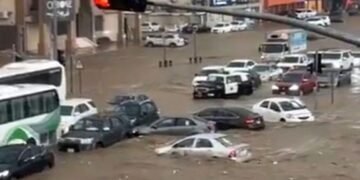
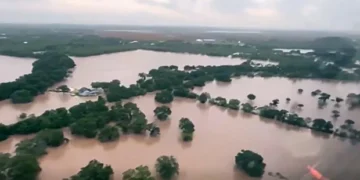
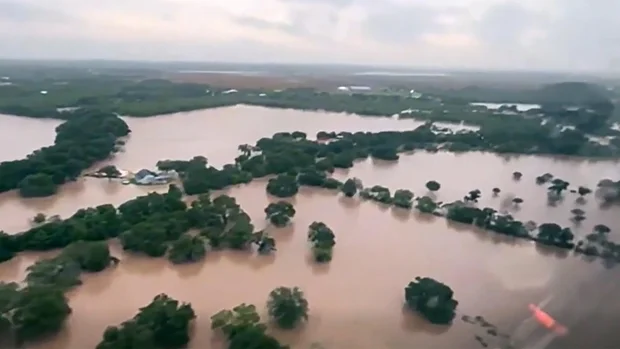
For tens of millions of Americans, the season long associated with getting away has increasingly become something to get away from. In Texas, a second once-in-a-thousand-year flood in 12 months occurred; in Indiana, outside Tornado Alley, a record 77 twisters were recorded; and there through it all, the heat persisted.
July was the hottest month ever in the Lower 48, breaking a record last set during the Dust Bowl. This trend is part of a broader escalation into a hotter, more dangerous planet that climate scientists have been warning about for decades.
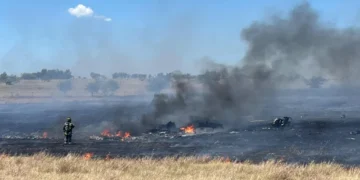
July’s heat, months of drought, and high winds fueled a brush fire in Spokane, Washington, allegedly started by an arsonist. Within hours, flames had gone from the forest into Ted Chauvin’s neighborhood. “We just got the dogs, the cat, the kid, and we just got out,” he said.
Asked to describe what he sees when surveying the remains of his family’s home, Chauvin replied, “I see where I was diagnosed with cancer, where I beat cancer. Where we had our child, and the memories we gave her in that house.” That honestly has been the hardest part, is the memories, and hearing our kiddo go, ‘I miss my house. I miss my house.’
This year has been Washington State’s most destructive wildfire season to date—another new record. “Something’s changing,” Chauvin said. “And what we need to do is really ask the questions to figure out what to do about it.”
The titles of climate journalist Jeff Goodell’s bestselling books, such as “The Heat Will Kill You First” and “The Water Will Come,” read like today’s headlines. Goodell noted that the summer of 2026 is another step in the escalation of our world into a hotter, more dangerous planet.
Asked if the extreme weather we witness are isolated events or are connected, Goodell replied, “Oh, they’re absolutely all connected. We’re creating a different world. And we need to think about that and adapt to that.”
But before we can adapt, Goodell says, we have to recognize there is a problem. “We just tend to normalize them, and tend to think, ‘Oh, it’s just an abnormal year.’ ‘There’s always been a heat wave.’ ‘It’s always been hot in Texas.’ You know, ‘There’s always been big hurricanes,’ whatever,” he said.
Applying the analogy of frogs in a pot that is slowly boiling that do not notice what’s happening around them, Goodell said, “I think that’s a very appropriate analogy, for sure. I do think that it captures this idea of… I’m not 100 percent sure myself.”
According to data from the EPA and NOAA, heat waves now occur three times as often as in the 1960s, while today’s wildfires burn twice as much land each year as in the 1990s. It is a similar pattern across the Atlantic, where deadly fires and record heat swept Europe, claiming more than 10,000 lives.
“All of human civilization, all of life that we know, has thrived in this sort of Goldilocks Zone,” Goodell said. When asked how much of American life is built based on a climate that no longer exists, Goodell replied, “All of it.”
Maria Molina, an atmospheric scientist at the University of Maryland, is using artificial intelligence and past weather data to model future seasons. “There have always been extreme events,” she said. “The question is, how are these extremes potentially evolving due to that background climate change?”
“Human civilization has evolved in the last, you know, 10,000 years, and we’ve evolved in this certain range of temperatures.
“It’s particularly difficult to do here in the United States, even when you have cities with the best intention, if you don’t have a federal government that is really, you know, helping.”
Trump’s EPA revokes the “endangerment finding” on greenhouse gases, a major reversal in climate policy
Trump loosens federal rule limiting greenhouse gas emissions
That is what could be concerning, because that could be a very small signal, like a slightly longer wildfire season, which may not seem meaningful when you hear it from, like, a statistical number.
But suddenly that changes your likelihood of experiencing an extreme event.
For Ted Chauvin, it’s research that could help him read the signals, and trust his next steps.
We didn’t have that for the first ten years that we lived here.
Asked whether he would move back, Chauvin said, “I don’t know.
Two o’clock yesterday, I would have said, ‘Yeah, sure, let’s go back.’ Five o’clock in the evening?
Jeff Goodell got emotional when asked to reflect on this period of time: “I walked through the woods with my daughter last weekend and thought about that.
… I mean, I wonder, when she’s walking through it with her kids, it won’t be the same.
“The Heat Will Kill You First: Life and Death on a Scorched Planet” by Jeff Goodell (Little, Brown & Co.), in Trade Paperback, eBook and Audio formats, available via Amazon, Barnes & Noble and Bookshop.org
Story produced by John Goodwin and Gabriel Falcon.
A city rises again from the ashes – but will it be strong enough?
Building healthier habitats to resist the impacts of climate change (“Sunday Morning”)
Source: CBS News