


















































I have a confession that is difficult to admit: Karoline Leavitt, the youngest-ever White House press secretary, became an unlikely source of fascination for me. At 28, she is stepping down from her role at the end of August, reportedly to focus on her young family, though she is expected to continue serving as an outside adviser to Donald Trump, according to Reuters.
Leavitt’s time at the podium was marked by a distinct, camera-ready polish that often gave way to intense, combative exchanges. During her tenure, she transformed the White House press briefing room into a stage for political theater. For many observers, including myself, her viral clips—often shared as memes or edited reels—were impossible to look away from, even for those of us who fundamentally disagreed with the policies she defended.
The central question that emerged from her performances was how she maintained such unwavering composure. Facing a room of veteran political journalists, she rarely appeared intimidated or hesitant. She seemed immune to that common, nagging internal doubt: “Oh God, did I just sound like an idiot?” This absolute conviction was clearly an asset in the role President Trump envisioned for her, as she was tasked with defending his agenda with aggressive, unapologetic force.
Her approach was tailor-made for the social media era. Every sharp comeback or heated confrontation was instantly repackaged for digital consumption. Depending on the viewer’s political leanings, these clips were seen either as a masterclass in holding the media accountable or as a display of dangerous hostility toward the press. Regardless of the interpretation, the exchange itself became the content.
However, this entertainment value masked a more troubling shift in the relationship between the government and the press. Critics argued that the administration’s actions went beyond mere communication, creating an environment where scrutiny was treated as an illegitimate obstacle. According to reports, the Trump White House allegedly exerted greater control over which journalists were permitted to participate in the presidential press pool.
While the administration maintained that these changes were intended to broaden access to non-traditional and newer media outlets, many observers, as noted by Reuters, viewed the move as a calculated effort to restrict who could closely cover the president. This highlights the uncomfortable boundary between effective political communication and the erosion of institutional transparency.
As someone who spends a career interviewing powerful figures and navigating the challenges of asking difficult questions, I recognize the importance of confidence. There is a certain power in refusing to shrink in a high-pressure environment. Yet, there is a profound difference between handling a challenging question and treating the questioner as an adversary. When conviction turns into contempt, the democratic process suffers.
I do not endorse the personal attacks or the dismissive nature that often characterized her briefings. However, one cannot ignore the sheer nerve required to stand one’s ground when an entire room is arrayed against you. She demonstrated an ability to occupy space without apology, a trait that is often scrutinized more harshly in women. Yet, that same strength becomes dangerous when it treats opposing voices as enemies to be defeated rather than participants in a democratic dialogue.
Leavitt’s departure marks the end of a tenure defined by this specific paradox. She proved that in 2026, political communication is often indistinguishable from combat. While I will not miss the politics or the frequent hostility toward legitimate journalism, I suspect the political landscape will feel less intense without her presence at the podium.
Ultimately, there is a lesson to be taken from her playbook: walk into the room with the certainty that you belong there. But it remains vital to remember that true confidence does not require the silencing of others. As she transitions to her role as an outside adviser, the debate over her style and its impact on the press corps will likely continue.
In other news, the administration continues to navigate various policy and personnel shifts, including a $400 million investment in an Australian rare earth mine and the recent removal of a teleprompter operator following betting-related allegations.
Dubai: I reluctantly have a confession to make, and it’s not something I’m particularly proud of.
And no, it’s not my other terrible habit; privately judging whether every newborn baby is actually as cute as everyone insists.
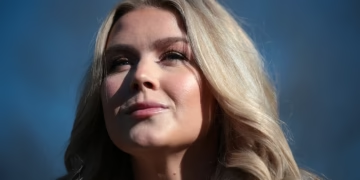
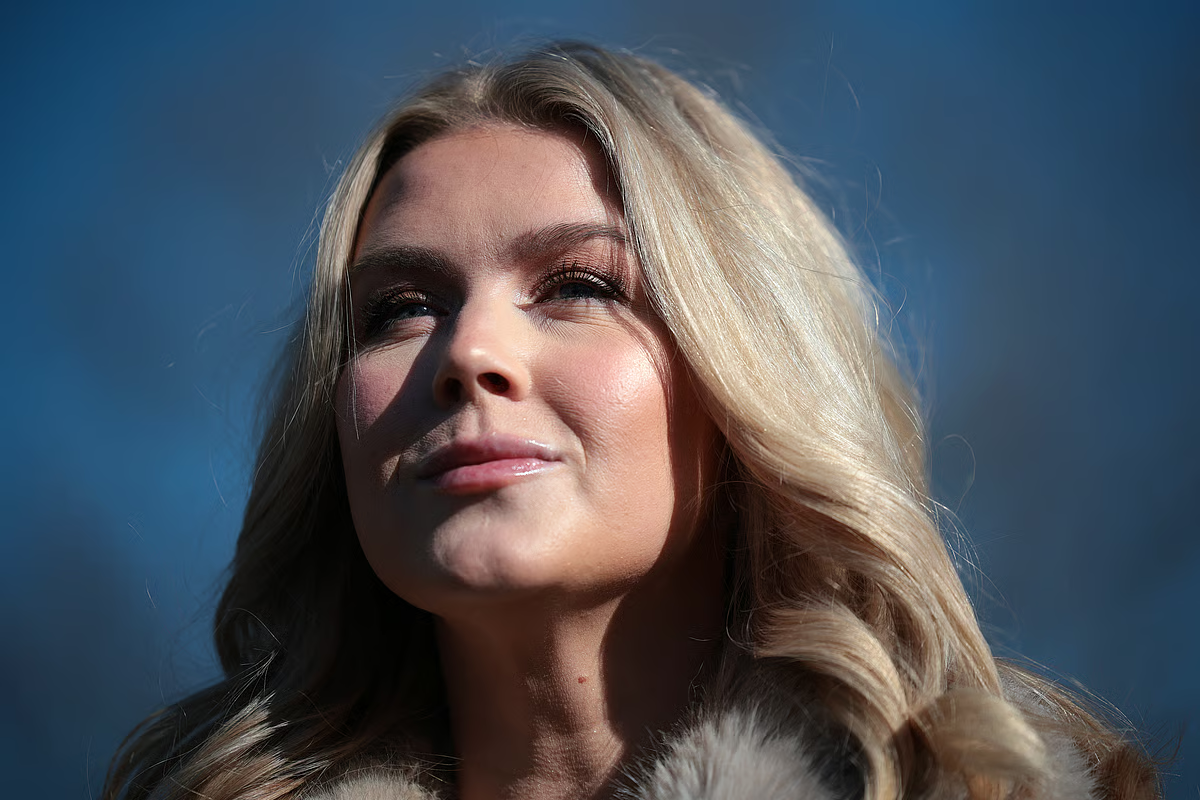
Salon-perfect blonde curls, sharp dresses/bright power suits, a curvy silhouette and the immaculate, camera-ready polish of a Hollywood/Bollywood star; until she opened her mouth.
For context, this wasn’t some high-minded political study on my part.
On particularly tough days at work, when my brain was fried and I was craving Nandos, I would find myself tumbling down a Karoline Leavitt Reels rabbit hole.
Parody accounts, savage memes, clips of her sparring with reporters from the White House podium; I consumed them all.
She could be combative, brusque and breathtakingly rude.
Sometimes I cringed with second-hand embarrassment.
But almost invariably, I watched until the very end.
Which is particularly inconvenient because I don’t agree with her politics.
So why couldn’t I stop watching her?
Because beneath all the politics, outrage and meme-worthy theatre, I was fascinated by one thing: the woman had nerve.
Where does that kind of confidence come from, I kept wondering with each hilarious, spoofy reel.
At 28, she leaves as the youngest person ever to have held the job.
Politics aside, she stood behind perhaps the world’s most scrutinised lectern and rarely looked intimidated.
Spectacularly dismissive and often dripping with disdain, her clashes with reporters could be reality-TV gold.
You rarely saw it and and that aspect fascinated me.
Clips were chopped up, captioned, celebrated, mocked and meme-ified.
And yes, I consumed those memes too.
That distinction matters because the person behind the White House podium isn’t simply participating in another television debate.
The journalists questioning it are supposed to scrutinise that power.
So my fascination with Leavitt comes with a very large caveat.
In fact, perhaps that contradiction is what made her so interesting to watch.
As a woman who spends much of her professional life asking questions, interviewing powerful people and occasionally being told that a perfectly legitimate question is inconvenient, I know confidence matters.
Watching Leavitt sometimes made me wonder whether women, in particular, could learn something from that absolute refusal to shrink in a difficult room.
The ability to articulate your position without constantly apologising for occupying space.
The willingness to withstand being disliked.
I believe there is something formidable about that.
She understood that in 2026 the exchange itself was content: every clash could become a reel, every comeback a headline, every confrontation another piece of political theatre.
That moment when a reporter had barely finished asking a question and you could already see Leavitt preparing to fire back?
Hezena Lemaletian: From glamour to governance
Jacinda Ardern made working motherhood look real
Saudi Crown Prince, Trump discuss regional tensions
Source: Gulf News