










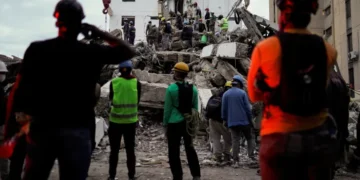


























































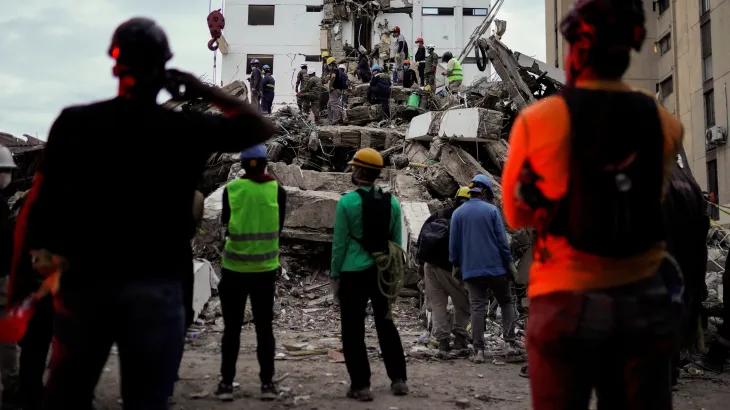
Rescue operations across Colombia have entered a critical “final phase” following Monday’s magnitude 7.4 earthquake, the most powerful to strike the country this century. As of Wednesday, the official death toll has reached 265, with more than 3,500 people reported injured. Authorities state that nearly 500 individuals remain missing, while the destruction has claimed over 9,550 homes.
Crews are currently racing against the 72-hour window, a period widely recognized as the most viable timeframe for locating survivors trapped beneath debris. Cali Mayor Alejandro Eder acknowledged the gravity of the situation, noting that while the operation has reached its final phase, the likelihood of finding survivors diminishes with each passing hour.
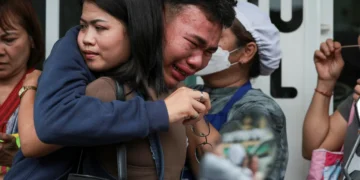
The impact has been particularly severe in the coffee region and Cali, the nation’s third-largest city, which have recorded 83 and 74 fatalities, respectively. In Pereira, rescue teams are focusing their efforts on a collapsed bakery, where they believe a street vendor named Pablo Loaiza may still be alive. His niece, 16-year-old Sara Loaiza, described the agonizing wait as rescuers used vibration-detecting equipment to pick up potential signs of life, including what appeared to be rhythmic tapping from beneath the rubble.
To manage the chaos, Bogota fire official Camilo Cano noted that police have begun restricting the number of volunteers at disaster sites. This measure has successfully reduced noise and ground vibrations, allowing specialized sensors to function more effectively. In Cali, emergency responders continue to work through the night, alternating between heavy machinery and manual labor, pausing every half hour to listen for survivors.
Volunteer rescuer Johana Sanchez reported that the team has successfully pulled three people alive from the wreckage, though they have also recovered three bodies. Across the affected regions, citizens have mobilized to provide support, forming long queues at blood donation centers and delivering essential supplies to displaced families.
President Abelardo de La Espriella, who assumed office just three days before the disaster, has declared an economic emergency to facilitate recovery. He pledged to establish a dedicated fund for the reconstruction of schools, hospitals, and critical infrastructure. “This is undoubtedly a tragedy of immense proportions,” the president stated, emphasizing that the government’s primary focus remains on the missing.
The disaster serves as a significant early challenge for the new administration. Tiziano Breda, a senior analyst at the conflict monitoring group ACLED, pointed out that the president’s previous political platform centered on reducing public spending, which included plans to defund the state’s risk management unit—the very agency currently spearheading the emergency response.
As the nation grapples with the aftermath, the focus remains on the delicate balance between rapid recovery and the search for those still buried. The government continues to assess the full scale of the damage as the country begins the long process of rebuilding in the wake of this historic seismic event.
Rescue crews on Wednesday were fast approaching the 72-hour mark since the quake, the period during which survivors are considered most likely to be found alive beneath collapsed buildings.
“That doesn’t mean there won’t be survivors afterwards, but it is more difficult.”
“My heart is about to burst out of my chest.”
Relatives said the trapped man appeared to respond when rescuers asked him to knock twice, then three times from beneath the rubble.
Many Colombians have mobilised to help, bringing water, food and supplies to affected neighborhoods, while long lines formed outside blood donation centers.
At the Torres del Limonar complex in southern Cali, residents formed long bucket brigades, with soldiers, employees of the mayor’s office and others handing down rubble from the peak of the debris.
Source: Aljazeera