


















































Rescuers are searching through collapsed buildings in western Colombia for survivors after the country’s strongest earthquake this century killed at least 132 people and caused widespread devastation. The magnitude 7.4 earthquake has left emergency teams in the worst-affected cities, including Cali and Pereira, working through the night and into Tuesday. Rescuers are listening for signs of life and trying to reach people trapped beneath concrete and debris.
Authorities have warned that the death toll from Monday’s quake could rise as search teams reach more affected areas in a significant challenge for newly elected far-right President Abelardo de la Espriella. This is the largest earthquake that Colombia has experienced in two decades, and the government has mobilized the entire military and police apparatus to manage the crisis.
Dozens of people were killed in Cali, located 280km (175 miles) southwest of the capital, Bogota. On Monday, President de la Espriella reported that 35 people were killed in the city alone. Dozens of buildings were left leaning precariously or destroyed, forcing residents into the streets in the city of about 2.2 million people.
Local authorities farther north in the Risaralda region, where Pereira is located, said the death toll included at least 40 people killed there. Authorities also confirmed nine people killed in the Choco region, two in the Caldas region, and a 73-year-old in the Antioquia region. These figures are expected to fluctuate as communication is restored in more isolated areas.
At least 87 people were initially reported injured, but de la Espriella later reported 700 injured in Valle del Cauca alone. Meanwhile, more than 2,700 people had been reported missing on citizen-run websites by Monday night, although that figure does not necessarily represent the number of people confirmed missing by official government agencies.
About 1,600 buildings have been damaged or destroyed, including the towers of a historic cathedral in the city of Manizales. Several of the top floors of one of Cali’s hospitals, some dedicated to paediatric care, collapsed upon themselves. This left some patients trapped and forced about 600 others to be tended to on a street strewn with rubble, according to hospital director Irne Torres Castr.
De la Espriella, who assumed power on Friday, said rescuing people trapped under rubble was the government’s first priority. He emphasized that there are no ideological divisions when it comes to defending the people. About 1,000 members of the security forces have been deployed to assist in the recovery efforts.
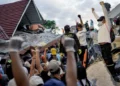
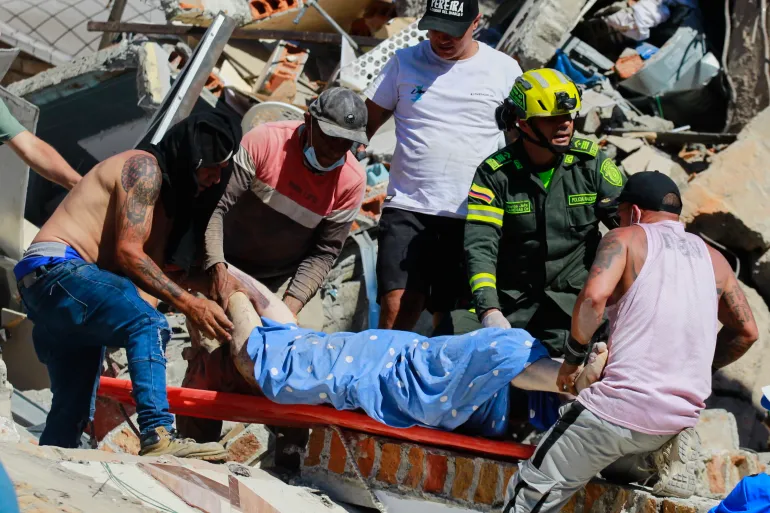
Search and rescue operations continued into Tuesday with soldiers, emergency workers, firefighters, volunteers, and relatives digging through collapsed buildings. In Cali, volunteers formed human chains to remove concrete, bricks, and other debris by hand. Rescuers repeatedly stopped to listen for signs of life from people trapped beneath the rubble.
In one instance, a rescuer named Garcia noted the difficulty of the task: “A moment ago, there was scratching, but now we can’t hear anything. We still have faith that the dog is alive and we can get these people out.” Another volunteer added, “We need people with sticks and spades. The more people lending a hand the better.” Two women and two children were rescued from a collapsed building, firefighters said.
In Pereira, rescue workers said they were in contact with a boy trapped beneath a bakery while cranes were being used to remove dangerous sections of damaged buildings. Authorities have also deployed engineers, rescue workers, and search dogs to Choco, where the extent of the destruction remains unclear because the region is remote and difficult to access.
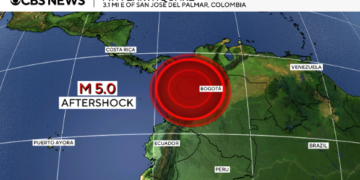
The rescue effort faces particular challenges in the Choco region, more than 200km (125 miles) west of Cali and Pereira. The city of San Jose Del Palmar was the epicentre of the quake. Much of Choco is reachable only by boat or plane, which may pose a problem for authorities in assessing the wider toll as they struggle to coordinate logistics in the rugged terrain.
International support has begun to arrive. The US announced $15.5m in emergency assistance for shelters, food, and other earthquake relief. Secretary of State Marco Rubio said Washington was closely monitoring the situation and stood ready to support Colombia. Additionally, the European Union mobilized the Copernicus satellite service to support rescue operations, while Salvadoran President Nayib Bukele and Mexican President Claudia Sheinbaum offered immediate support with rescue teams and medical personnel.
It is a community of 4,800 people about 400km (250 miles) west of Bogota.
Colombia’s Geological Service said 21 aftershocks had been recorded by late Monday as authorities warned that further tremors were possible.
“From what we have seen already, there is a clear need, of course, for health services and education services because some of the education facilities – at least, I think, 50 of them – have been affected by this earthqua
“Our intention is to cooperate in any way necessary.
Camila Gomez, the deputy director of programmes for Colombia and Venezuela at the International Rescue Committee, warned that the powerful earthquake hit a region already in deep crisis.
“From what we have seen already, there is a clear need, of course, for health services and education services because some of the education facilities – at least, I think, 50 of them – have been affected by this earthquake.”
Authorities declared nighttime curfews in Cali, Armenia and Manizales.
Hospitals in five cities were placed on red alert while authorities suspended operations at airports in Pereira, Manizales, Quibdo, Armenia, Cartago and Buenaventura to allow for structural inspections.
Civilians have played a major role in the immediate response, bringing food and supplies and helping firefighters search for survivors.
Carmen Yasmin Garcia, 43, a Cali resident volunteering with rescue teams, said on Monday afternoon that her group had freed seven people from a collapsed building but four others and a dog remained trapped.
Authorities have also postponed the Petronio Alvarez Music Festival in Cali, an annual celebration of Pacific music that was due to start on Wednesday, as well as professional football matches.
Source: Aljazeera