






































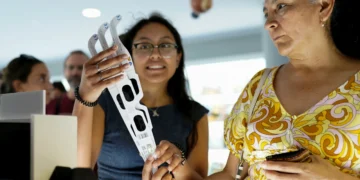


























A team of scientists from Padua, Italy, has spent weeks in their laboratory perfecting a new instrument that could significantly advance the study of the solar corona, the sun’s outer atmosphere. This device, known as the Circular Slit Spectrometer (CISS), is scheduled for a critical field test during the total solar eclipse crossing Europe on August 12. The researchers will conduct their observations at Spain’s Javalambre Astrophysical Observatory, aiming to demonstrate the prototype’s ability to analyze the sun’s light wavelengths with unprecedented speed.
The solar corona is a region of intense scientific interest due to its potential to influence Earth’s power grids and communication networks. Unlike traditional linear spectrometers that require hours to map the corona line by line, the CISS prototype features a circular slit. According to Principal Investigator Federico Landini of the Astrophysical Observatory of Turin, this design allows the instrument to capture the spectrum of the entire corona at a specific distance from the sun’s center in a single photograph. This capability is vital because the solar region often changes on a timescale of minutes.
The project represents the culmination of two and a half years of intensive work. If the team successfully proves this optical principle during the brief window of totality—when the moon obscures the sun—the technology could eventually be integrated into future space missions. The team is looking to improve upon the performance of the UVCS, an ultraviolet spectrometer that operated on the SOHO spacecraft between 1996 and 2013 but was limited by its slow mapping speed.
Logistics have become a primary concern for the researchers as they prepare for the event. Senior Researcher Paola Zuppella of the Institute for Photonics and Nanotechnologies in Padua emphasized that there is no room for the unexpected, noting that team coordination and weather conditions will be decisive factors. To ensure the delicate instrument arrives safely and remains intact, the team opted to transport it by van from Italy to Spain rather than flying, which would have required dismantling and reassembling the device.
Landini noted that the decision to travel by road was also a precaution against potential flight cancellations. By driving, the team avoids the risk of last-minute travel disruptions, ensuring they reach the observatory in time to put their years of research to the ultimate test under the darkened sky.
As a total solar eclipse sweeps across Europe on August 12, the Circular Slit Spectrometer (CISS) will undergo a decisive test at Spain’s Javalambre Astrophysical Observatory, where researchers hope to prove it can bre
Source: Gulf Today