













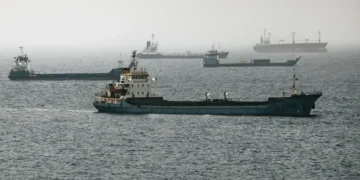
























































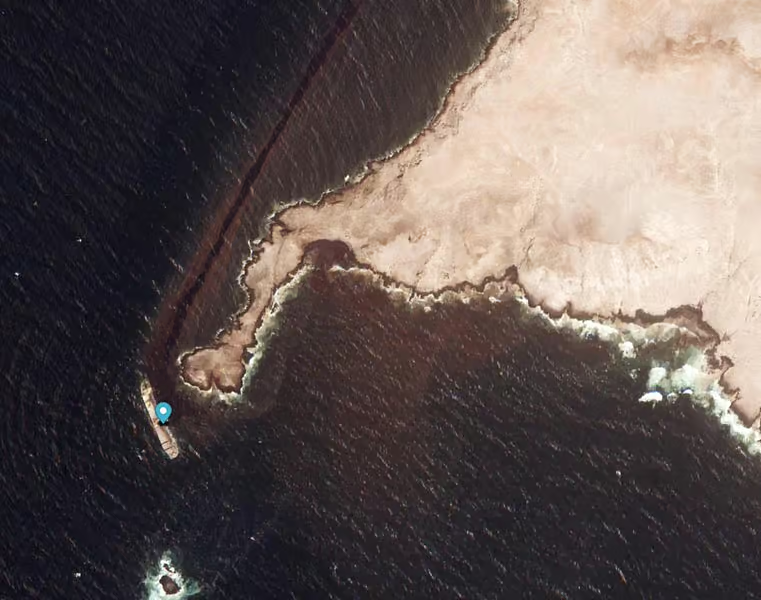
Oman announced on Thursday that a ship had run aground at its Al Hallaniyat Islands in the Dhofar Governorate, with national authorities actively managing the incident. The vessel, identified as the ‘Caroline Bezengi’, reportedly struck the seabed and became stuck in the area. The Ministry of Transport, Communications and Information Technology, alongside the Environment Authority, confirmed they are working to mitigate any potential effects on the environment.
The Al Hallaniyat Islands comprise a remote group of five islands located approximately 40 kilometers off the southeastern coast of Oman in the Arabian Sea. Al Hallaniyah, the largest and only inhabited island in the group, is a popular destination recognized for its rich marine life and protected status. To stay up to date with the latest news regarding this incident, readers are encouraged to follow official channels.
In a statement issued by the Oman News Agency (ONA), authorities confirmed that specialized technical teams are monitoring developments and implementing procedures in accordance with approved emergency response plans. The primary objective remains the reduction of any potential impacts on the marine environment and the maintenance of navigational safety. Authorities are utilizing satellite imagery, field surveys, and technical models to assess the situation and ensure compliance with international laws and agreements.
The Environment Authority affirmed that all updates will be announced exclusively through official channels. They urged the public to obtain information only from these verified sources and to avoid circulating or publishing undocumented information that could lead to confusion.
The ‘Caroline Bezengi’ is a crude oil tanker sailing under the flag of Cameroon. According to data from Marine Traffic, the vessel measures 274.48 meters in length and 48 meters in width. This incident follows a separate event on July 2, when another vessel ran aground near an island within the buffer-zone marine reserve surrounding the Al Hallaniyat Islands in the Wilayat of Shalim and the Hallaniyat Islands.
Residents and visitors have been reassured that there is currently no evidence of oil pollution. Water samples have been collected from the coastal areas surrounding Al Hallaniyah Island for rigorous laboratory testing to ensure the safety of the local ecosystem.
The islands are currently proposed for designation as a nature reserve under UNESCO, aiming to conserve turtle nesting beaches, coral reefs, and bird populations. According to the UNESCO World Heritage Convention, the coastline is characterized by a large diversity of coral reefs, fish, and turtles that visit the island beaches to lay their eggs. Furthermore, dolphins and whales can be seen in the surrounding waters on a daily basis.
The islands are also a critical habitat for seabirds, providing the only nesting sites in Oman and the Arabian Sea for the Masked Booby. Other species, including the Socotra Cormorant, Sooty Gull, and Bridled Tern, rely on these shores. Notably, the Socotra Cormorant is known to breed exclusively on these islands within the region. The area remains a vital sanctuary where food sources are guaranteed for these avian populations.
Source: Khaleej Times