





































































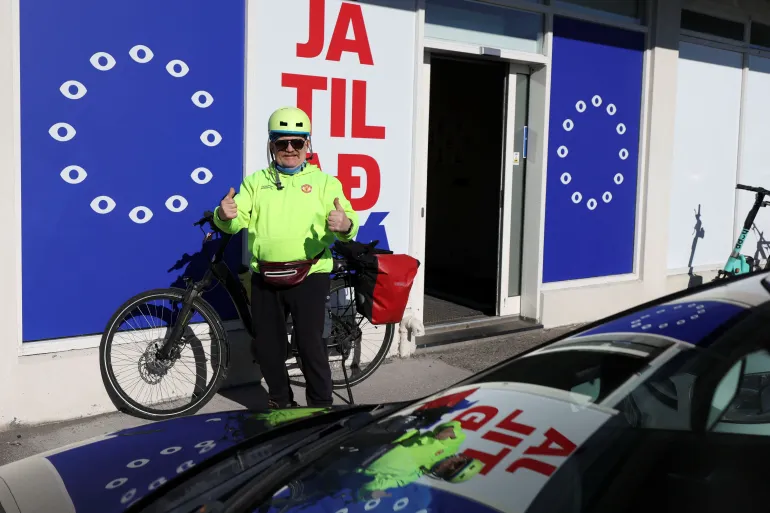
Icelanders are heading to the polls this Saturday to decide whether the nation should resume negotiations to join the European Union. This referendum marks a significant potential shift for the Arctic nation, coming 13 years after a previous Eurosceptic government halted accession talks under the belief that the country would be more prosperous outside the bloc.
The current political climate is defined by both economic and security pressures. Prime Minister Kristrun Frostadottir, who leads the pro-EU Social Democrats, has pledged to respect the public’s decision. She stated that a vote in favor would allow the nation to “enter negotiations with our heads held high and stand together in seeking a good agreement.” Conversely, she noted that if the public rejects the proposal, “all speculation about what [EU membership] might involve will be set aside.”
Public opinion remains deeply divided. A Gallup poll conducted this week indicated that 51.6 percent of respondents oppose new talks, while 48.4 percent support them. This follows an earlier survey by the Icelandic firm Maskina, which found a narrow majority of 51.3 percent in favor of restarting the process.
Should the electorate vote “yes,” the country would embark on years of complex negotiations with Brussels, followed by a second, final referendum on formal accession. Proponents argue that membership could stabilize the economy by curbing high inflation and providing a more reliable currency. Currently, Iceland’s krona is prone to significant exchange-rate volatility, which critics argue hampers investment and increases borrowing costs. A recent report from the Ministry of Finance and Economic Affairs suggested that the costs of maintaining an independent currency likely exceed its benefits, noting that adopting the euro could reduce transaction costs and interest rates.
Adam Fishwick, a lecturer in international relations at the University of Iceland, highlighted that membership could offer access to dedicated EU regional development funds and reduce customs barriers. However, the debate remains polarized. Opponents express concern that a nation of 395,000 people would lose autonomy over domestic policy and struggle to influence a bloc dominated by larger powers.
A primary point of contention is the fishing industry, which remains the “backbone of the economy,” contributing roughly 8 percent of GDP directly in 2024. Valur Ingimundarson, a professor of contemporary history at the University of Iceland, noted that the “fundamental objection” is the potential loss of full control over fisheries under the EU’s Common Fisheries Policy. Industry stakeholders fear that joining could lead to restrictive catch quotas and increased foreign competition. Consequently, analysts suggest that even with a “yes” vote, Iceland would likely only proceed if it secures “ironclad” exemptions for its fishing sector.
Beyond economic factors, security concerns are playing a central role. While Iceland is a founding member of NATO and maintains a 75-year defense treaty with the United States, it lacks its own standing armed forces. Gabriella Gricius of the Norwegian Military Academy explained that Iceland has historically relied on the U.S. for security, but growing unpredictability in American rhetoric—particularly regarding Greenland—has prompted a search for additional guarantees.
Foreign Minister Thorgerdur Gunnarsdottir described EU membership as a “valuable addition” for the country, even as it maintains its core security partnerships with the U.S. and NATO. She expressed disappointment regarding the U.S. “pressure campaign waged against both Greenlanders and Denmark.” Furthermore, she identified Russia as a persistent security threat in the North Atlantic and nearby waters. Gricius added that while Iceland’s membership would not necessarily alter Arctic security dynamics, it would increase the number of Arctic states within the EU to four, potentially influencing how the bloc engages in the region. The report also notes that the cost of living has climbed and Iceland’s currency has kept wavering, arctic security concerns have grown amid Russia’s war against Ukraine and United States President Donald Trump’s threats to invade neighbouring Greenland. The report also notes that it would then hold a second referendum on whether to formally become part of the EU. The report also notes that recent surveys show Icelanders are almost evenly split on the proposal. The report also notes that currency, voters to weigh impact on inflation. The report also notes that as a member of Schengen and the European Economic Area, already gets a lot of the single-market access that would come with EU membership, iceland is a relatively wealthy country that. The report also notes that consumer prices in 2025 exceeded those of any EU state and were 87 percent higher than the EU average. The report also notes that joining the EU could help address both issues.
Source: Al Jazeera