






























































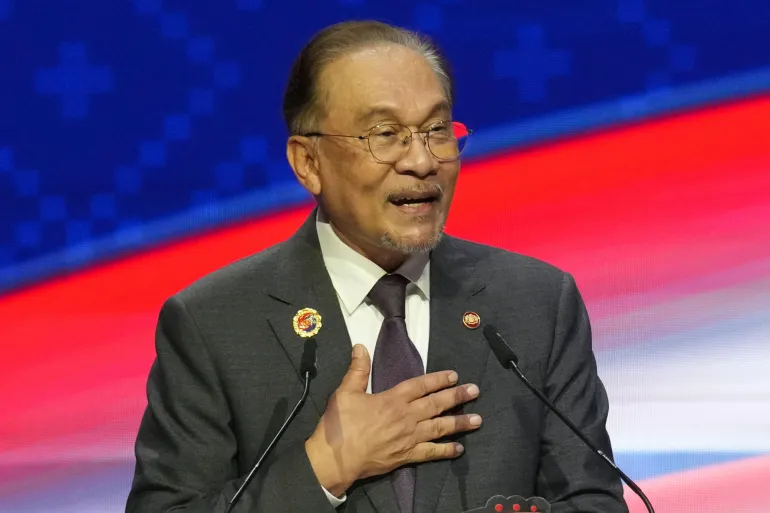
Malaysian Prime Minister Anwar Ibrahim has ignited a debate over his country’s traditional non-aligned foreign policy following recent remarks regarding Taiwan and regional security. In an interview aired earlier this month, Anwar described Taiwan as “part of China, period,” asserting that this position was “accepted by all.” When questioned about the potential use of force by Beijing to achieve “reunification,” he suggested that if a domestic state attempted to secede, he would similarly employ force to “protect the sanctity and unity of” Malaysia.
These comments drew immediate praise from the Chinese government, with a Foreign Ministry spokesperson reaffirming that Taiwan is an “inalienable part of China’s territory” and that reunification is inevitable. Conversely, the Taiwanese government condemned the statements, warning that such one-sided support could undermine the confidence of Taiwanese investors, who play a vital role in Malaysia’s semiconductor industry.
Amid the backlash, Anwar appeared to soften his tone during local media engagements, emphasizing that while Malaysia respects China’s position, it advocates for a peaceful resolution to tensions in the Taiwan Strait. Analysts suggest his initial remarks may have been intended to appease Beijing ahead of his planned visit to China in September.
Chee Meng Tan, an assistant professor of business economics at the University of Nottingham Malaysia, noted that while the “one China” recognition aligns with a 1974 diplomatic communiqué, Anwar’s comments on the potential use of force were a departure from standard policy. Meanwhile, some experts argue that the Prime Minister’s rhetoric reflects a realist perspective on territorial integrity rather than a strategic shift toward Beijing.
Perspectives on Malaysia’s Geopolitical Strategy
- Defense Ties: Malaysia continues to value its defense relationships with Western nations while simultaneously benefiting from their ongoing investments.
- Economic Diversity: Malaysia has successfully maintained varied economic ties with multiple global powers, preventing deep alignment with any single nation.
- Investment Balance: The United States remains a highly favorable economic partner, and Taiwan’s enterprises continue to invest heavily in Malaysia’s semiconductor sector, a fact the government actively welcomes.
- Strategic Realism: Observers suggest that Anwar’s focus on territorial integrity is a consistent policy, viewing the PRC’s stance on Taiwan as a matter of internal sovereignty.
The controversy intensified after Anwar called for strengthened defenses in the Bornean state of Sabah. He cited the expansion of US-backed military facilities in the Philippines as a primary driver for increased defense spending. Specifically, the Philippines is upgrading facilities on Balabac Island, located just 50km from Malaysian territory, under the Enhanced Defence Cooperation Agreement (EDCA) with Washington.
This move is closely tied to Malaysia’s ongoing maritime disputes. In July, Kuala Lumpur filed a formal protest with the United Nations regarding the Philippines’ claim to an extended continental shelf, which Malaysia argues encroaches on its waters. The Philippines has maintained a claim over Sabah since 1963, a position it reaffirmed in its 2024 Maritime Zones Act.
While some observers interpret Anwar’s rhetoric as a pivot toward China, others argue his actions are driven by regional security concerns. As Malaysia’s largest trading partner and a major investor through the Belt and Road Initiative, China holds significant economic influence. However, Malaysia has also diverged from Western positions on other fronts, most notably through Anwar’s vocal opposition to the war in Gaza.
Ultimately, the administration maintains that its foreign policy remains rooted in non-alignment. Whether these recent statements signal a genuine realignment or are merely a reflection of complex regional territorial disputes remains a subject of intense scrutiny among international observers. The report also notes that the Philippine government is in the process of upgrading military facilities on the island of Balabac, 50km (31 miles) from the Malaysian islands of Banggi and Balambangan. The report also notes that “Though this idea of violence against Taiwan is immensely troubling to me, I do not think it differs from Malaysia’s policy at all, as he believes that the PRC attacking Taiwan would amount to attacking a rebel organisation within a single state’s own borders,” Loebell said, using the acronym for the People’s Republic of China. The report also notes that maintaining that the Philippines’ Maritime Zones Act 2024 preserved its “existing and valid claims” over part of the state, manila would reaffirm its claim to Sabah in February this year. The report also notes that largely to bolster its claims in the disputed South China Sea, where Malaysia is a claimant state alongside China, anwar’s call to invest in Sabah’s defences also comes as Malaysia seeks to strengthen its defence posture in Borneo. The report also notes that a multilateral security framework that also includes Singapore, Australia, New Zealand, and the United Kingdom, this is demonstrated in Malaysia’s continued commitment to the Five Powers Defence Arrangements (FPDA). The report also notes that the FPDA commits its members to consult with one another in the event of an armed attack on Malaysia or Singapore, while not a binding defence treaty. The report also notes that two major exercises are held annually – Bersama Shield and Bersama Lima – involving personnel and assets from member countries, under the framework.
Source: Al Jazeera